by Arthipo | 13 September 2021 | History of Art
Ancient Egyptian art and architecture is one of the popular subjects in the world. The ancient Egyptian culture, which has been the subject of many movies, has attracted the attention of many people.
Ancient Egyptian Art and Architecture
Ancient Egyptian art includes painting, sculpture, architecture, and other forms of art such as drawings on papyrus, created between 3000 BC and 100 AD. Much of this art was highly stylized and symbolic. Most surviving forms come from tombs and monuments and therefore focus on the afterlife and the preservation of knowledge. Symbolism meant order in the pharaoh’s clothing or the use of certain colours. In Egyptian art, the size of a figure indicates its relative importance. The paintings were often made on stone, and the tombs depicted delightful afterlife scenes. The ancient Egyptians created both monumental and smaller sculptures using the sunken relief technique. The tile was a surface vitrified sintered quartz ceramic used to create relatively inexpensive small objects in many colors.
Glass was originally a luxury item, but became more common and was used to make small jars for perfume and other liquids to be placed in tombs. Vases, amulets and images of gods and animals are made of steatite. The pottery was sometimes coated with enamel, especially of a blue color. Papyrus was used for writing and painting, and was used to record every aspect of Egyptian life. The architects planned carefully, aligning the buildings with astronomically significant events such as solstices and equinoxes. They mostly used sun-baked adobe, limestone, sandstone and granite. The Amarna period (1353-1336 BC) represents a break in the ancient Egyptian art style, the subjects were represented more realistically, and the scenes included depictions of love among the royal family.
Ancient Egyptian art includes painting, sculpture, architecture, and other forms of art, such as drawings on papyrus created between 3000 BC and 100 AD. Much of this art was highly stylized and symbolic. Most surviving forms come from tombs and monuments and therefore focus on the afterlife and the preservation of knowledge.
Ancient Egyptian Art and Architecture
Symbolism in Ancient Egyptian Art
Symbolism in ancient Egyptian art conveyed a sense of order and the influence of natural elements. Pharaoh’s reign symbolized his power to rule and maintain the order of the universe. Blue and gold denoted holiness as they were rare and associated with precious materials, while blacks denoted the fertility of the Nile River.
Hierarchical Scale
In Egyptian art, the size of a figure indicates its relative importance. This meant that the gods or pharaoh were often larger than other figures, followed by figures of high officials or tombholders; the smallest figures were servants, amusements, animals, trees and architectural details.
Painting
Before painting a stone surface, it was whitewashed and sometimes covered with mud plaster. The pigments are made of mineral and can withstand strong sunlight with minimal fading. The binding environment is unknown; the paint was applied to the dried plaster in a “fresco a secco” style. Later, a varnish or resin was applied as a protective coating that protected the painting very well with the dry climate of Egypt. The purpose of the tomb paintings was to create a pleasant afterlife for the deceased, with themes such as a journey into the afterlife or gods providing protection. Generally, the side view of the person or animal is shown, and the pictures are usually made in red, blue, green, gold, black and yellow.
Sculpture in Ancient Egyptian Art and Architecture Statues
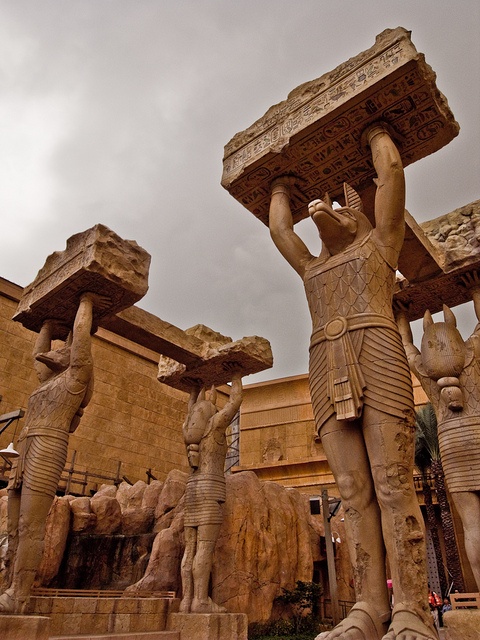
The ancient Egyptians created both monumental and smaller sculptures using the sunken relief technique. In this technique, the image is made by cutting the relief sculpture onto a flat surface placed within a sunken area that is shaped around the image. In strong sunlight, this technique is very visible, emphasizing outlines and forms with shadow. The figures are shown with the torso facing forward, the head in side view and the legs apart, with the males sometimes darker than the females. Large statues of gods (with the exception of the pharaoh) were not common, but deities were often depicted in paintings and reliefs. The colossal statue to the scale of the Great Sphinx of Giza was not repeated, but smaller sphinxes and animals were found in temple complexes.
The most sacred cult image of a temple’s deity was supposedly kept in small boats in the naos, carved from precious metals, but none have survived. Ka statues, which are intended to provide a resting place for the ka part of the soul, IV. It has been in tombs since the Dynasty (2680-2565 BC). These were usually made of wood and were called replacement heads, which were flat, hairless, and naturalistic. The first tombs had models of small slaves, animals, buildings, and objects to provide life for those who died in the afterlife. Later, uhabti figures existed as funerary figures who would act as the deceased’s servants if the deceased were called to do manual labor in the afterlife.
Tiles, Pottery and Glass
The tile was a sintered-quartz ceramic with surface vitrification used to create relatively inexpensive, small objects in many colors, but most commonly blue-green. It was often used for jewellery, scarabs and figurines. Glass was originally a luxury item, but became more common and was used to make small jars, perfume and other liquids to be placed in tombs. Vases, amulets and images of gods and animals are made of steatite. The pottery was sometimes coated with enamel, especially of a blue color. In burials, pottery was used to represent organs of the body removed during mummification or to create cones about ten inches long, carved with legends of the deceased.
Papyrus
Papyrus is very delicate and has been used for writing and painting; however, it survived for a long time when it was buried in tombs. Every aspect of Egyptian life is found recorded on papyrus, from literary documents to administrative documents.

Ancient Egyptian Art and Architecture
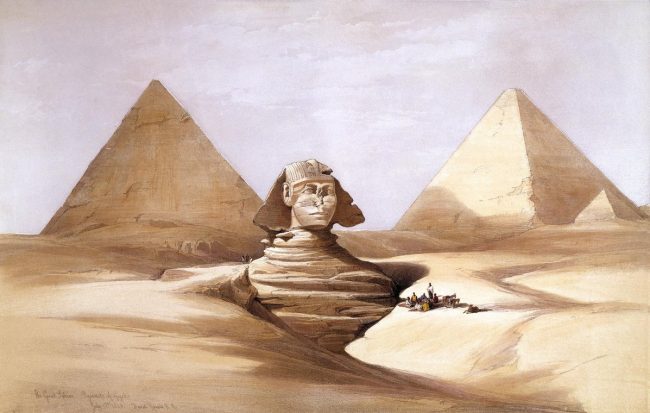
The architects carefully planned the buildings by aligning them with astronomically significant events such as the solstices and equinoxes, and they often used sun-baked adobe, limestone, sandstone and granite. Stone was reserved for tombs and temples, while other buildings such as palaces and castles were made of brick. The houses are made from the mud of the Nile River, which hardens in the sun. Many of these houses were destroyed or dismantled by the flood; Examples of preserved structures include the village of Deir al-Medinah and the fort at Buhen. Egyptian Pyramids; Built during the Fourth Dynasty, the Giza Necropolis features the Pyramid of Khufu (also known as the Great Pyramid or the Pyramid of Cheops), the Pyramid of Khafre, and the Pyramid of Menkaure, along with the smaller “queen” pyramids and the Great Sphinx. Karnak Temple was first built in the 16th century BC. About 30 pharaohs contributed to the buildings, creating an extremely large and diverse complex. It includes the Regions of Amon-ra, Montu and Mut, and the Temple of Amehotep IV. Luxor Temple, 14th century BC III. It was built by Amenhotep in the ancient city of Thebes, now Luxor, in the 13th century BC. It was built by Ramesses with a great expansion. The 79-foot-tall First Pylon includes friezes, statues, and columns.
Representing a discontinuity in the style of ancient Egyptian art and architecture, during this period the subjects were represented more realistically and the scenes included depictions of love among the royal family. There was a sense of movement in the paintings, with overlapping figures and large crowds. In style, it reflects Akhenaten’s conversion to monotheism, but disappeared after his death.
Ancient Egyptian Art and Architecture Features
Ancient Egyptian Art and Architecture, ancient architectural monuments, sculptures, paintings, and applied crafts produced mainly during the dynastic periods of the first three thousand BC in the Nile valley regions of Egypt and Nubia. The course of art in Egypt largely paralleled the country’s political history, but it also depended on a deep-rooted belief in the permanence of a natural, divinely ordained order. Artistic achievement, both in architecture and in representational art, seeks to preserve the forms and conventions held to reflect the perfection of the world in the early days. To embody the right relationship between the moment of creation and the pantheon of humanity, king and gods. Egyptian art therefore seems outwardly resistant to development and the application of individual artistic judgments, but Egyptian artisans of each historical period have found different solutions to the conceptual difficulties posed to them.
Geographical factors predominated in creating the special character of ancient Egyptian art and architecture. Providing Egypt with the most predictable agricultural system in the ancient world, the Nile river provided a stability of life in which arts and crafts flourished easily. Likewise, the deserts and sea that protected Egypt from all sides contributed to this stability by protecting it from serious invasion for nearly 2000 years. In general, the search for useful and valuable material determined the direction of foreign policy and the establishment of trade routes, ultimately leading to the enrichment of Egyptian material culture.
Predynastic Period
The term predynastic refers to the period of emerging cultures before the establishment of the dynasty in Egypt. In the 6th Millennium BC. Patterns of civilization began to emerge, displaying characteristics that deserved to be called Egypt. The accepted ordering of predynastic cultures is based on the excavations of the English archaeologist. Sir Flinders Petrie deNaqadah, enAl-Amirah (Al-Amra) and Al-Jizah (Al-Giza). Another early stage of predynastic culture, El-Badari, in Upper Egypt. Evidence of a relatively rich and developed artistic and industrial culture was obtained from the tombs at Al-Badari, Dayr Tasa and Al-Mustaqiddah. The pottery, made of a fine red polished ware with blackened tops, already shows distinctive Egyptian shapes. Copper has been worked into small embellishments, and steatite beads (soapstone) show traces of glass. Later Naqadah 1 and Naqadah 2 stages, predynastic civilization developed steadily. Pottery remained a distinctive product, demonstrating the intricacies of technique and the evolution of adventurous decoration. Figures already found in Badarian tombs were crafted with superior skill at Naqdah I and decorated with geometric designs of white-filled lines and even depictions of animals. Later, new clays were used and fine buff colored products were used in deep red pigment, decorated with ship scenes, figures and a wide variety of symbols.
The processing of hard stones also began in earnest in the late predynastic period. At first, artisans were devoted to the shaping of fine vessels and jewelry made of semiprecious stones, based on existing pottery forms.
The basic techniques of two-dimensional art, drawing and painting, are exemplified in the Upper Egyptian rock drawings and the painted tomb at Hierakonpolis, which is now lost. Scenes of animals, boats, and hunting (common subjects of rock drawings) were more elaborately painted in the tomb, and those found in heraldic art became additional themes, possibly related to conquest.
Egyptian Statues, Dynastic Period
Evidence shows that the unification of Upper and Lower Egypt brought together the various threads that would become the rich tapestry of Egyptian culture and initiated intricate weaving on the loom of the time. Most of the new artistic developments undoubtedly date back to Nakade’s 2nd period; however, the abundant evidence from the great 1st dynasty tombs at Abydos and Aqqarah far outweighs that found in the modest tombs of earlier times. This impression is certainly one of the extraordinary flowering of civilization. The motif of conquest is dramatically characterized in the scenes depicted in the painting. The Narmer Palette is where Narmer (better known as Menes), possibly the last ruler of predynastic Egypt, is depicted as the victorious ruler.
Narmer depictions display many of the features typical of Dynastic Egyptian art. Here is the characteristic image of the king striking his enemy, depicted by the conventions that separated the two-dimensional art of Egypt. The head is shown in profile, but the eye is full; the shoulders are represented from the front, while the torso is three-quarters in view; legs in profile again. Presenting every single part of the human form from its most characteristic point of view was the artist’s main intention, and to show that they knew it was there, not just what they could see from one perspective.
Conservatism in artistic matters was nurtured by a relative coherence of culture, reinforced by a strong tradition of writing education, and tempered by a canon. Ratio for the representation of the human figure, walls prepared for decoration in the Old Kingdom were marked with red horizontal lines; vertical lines were added in later times. For most of the dynastic period, a grid of 18 rows of squares was used to hold a standing man figure; Of the 26 dynasties, 21 rows of squares were used for the same purpose. In different eras, differences in the placement of certain body features produced interesting and subtle nuances. Ancient Egyptian art and architecture.
Architectural
The two main building materials used in Ancient Egypt were unbaked adobe and stone. From the Old Kingdom, stone was often used for the eternal abodes of the gods in tombs, the eternal dwellings of the dead, and temples. Mud brick remained the native material used even for royal palaces; it was also used for forts, great walls of temple districts and towns, and auxiliary buildings in temple complexes.
Tomb architecture
Mortuary architecture in Egypt was highly developed and often splendid. The tomb was a place where a corpse could be protected from desecration and material objects could be provided to ensure its survival after death. Part of the tomb is adorned with scenes appropriate to the individual’s earthly existence and magically following a similar afterlife.

by Arthipo | 13 September 2021 | History of Art
The subject of this article is: Cave art, arehistoric art in primitive societies, cave paintings.
Cave Art, Prehistoric Art in Primitive Societies, Cave Paintings
Cave art generally consists of numerous paintings and engravings found in caves and shelters from the Ice Age (Upper Paleolithic) about 40,000 to 14,000 years ago. The first painted cave considered to be Paleolithic, that is, from the Stone Age, was Altamira in Spain. The art discovered there was recognized by experts as the work of modern humans (Homo sapiens). Most examples of cave art have been found in France and Spain, but a few are also known in Portugal, England, Italy, Romania, Germany, Russia and Indonesia.
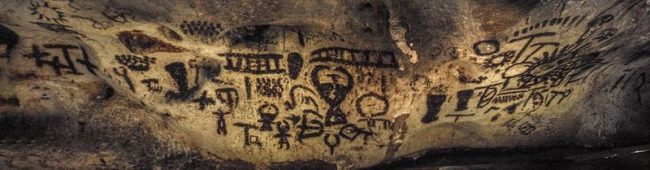
The total number of known decorated caves is about 400. Most cave art consists of paintings made with red or black pigment. Reds were made with iron oxides (hematite), while manganese dioxide and charcoal were used for blacks. Sculptures have also been discovered, such as bison clay sculptures in the Tucd Audoubert cave in 1912 and a bear sculpture in the Montespan cave in 1923, both located in the French Pyrenees. Carved walls were discovered in shelters. Roc-aux-Sorciers (1950) in Vienne and Cap Blanc (1909) in Dordogne. In many other caves and shelters, engravings were made with fingers on soft walls or with flint tools on hard surfaces. Pictorial or other representations in caves include few humans, but sometimes human heads or genitals appear alone. Hand patterns and handprints are characteristic of earlier periods, as in the Gargas cave in the French Pyrenees. Animal figures make up most of the images in caves of every period.
During the millennium when cave art was first made, the most frequently represented species, such as in the Chauvet-Pontdarc cave in France, were the most elusive species that are now extinct; cave lions, mammoths, woolly rhinos, cave bears. Later, horses, bison, aurochs, cypresses and mountain goats became common, as in the caves of Lascaux and Niaux. Birds and fish were rarely depicted. Geometric markings are always plentiful, but the specific types vary according to the time period in which the cave was painted and the location of the cave.
Cave Art, Prehistoric Art in Primitive Societies, Cave Paintings
Cave Paintings Meanings, Why They were Made
Cave art is generally considered to have a symbolic or religious function, sometimes both. The exact meaning of the images is not known, but some experts think they may have been created around shamanic beliefs and practices. One such practice involved entering a deep cave for a ceremony where a shaman entered a state of trance and sent his soul to the other world to contact spirits and obtain their favors. Examples of paintings and engravings in deep caves (that is, existing in total darkness) are rare outside of Europe, but do exist in the Americas (eg Maya caves in Mexico, so-called mud-glyph caves in the southeastern United States). states), Australia (Koonalda Cave, South Australia) and Asia (Kalimantan caves in Borneo, Indonesia, with many hand templates). Art in the open, in shelters or on the rocks is extremely abundant throughout the world and is often much later. Why were cave art, art, cave paintings made in primitive societies? Was existence part of the problem?
Cave Paintings Meanings, Why They were Made
Some theories have been proposed for the cave arts; Henri Breuil interpreted the paintings as hunting spells to increase the abundance of prey. Another theory developed by David Lewis-Williams, based largely on ethnographic studies of contemporary hunter-gatherer societies, was that the paintings were made by paleolithic shamans. The shaman would retreat into the darkness of the caves, go into a trance state, then paint pictures of his visions, perhaps with the notion of drawing power from the cave walls. Working on both artistic and low-quality art and figurines, R. Dale Guthrie identifies a wide range of skills and ages among artists. He assumes that the main themes in the paintings and other works (powerful monsters, risky hunting scenes, and the representation of women in Venus figurines) were the work of adolescent males, who at that time made up a large proportion of the human population. However, Dean Snow of Pennsylvania State University has suggested in his analysis of handprints and stencils from French and Spanish caves that some of them belonged to female hands, including those around spotted horses at Pech Merle.
Prehistoric Cave Paintings
Important cave paintings made in the prehistoric period are given below.
Magura Cave
It is one of the largest caves in Bulgaria, located in the northwestern part of the country. The cave walls are decorated with prehistoric cave paintings dating back about 8,000 to 4000 years. More than 700 drawings have been discovered on the cave walls. They are painted with bat dung (bat excrement) and represent hunting and dancing humans and a wide variety of animals.
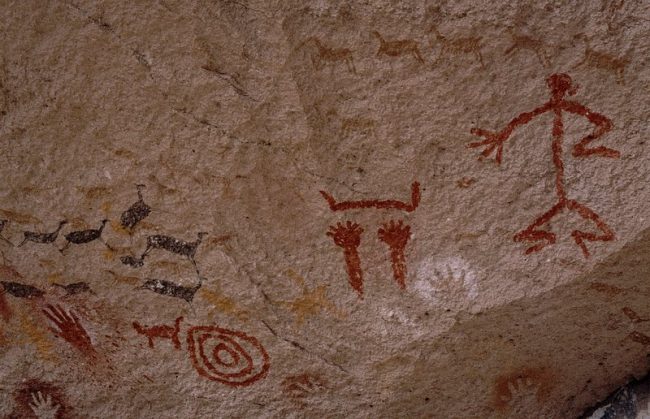
It is a cave located in an isolated area in the Patagonia region of southern Argentina. It gets its name (Cave of Hands) from the stenciled outlines of human hands, but there are many depictions of guanacos, rheas, and other animals as well as hunting scenes. Most of the hands are left hands, which shows the painters holding a spray lance with their right hand. The paintings are thought to have been created between 13,000 and 9,500 years ago.
Bhimbetka Cave
Located in central India, Bhimbetka contains more than 600 rock shelters decorated with prehistoric cave paintings. The paintings, which are predominantly red and white with the occasional use of green and yellow, often depict the lives and times of people living in caves. Animals such as bison, tigers, lions and crocodiles are also abundantly depicted in some caves. The oldest paintings are considered to be 12,000 years old.
Serra da Capivara
Serra da Capivara National Park in northeastern Brazil is home to numerous rock shelters decorated with cave paintings. The paintings feature ritual and hunting scenes, trees and animals, capivars. Some scientists believe that the oldest cave paintings in the park were made 25,000 years ago. This is debated by several geneticists, but this would contradict the currently accepted history of human settlement in the Americas.
Laas Gaal Cave
It is a complex of caves and rock shelters in northwestern Somalia that contains some of the earliest known rock art in the Horn of Africa and the African continent in general. Prehistoric cave paintings are estimated to be between 11,000 and 5,000 years old. They show cows in ceremonial robes accompanied by humans, domesticated dogs, and even a giraffe. The cave paintings have been perfectly preserved and have preserved their clear outlines and strong colours.
Tadrart Acacus Cave
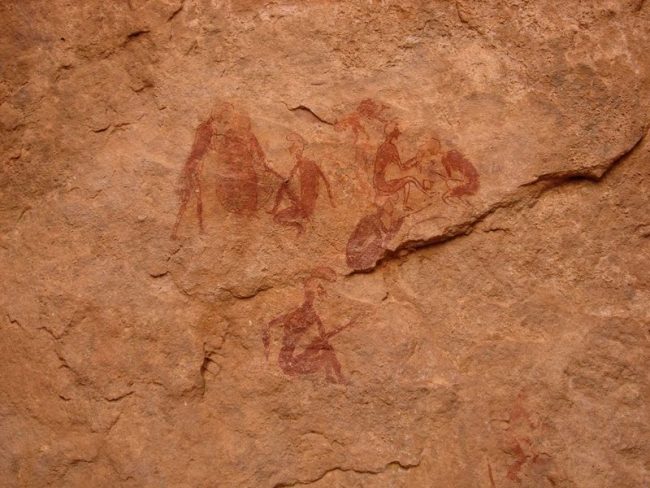
It forms a mountain range in the Sahara desert of western Libya. The region is known for its rock paintings dating from 12,000 BC to 100 AD. The paintings reflect the changing environment of the Sahara Desert with a more humid climate. Nine thousand years ago the environment was green with lakes and forests and large herds of wild animals as shown in rock paintings of animals such as giraffes, elephants and ostriches at Tadrart Aracus.
Cave Paintings Meanings, Why They were Made
Chauvet Cave
It contains some of the oldest known prehistoric cave paintings in the world. The oldest paintings in the cave may have been dated to 32,000 years old, according to radio carbon. The cave was discovered in 1994 by Jean-Marie Chauvet and his team of caving experts. These images contain images of animals such as ibex, mammoth, horses, lions, bears, rhinos and lions. Advanced techniques such as the use of perspective are clearly demonstrated in the ‘horses panel’ showing several animals in the same plane.
Kakadu Rock Pictures
Contains one of the largest concentrations of Aboriginal art sites in Australia. Nearly 5,000 art sites have been discovered along the hillside and on the cliffs in Kakadu. Aboriginal painting is estimated to have changed from 20,000 years to the present, but most paintings are less than 1,500 years old. The site at Ubirr has some of the finest examples of “X-ray art” in the world. Aborigines painted not only the exterior, but also the bones and internal organs of animals.
Altamira Cave
Discovered in the late 19th century, the Cave of Altamira in northern Spain was the first cave where prehistoric paintings were discovered. The paintings were of such an astonishing quality that the scientific community doubted their authenticity and even accused the discoverer, Marcelino Sanz de Sautuola, of forgery. Many people did not believe that prehistoric man had the intellectual capacity to produce any kind of artistic expression. It wasn’t until 1902 that the paintings were considered original. The charcoal and ocher paintings of horses, bison and hand prints in Altamira Cave are among the best preserved cave paintings in the world.
Lascaux Caves
It is called the “prehistoric Sistine Chapel”. It is a cave complex in southwestern France decorated with some of the most impressive and famous cave paintings in the world. Lascaux paintings are estimated to be 17,000 years old. Most of the cave paintings are quite far from the entrance and must have been made with the help of candles. The most famous cave painting is the Hall of the Great Bulls, where bulls, horses and deer are depicted. One of the bulls is 5.2 meters long, making it the largest animal ever discovered in any cave.
by Arthipo | 13 September 2021 | History of Art
Hittite State Civilization
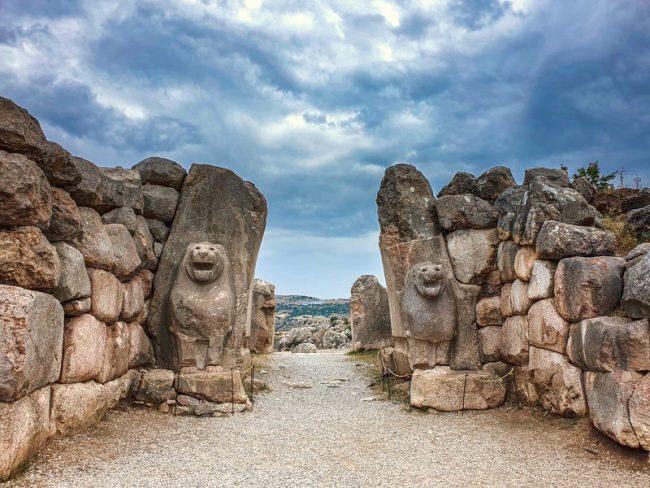
The Hittite State civilization, the Old Hittite kingdom, its capital, Hattusa (modern Boğazköy), was one of the few states in which Anatolia was divided in the second quarter of the 2nd millennium BC, at the Halys bend. Its most beautiful monuments date from the imperial period that followed. Strategically placed in a rocky passage, the capital has an inner enclosure that rises up to a high castle rock (Büyükkale). Expanding greatly during the imperial period, the outer city has a mighty four-mile cycle. The fortifications, defensive towers, and double walls of cyclopean masonry (large irregular blocks without mortar) stand on a stone-faced earthen rampart, itself protected by a stone apron wall. The lapped arches of its gates are flanked by portal statues such as lions or sphinxes that anticipate statues of Late Assyrian palaces. Carved on the stone door jamb of an arch, it is a famous relief of a warrior wearing a characteristic Hittite short skirt and conical helmet.
Elsewhere in the city there are four recognizable buildings as temples, the largest of which has been fully excavated. It is a huge structure surrounded by various store rooms, planned around a large colonnaded courtyard and a small independent temple at one corner. These features and the isolated location of the main sanctuary have no resemblance to Mesopotamian or Syrian temples.

Hattusas Hittite Bogazkoy
Hittites Hittite State Civilization Architecture Sculptures Reliefs
Hittite State Civilization Statues
The modern Hittite knowledge sculpture, first from the portal sculptures of Hattusa, and secondly, the rock sculptures, including those adorning the extraordinary temple called Yazılıkaya, is a little outside of the district. Here, deep fissures in the limestone open to the sky create a setting for the cult, reliefs carved into the vertical faces of the rock. One of the recesses or rooms is decorated with a display of deities, some standing on appropriate cult animals or identified by a hieroglyphic inscription. These figures are carved with only average mastery, and some of the iconography is borrowed from the Hurrians with whom the Hittite royal family married. The figures in the second or inner sanctuary are carved with a work of art inspired by religious fervor. The figure of a young king (Tudhaliyas IV) in the protective embrace of a god is less impressive than the symbolism of a large dagger stabbing into the rock in front of him. Rock reliefs from this period elsewhere in Anatolia – Sirkeli, Gavur Castle and Fraktin for example – are mainly of archaeological interest. They are inferior to contemporary reliefs and Iron Age carvings, of which there is a good example. The Ivriz Ruin in the Taurus Mountains shows a local ruler of the 8th century BC paying homage to a fertility god.
Hattusas Hittite Bogazkoy
Hittites Hittite State Civilization Architecture Sculptures Reliefs
Hittite State Civilization Statues
Monuments such as the İvriz Ruin represent an interesting aftermath of Hittite history. In about 1190 BC the empire was destroyed by the Phrygians, the Hittites exiled from their homeland on the Anatolian plateau, but in the 10th-8th centuries they reappeared as travelers in a small part of city-states such as Milid (modern Arslantepe-Malatya), Samʾal (modern chain) and Karkamış, Taurus or Northern In Syria, where they shared political authority with the native Aramaeans and other peoples. During this Syro-Hittite period, their art and architecture were hybrid and of a rather inferior character, heavily influenced by Assyria, to which the Hittites were often exposed, as well as Phoenicia and Egypt. Sculptures that stand out in their buildings, orthostats that flank the bases of the walls, often alternate from rough, black basalt to oddly white limestone. The columns are made of wood with stone bases and capitals, and larger-than-life monoliths are a common feature. Fortifications are still an important aspect of their city. The ones in Zincirli surround a round town half a mile in diameter, with a high-walled fortress in the middle containing a palace complex. Like all Syrian palaces, they contain one or more hilani units consisting of a colonnaded portico, a long reception room with a staircase adjacent to the roof, and a varying number of retirement rooms (see Art and architecture, Syro-Palestine). A striking example of these is the Bit hilani Kaparu Palace, a high Ḥalaf near the source of the Khābūr River. The almost barbaric array of statues indicates that the city is predominantly Aramaic. gave them an advantage over their competitors. Iron was a stronger material than items made of bronze used by many cultures before the advent of iron.
Hittite Art and Architecture
The Hittites were traders and developed excellent metalworking skills. In the 1400s, they began making objects such as iron tools and weapons, which gave them an advantage over their rivals. Iron was a stronger material than bronze items used by many cultures before it.
In Yazılıkaya, just outside the capital Hattusha, the open-air “rooms” made by adding barriers between natural rock formations are decorated with reliefs of Hittite gods. This area was apparently a sanctuary and possibly a burial ground in memory of the ancestors of the ruling dynasty. Unlike public roadside reliefs, it was perhaps a private site for a small group of dynastic and elite.
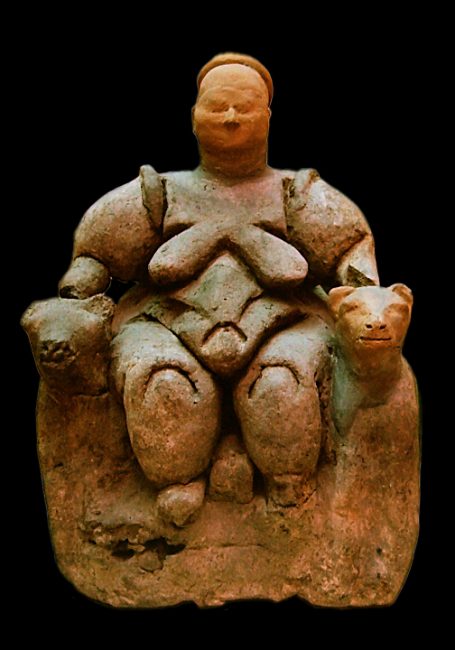
Çatalhöyük Archaeological Ruins
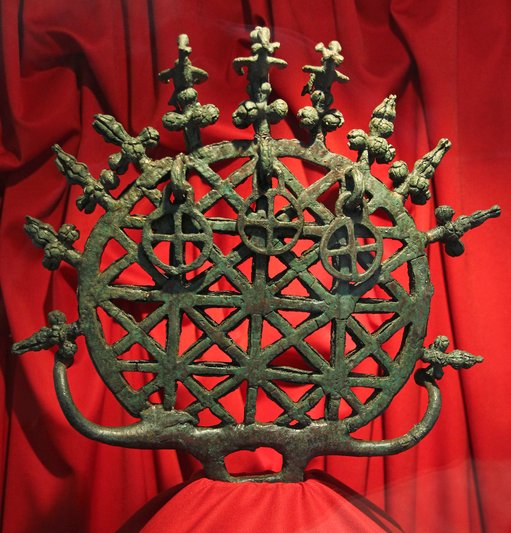
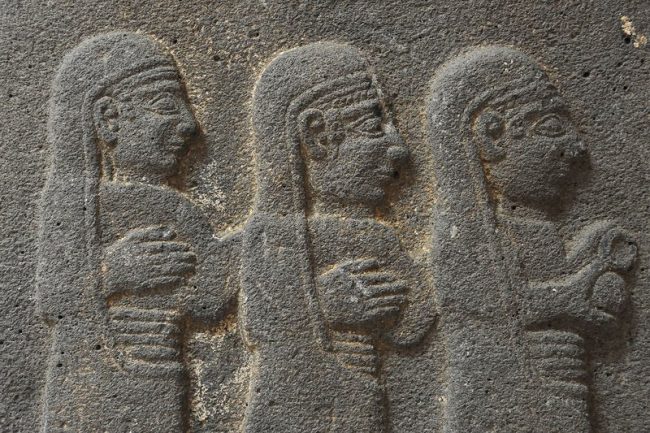
The Hittites were important producers of rock reliefs, which make up a relatively large part of the few artistic remains they left. They created works of art from metal and made pottery such as ritton, a type of drinking vessel. They also carved small cylinder seals from precious stones that, when printed, serve as official signatures for documents. However, the Hittites were very successful in stone carving, especially in relief sculptures where the figure was carved from a solid stone surface but remained attached to it. The reliefs included scenes of some kings, animals and warriors in chariots.
Hittite State Civilization Architecture Sculptures Reliefs
Because the Hittites lived on a rocky terrain surrounded by limestone cliffs, they had plenty of natural resources to build on. Much of their architecture has been lost, but what remains is defensive architecture made up of heavy stone structures. They were heavy double-walled ramparts, some with tunnels, surrounding Hattusha and other cities. As the city expanded over time, the walls grew too. The Hittites were always ready to defend themselves. Some walls had large arched gates with huge entrance statues of lions and sphinxes. The Hittites used a style of stonework called cyclopean masonry, structures built with large stones of many different sizes but not held together by a mortar-like binder (a mixture of sand, cement, and water). The Hittites created a kind of palace structure called bit-hilani, which was an entrance hall surrounded by columns. People approached the hall by climbing a columned staircase. The Hittites also built huge temple structures with numerous storage areas, central courtyards and surrounding rows of columns. Four great temples were built in Hattusha, of which only one has been excavated. Hittite State Civilization.

by Arthipo | 13 September 2021 | History of Art
Ephesus Ancient City
The Ancient City of Ephesus, Ephesus, the most important city of Ionia, dates back to the Polished Stone Age 6000 BC. It was built in the 10th century BC by Attic and Ionian Greek colonists on the site of the former capital of Arzawa. It was one of the twelve cities of Ionia during the classical Greek period. The city flourished after falling under the control of the Roman Republic in 129 BC. Ephesus, located in the Aegean Region in the west of today’s Turkey, was on a fertile plain because it was located in the south of the Cayster (Küçük Menderes) River and had rich alluvial soil.
What the ancient city of Ephesus owes its fame is undoubtedly the nearby Temple of Artemis, one of the Seven Wonders of the Ancient World. Among the many monuments, the city had the Library of Celsus and a theater that could hold 25,000 spectators.
Ephesus Ancient City Neolithic period
The area surrounding Ephesus was already inhabited during the Neolithic Age (about 6000 BC), as revealed by nearby artificial mounds known as Arvalya and Cukurici. Çukuriçi Höyük was discovered in 1996, approximately 100 m south-west of the Selçuk, Aydın and Ephesus road triangle, on the banks of the Derbent Stream, among the tangerine orchards. As a result of the research and excavations, stone and bronze axes, needles, burnished pottery fragments, spindle whorls, obsidian (volcanic glass) and silex (flint), shellfish, grinding and polishing tools were found in this mound. With the evaluations, it was determined that there was a settlement and life in Çukuriçi Höyük from the Neolithic period to the Early Bronze Age. The same type of materials were also found in the field of Gül Hanım, Arvalya Höyük, adjacent to Arvalya Stream, at approximately 8 km from Selçuk, Kuşadası road. The history of the artifacts found in Çukuriçi and Arvalya (Gül Hanım) mounds and the immediate surroundings of Ephesus thus reaches the Neolithic Period.
Hellenistic period
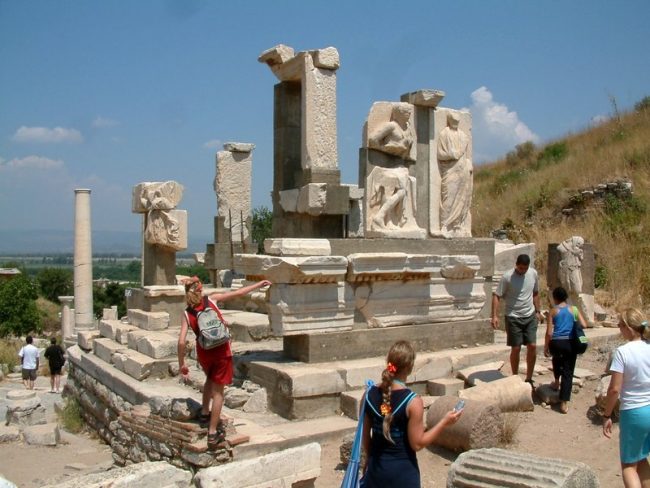
The port city of Ephesus, where immigrants from Greece started to live in 1050 BC, was moved around the Temple of Artemis in 560 BC. Ephesus, which is visited today, was founded by Lisimahos, one of the generals of Alexander the Great, around 300 BC. The city minted common money with the city of Apameia Kibotos, autonomously from Rome. These cities began to behave very brilliantly semi-autonomously in classical Asia Minor. Lisimahos re-establishes the city according to the Grid Plan found by Hippodamos of Miletus. According to this plan, all avenues and streets in the city intersect each other perpendicularly.
Ephesus Ancient City Roman period
The Ancient City of Ephesus, which lived its most glorious periods in the Hellenistic and Roman ages, became the capital of the Province of Asia during the reign of Roman Emperor Augustus, and its population exceeded 200,000 people at that time (1st-2nd century BC). In this period, everywhere is equipped with monumental structures made of marble. IV. As the port was filled in the 16th century, trade in Ephesus declined. Emperor Hadrian had the port cleaned several times. The port is filled with alluvium brought by the Marnas Stream and Küçük Menderes river coming from the north. Ephesus is far from the sea. VII. century Arabs attack these shores. Ephesus, which moved again during the Byzantine period and came to Ayasuluk Hill in Selçuk, where it was founded for the first time, was taken by the Turks in 1330. Ayasuluk, the center of Aydınoğulları, XVI. century began to shrink gradually. Today, there is Selçuk district in the region.
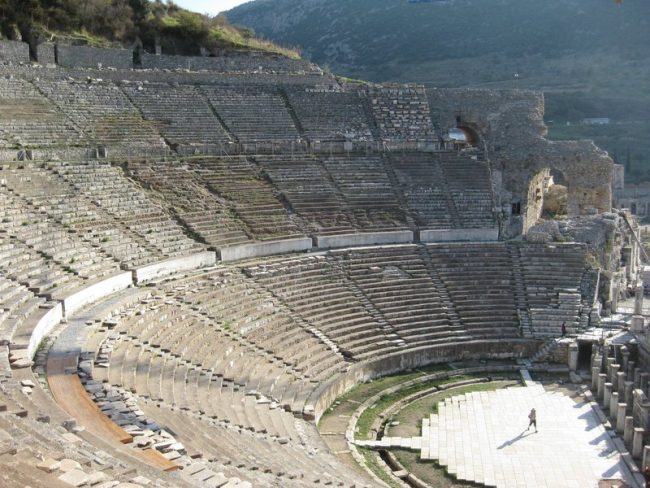
Ephesus Roman Period, Hadrian, Hellenictic
At the Ephesus ruins, on the frieze at the entrance of the Temple of Hadrian, the 3,000-year-old foundation legend of Ephesus takes place with the following sentences, “Androklos, the brave son of Kodros, king of Athens, wants to explore the opposite side of the Aegean. First, he consults the oracle of the Temple of Apollo in Delphi. The oracles tell him that he will establish a city where the fish and the pig point. While thinking about the meaning of these words, Androklos sails to the dark blue waters of the Aegean… When they come to the gulf at the mouth of the Kaystros (Küçük Menderes) River, they decide to go ashore. While they are cooking the fish they catch by lighting a fire, a wild boar emerges from the bushes and escapes by snatching the fish. Here the prophecy has come true. They decide to establish a city here…”
Ephesus, which was the main gate between East and West, was an important port city. This location enabled Ephesus to develop as the most important political and commercial center of its age and to become the capital of the province of Asia in the Roman Period. Ephesus does not owe its importance in antiquity to this alone. The largest temple of the Artemis culture based on the ancient mother goddess (Kybele) tradition of Anatolia is also located in the Ancient City of Ephesus. Ephesus, which was at the forefront with Miletus in science, art and culture in the VI century BC, raised famous people such as the wise Heraclitus, the dream interpreter Artemidoros, the poet Callinos and Hipponaks, the grammar scholar Zenodotos, the physician Soranos and Rufus.
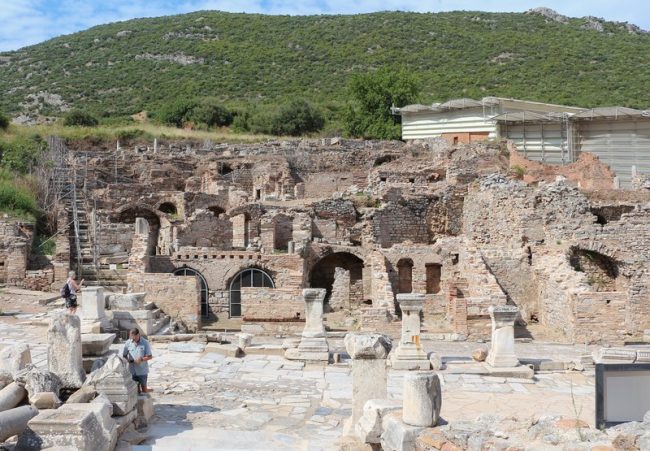
The Temple of Artemis
The Temple of Artemis, one of the seven wonders of the world, is the first temple of the ancient world built of marble and its foundations date back to VII. goes back to the century. Built by the Lydian king Croesus, dedicated to the goddess Artemis, the building was designed by the Greek architect Chersiphron.
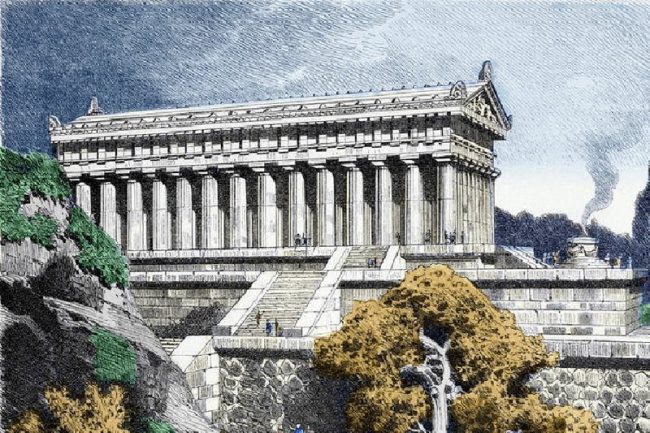
Ephesus Artemis Temple
The temple was used both as a marketplace and a religious institution. The Temple of Artemis was burned on July 21, 356 BC, by a Greek named Herostratus, who wanted to immortalize his name. That same night, Alexander the Great was born. When Alexander the Great conquered Anatolia, he offered help to rebuild the Temple of Artemis, but was refused. Only a few marble blocks remain from the temple. Excavations for the Temple of Artemis were started by the archaeologist John Turtle Wood in 1863 with the contributions of the British Museum, and in 1869, the foundations of the Temple of Artemis were reached at a depth of 6 meters.
Celsus Library
The building, which is one of the most beautiful buildings of the Roman period, served as both a library and a tomb monument. When Celsius, the governor of Ephesus, died in 106, his son had the library built in his father’s name as a funerary monument. Celsius’s sarcophagus is under the west wall of the library.
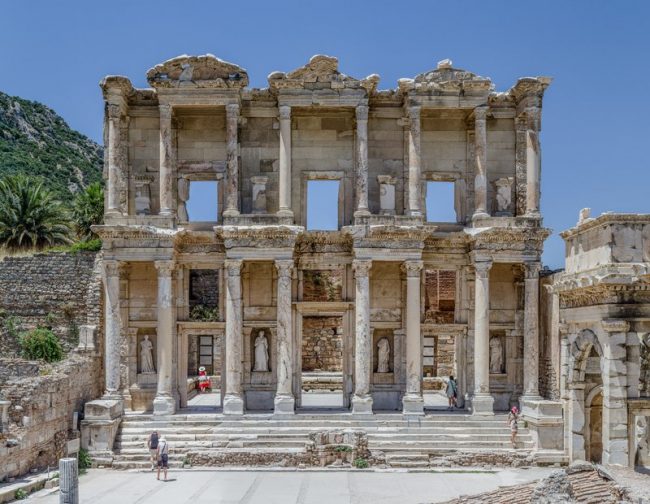
Celsus Library Ephesus Ancient City Ruins
It is the church in Bülbüldağı, where it is believed that Mary, the mother of Jesus, spent her last years with John. It is a place of pilgrimage for Christians and has also been visited by some popes. Although it is thought that Mary’s dead grave is on Bülbül Mountain, it is believed that Mary’s grave is in today’s Silifke, in the Seleucid of the time, as described in the Bible.
Seven Sleepers (Ashab-i Kehf)
This place, which was converted into a burial church during the Byzantine period, is believed to be the cave where seven Christian youths who escaped from the persecution of the pagans during the reign of Decius, one of the late Roman emperors, took refuge on the skirts of Panayır Mountain. Although there are 33 cities in the world claiming that the cave is within their borders, according to most of the Christian sources, the city is Ephesus, which is considered sacred by Christians. The most known and visited cave in Turkey as the Seven Sleepers cave is an important center of the period and St. It is in Tarsus, the birthplace of Paul. Afşin, whose old name was mentioned as Efsus in Arab sources, increased its claim with a report prepared by a committee of scientists and an exploration case they filed in the local court. The other Ashab-i Kehf in Turkey is in Lice.
A church built on top of this cave in the Ancient City of Ephesus was unearthed during an excavation between 1927-1928, and tombs belonging to the 5th and 6th centuries were also found as a result of the excavation. Inscriptions dedicated to the Seven Sleepers are found both in the tombs and on the church walls.
Hadrian’s Temple
It was built as a monumental temple in the name of Emperor Hadrian. Corinthian is regular and the foundation legend of Ephesus is embroidered on its friezes.
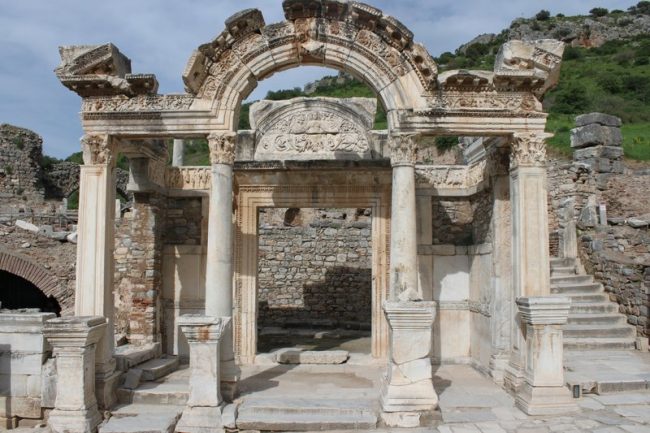
Hadrian Tempel Ephesus Ancient City Ruins
The temple, which was built in the name of Emperor Domitianus, which is thought to be one of the largest structures in the city, is located opposite the Traianus Fountain. It has been determined that there are columns on the sides of the temple, of which only the foundations have survived to the present day. What remains of the statue of Domitianus is the head and an arm.
Temple of Serapis
The Temple of Serapis, one of the most interesting structures of Ephesus, is right behind the Celsus Library. It is thought that the temple, which was converted into a church during the Christian era, was built by the Egyptians.
Virgin Mary Church
The Church of the Virgin Mary (Consul Church), where the Consul Meeting was held in 431, is the first church built in the name of the Virgin Mary. It is located to the north of the Harbor Bath. It is among the first Seven Churches in Christianity.
st. Jean’s Basilica
In the central part of the basilica with 6 domes, one of the largest structures of that period and built by the Byzantine Emperor Justinian the Great, at the bottom, St. It is claimed that the tomb of Jean (John) has been found, but no finds have been found yet. Here St. There is also a monument erected in the name of Jean. This church, which is considered very important for Christians, is located in Ayasuluk Castle and there is a treasury building and a baptistery in the north. The ancient city of Ephesus is an important place to be seen.
by Arthipo | 12 September 2021 | History of Art
Perge Ancient City
Perge ancient city, one of the cities of Pamphylia, is an ancient city located 18 km east of Antalya, within the borders of Aksu district, and once the capital of the Pamphylia Region. It is thought that the acropolis in the city was founded during the Bronze Age. During the Hellenistic period, the city was considered among the richest and most beautiful cities in the old world. It is also the hometown of the Greek mathematician Apollonius of Perga. The city, which came under the rule of Lydia and Persia, surrendered to Alexander the Great in 334 BC. The heyday of the city, AD II. and III. centuries, during the Roman period.
When St. Paul started his journey, he visited Perge in 46 AD and gave his first sermon there, so it became an important city for Christians during the Byzantine period. It is understood from the inscription on the bronze plate found in the Hattusa excavations in 1986 that the city of Perge occupied an important place during the Hittite Empire. B.C. The bronze plate dated just before 1235 was the Hittite King IV. Tuthaliya contains the text of the agreement between his enemies and Vasal King Kurunta. The text about Perge is: “The territory of the city of Parcha (Perge) borders the Kaštarja river. If the King of Hatti attacks the city of Parha and takes it under his dominion by force of arms, the aforesaid city will be attached to the king of Tarhuntassa”. As it is understood from the text, in this agreement, which was signed as a result of the war, the city and the region it owned did not belong to either side, and continued to protect its independence. We can accept the assumption that although the Hittite King had the power to dominate the city as it was spelled, he was not very interested in the southwestern region of Pamphylia. It is estimated that Perge did not play an important role in the Late Hittite Period. It must have lived as a small settlement on the Acropolis.
On the Perge city coin, Artemis Pergaia, the chief goddess of the city, was always written as Wanassa Preiis. Preiis or Preiia is most likely the name of the city. In the Early Aspendos Coin, the name of the city was written as “Estwediiys” and in Syllion as “Selyviis”. According to Strabo, the Pamphylian dialect was foreign to the Hellenes. Inscriptions written in the local language were found in Side and Sillyon. Arrian says in Anabasis: “When the Kymelians came to Side, they forgot their own language and started to speak the local language in a short time”. The mentioned language is Side. From this, it can be concluded that while Perge, Syllion and Aspendos spoke Hellenic with the Pamphylian dialect, Side continued to be an active language in and around Side, and Side is considered a language belonging to the Luwian language group.

Perge Ancient City, Roman Period, Hadrian Period
Entry of Alexander the Great to the Ancient City of Perge
B.C. When Alexander the Great won the Battle of Granikos in 334, he liberated Asia Minor from the rule of the Achaemenid Empire. According to Arrian, the people of Perga made contact with Alexander the Great in the city of Phaselis before they came to Pamphylia. The King of Macedonia sent his army from Lycia to Pamhylia by the way that the Thracians had opened over the Taurus, and he reached Perge by following the coastline with his close commanders. Since Arrian did not mention any war between the city of Perge and the Macedonian army, the city must have opened its doors to the king without a fight. Although the city was protected by a strong city wall in the classical period, he must not have wanted to fight the mighty Macedonian Army. Alexander the Great then continued his progress towards Aspendos and Side, and when he reached Side, he returned to Perge via Aspendos.
Roman period
B.C. In 133, the Kingdom of Pergamon III. It was transferred to the Roman Republic with the will of Attalos. The Romans established the Province of Asia in Western Anatolia. But Pamphylia remained outside the borders of this province. One of the points that has not been clarified until now is whether the West Pamphylia part belonging to the Pergamon Kingdom was included within the borders of the Province of Asia. Perhaps the cities of Pamphylia were freed for a while or were included in the province. The Kingdom of Pergamum ruled Western Pamphylia until Kestros. The river formed the natural boundary. The Romans were able to have a say in Pamphylia only after the end of the sea domination of the Rhodesians and the destruction of the Cilician pirates. We get the first information about Perge in the Roman period from what Cicero wrote against Verres.
Hadrian’s Period
Under Hadrian’s rule, the status of Lycia and Pamphylia was changed to the Province of Sanato, Bithynia and Pontus Province to the Imperial Province. This arrangement was a forced change that lasted only three or four years. The most important epigraphic source of Hadrian’s period is the ktistes inscriptions belonging to the Plancii Family. The Plancii dynasty plays an important role in the history of Perge during the Roman Imperial period.
Perge in the Eastern Roman Empire Period
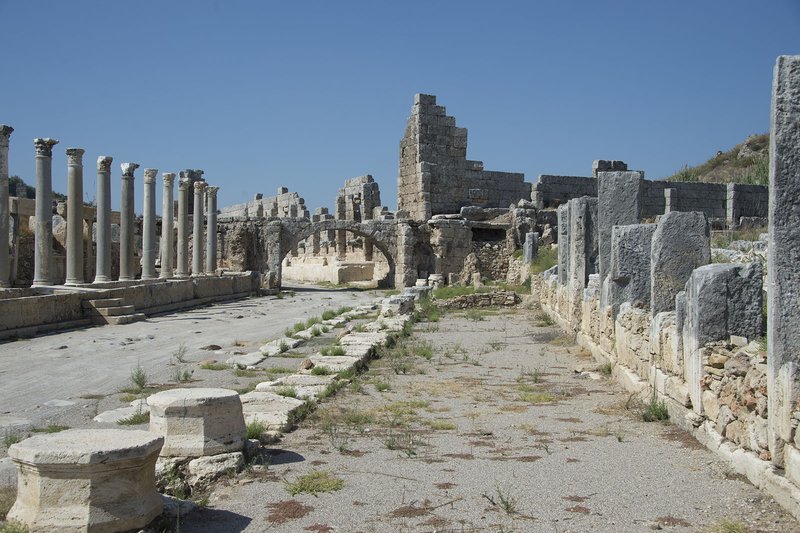
During the period of the Eastern Roman Empire, Side was declared as the first Episcopal center and Perge as the second Episcopal center with a special situation in Pamphylia in the Episcopal arrangement. Here, the rivalry between the two cities, which has become a tradition again, can be seen. The only issue that remains unclear is which city was the capital of Pamphylia. VII. In the 19th century, Arab raids began in the region. There is no direct information about Perge in late antiquity and the Byzantine period. Only the final declarations of the Church Council meetings can be heard. The people of Perge started to leave the city slowly over time between these dates. XVII. In the 19th century, the traveler Evliya Çelebi came to Pamphylia. Evliya Çelebi mentions a settlement called Tekke Hisarı in this region. Tekke Fortress and some researchers argue that the ancient city of Perge may be the same settlement. No Ottoman finds or remains were found in the archaeological excavations carried out in the city of Perge. Today’s modern settlement Aksu is located approximately 1 km south of the city. For these reasons, the core settlement of Perge must have been abandoned by its people at any time after the Byzantine period. The ancient city of Perge, a part of Pamphylia, tells the rise and fall of many civilizations with its ruins that have survived to the present day. Social and cultural structures reflecting the magnificence of the Ancient City of Perge; necropolis, theatre, walls, stadium, gymnasion, Roman baths, rectangular planned agora, high towers, monumental fountains, columned streets, Greek and Roman gates.
Theatre
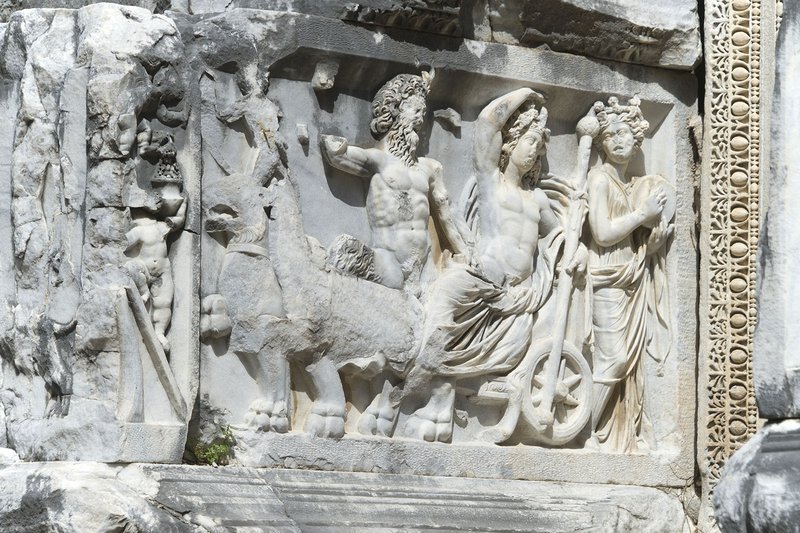
It consists of three main parts: Cavea (the area where the audience seats are located), Orchestra and Scene. The area reserved for the orchestra between the cavea and the stage is slightly wider than a semicircle. Gladiator and wild animal fights, which were popular in the same period, were held in the orchestra for a period. It has a capacity of 13000 spectators. There are 19 rows of seats at the bottom and 23 at the top. The fact that the orchestra is surrounded by railings in the theater shows that gladiator games were also held here. But the most interesting part of Perge theater is the stage building. On the face of the stage building, which opens to the backstage with 5 doors, there are reliefs depicting the life of Dionysus, the god of wine. The marble reliefs on the stage building of the Perge theater are also depicted like the frames of a movie. Although many of these reliefs were heavily damaged as a result of the demolition of the stage building, the sections describing the life of Dionysus are quite understandable.

Perge Ancient City, Roman Period, Hadrian Period Agora Theatre Stadium
Stadium
Perge Stadium is one of the best stadiums that has survived from the ancient world. The main material of the building, which has a thin and long rectangular plan, consists of conglomerate blocks, which are the natural stones of the region. It measures 234 x 34 meters and the north is closed in the form of a short side shoe, and the south is open. The building consists of 11 rows of seats, 30 of which are closed on both long sides and 10 of which are on the short side, which are placed on 70 arches. The height of the rows is 0.436 meters and the width is 0.630 meters. The top level consists of rows with backrests on the 3.7 meters wide excursion area. It is thought that there was a monumental wooden entrance on the southern short side. It is understood from the inscriptions that the arches with long sides were used as shops, and the name of the shop owner and the type of goods sold on them are written. The stadium’s M.S. It is possible to say that it started to be built in the second half of the first century. It has about 12000 people.
Agora
It is the commercial and political center of the city. There are shops all around the courtyard in the middle. The floors of some shops are covered with mosaics. One of the shops opens to the agora, and the other to the streets surrounding the agora. Depending on the slope of the land, the shops in the south wing have two floors. During the Eastern Roman Empire, the main entrances except the western entrance were closed with a wall, and the northern entrance was probably used as a chapel. The agora, which has a circular structure with a diameter of 13.40 meters in the middle of the square, measures 75.92 x 75.90 meters.
Perge Hellenistic Gates
The Hellenistic wall has three gates in the east, west and south. This door in the south falls into the courtyard door type. B.C. II. The Hellenistic gate, dated to the 16th century, is a monumental structure with an oval courtyard, protected by two four-storey round towers for the defense of the age. The existence of three phases was detected at the gate. M.S. In 121, it was transformed into a courtyard of honor by undergoing some changes. It is understood that a columned facade architecture was created in which the Hellenistic walls were covered with colored marbles, and statues of the gods and the legendary founders of the city were placed in the niches opened to the walls.
Perge Southern Bath
The Southern Bath, one of the best preserved structures of the city, draws attention with its size and monumentality when compared to its counterparts in the Pamphylia Region. Spaces separated for different functions such as undressing, cold bath, warm bath, hot bath, body movements (palaestra) are lined up side by side and the person who comes to the hammam can pass from one place to another and benefit from the hammam complex. The heating system under the floor of some rooms can be seen today. Perge Southern Bath, M.S. It reflects the construction, alteration and addition activities of different phases from the 1st to the 5th centuries.
Other structures in Perge are the necropolis, city walls, gymnasium, monumental fountain and gates.