


Ephesus Ancient City
The Ancient City of Ephesus, Ephesus, the most important city of Ionia, dates back to the Polished Stone Age 6000 BC. It was built in the 10th century BC by Attic and Ionian Greek colonists on the site of the former capital of Arzawa. It was one of the twelve cities of Ionia during the classical Greek period. The city flourished after falling under the control of the Roman Republic in 129 BC. Ephesus, located in the Aegean Region in the west of today’s Turkey, was on a fertile plain because it was located in the south of the Cayster (Küçük Menderes) River and had rich alluvial soil.
What the ancient city of Ephesus owes its fame is undoubtedly the nearby Temple of Artemis, one of the Seven Wonders of the Ancient World. Among the many monuments, the city had the Library of Celsus and a theater that could hold 25,000 spectators.
Ephesus Ancient City Neolithic period
The area surrounding Ephesus was already inhabited during the Neolithic Age (about 6000 BC), as revealed by nearby artificial mounds known as Arvalya and Cukurici. Çukuriçi Höyük was discovered in 1996, approximately 100 m south-west of the Selçuk, Aydın and Ephesus road triangle, on the banks of the Derbent Stream, among the tangerine orchards. As a result of the research and excavations, stone and bronze axes, needles, burnished pottery fragments, spindle whorls, obsidian (volcanic glass) and silex (flint), shellfish, grinding and polishing tools were found in this mound. With the evaluations, it was determined that there was a settlement and life in Çukuriçi Höyük from the Neolithic period to the Early Bronze Age. The same type of materials were also found in the field of Gül Hanım, Arvalya Höyük, adjacent to Arvalya Stream, at approximately 8 km from Selçuk, Kuşadası road. The history of the artifacts found in Çukuriçi and Arvalya (Gül Hanım) mounds and the immediate surroundings of Ephesus thus reaches the Neolithic Period.
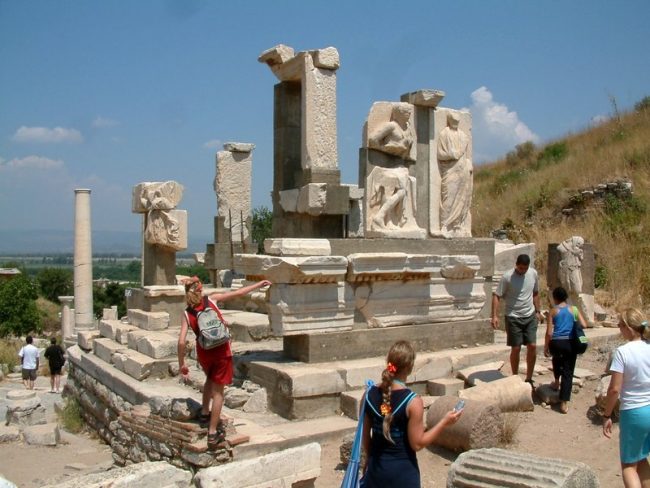
Hellenistic period
The port city of Ephesus, where immigrants from Greece started to live in 1050 BC, was moved around the Temple of Artemis in 560 BC. Ephesus, which is visited today, was founded by Lisimahos, one of the generals of Alexander the Great, around 300 BC. The city minted common money with the city of Apameia Kibotos, autonomously from Rome. These cities began to behave very brilliantly semi-autonomously in classical Asia Minor. Lisimahos re-establishes the city according to the Grid Plan found by Hippodamos of Miletus. According to this plan, all avenues and streets in the city intersect each other perpendicularly.
Ephesus Ancient City Roman period
The Ancient City of Ephesus, which lived its most glorious periods in the Hellenistic and Roman ages, became the capital of the Province of Asia during the reign of Roman Emperor Augustus, and its population exceeded 200,000 people at that time (1st-2nd century BC). In this period, everywhere is equipped with monumental structures made of marble. IV. As the port was filled in the 16th century, trade in Ephesus declined. Emperor Hadrian had the port cleaned several times. The port is filled with alluvium brought by the Marnas Stream and Küçük Menderes river coming from the north. Ephesus is far from the sea. VII. century Arabs attack these shores. Ephesus, which moved again during the Byzantine period and came to Ayasuluk Hill in Selçuk, where it was founded for the first time, was taken by the Turks in 1330. Ayasuluk, the center of Aydınoğulları, XVI. century began to shrink gradually. Today, there is Selçuk district in the region.
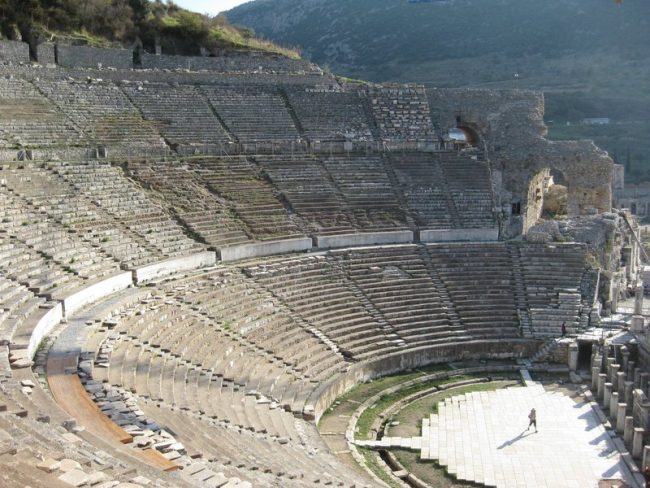
Ephesus Roman Period, Hadrian, Hellenictic
At the Ephesus ruins, on the frieze at the entrance of the Temple of Hadrian, the 3,000-year-old foundation legend of Ephesus takes place with the following sentences, “Androklos, the brave son of Kodros, king of Athens, wants to explore the opposite side of the Aegean. First, he consults the oracle of the Temple of Apollo in Delphi. The oracles tell him that he will establish a city where the fish and the pig point. While thinking about the meaning of these words, Androklos sails to the dark blue waters of the Aegean… When they come to the gulf at the mouth of the Kaystros (Küçük Menderes) River, they decide to go ashore. While they are cooking the fish they catch by lighting a fire, a wild boar emerges from the bushes and escapes by snatching the fish. Here the prophecy has come true. They decide to establish a city here…”
Ephesus, which was the main gate between East and West, was an important port city. This location enabled Ephesus to develop as the most important political and commercial center of its age and to become the capital of the province of Asia in the Roman Period. Ephesus does not owe its importance in antiquity to this alone. The largest temple of the Artemis culture based on the ancient mother goddess (Kybele) tradition of Anatolia is also located in the Ancient City of Ephesus. Ephesus, which was at the forefront with Miletus in science, art and culture in the VI century BC, raised famous people such as the wise Heraclitus, the dream interpreter Artemidoros, the poet Callinos and Hipponaks, the grammar scholar Zenodotos, the physician Soranos and Rufus.
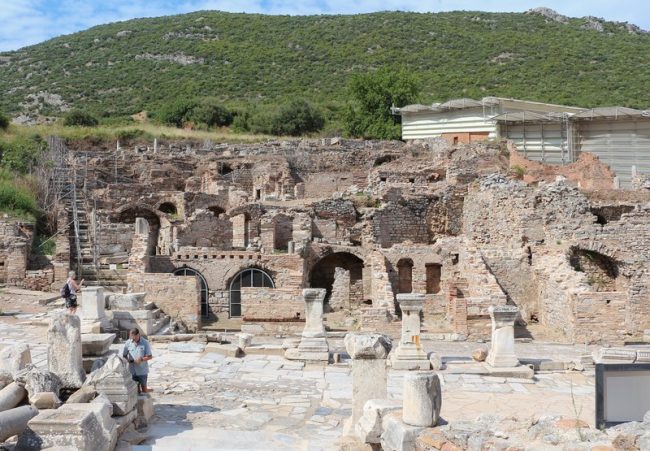
The Temple of Artemis
The Temple of Artemis, one of the seven wonders of the world, is the first temple of the ancient world built of marble and its foundations date back to VII. goes back to the century. Built by the Lydian king Croesus, dedicated to the goddess Artemis, the building was designed by the Greek architect Chersiphron.
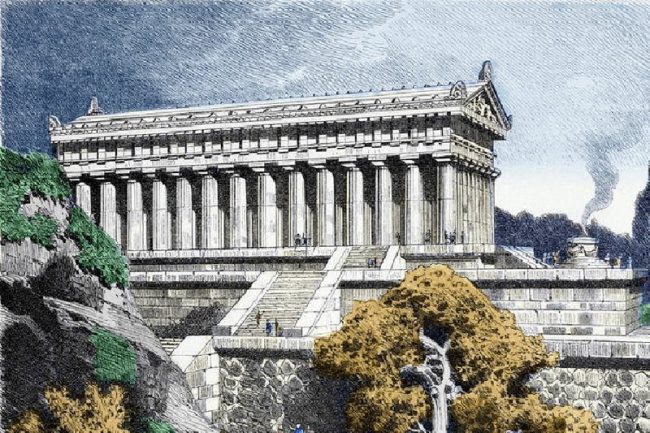
Ephesus Artemis Temple
The temple was used both as a marketplace and a religious institution. The Temple of Artemis was burned on July 21, 356 BC, by a Greek named Herostratus, who wanted to immortalize his name. That same night, Alexander the Great was born. When Alexander the Great conquered Anatolia, he offered help to rebuild the Temple of Artemis, but was refused. Only a few marble blocks remain from the temple. Excavations for the Temple of Artemis were started by the archaeologist John Turtle Wood in 1863 with the contributions of the British Museum, and in 1869, the foundations of the Temple of Artemis were reached at a depth of 6 meters.
Celsus Library
The building, which is one of the most beautiful buildings of the Roman period, served as both a library and a tomb monument. When Celsius, the governor of Ephesus, died in 106, his son had the library built in his father’s name as a funerary monument. Celsius’s sarcophagus is under the west wall of the library.
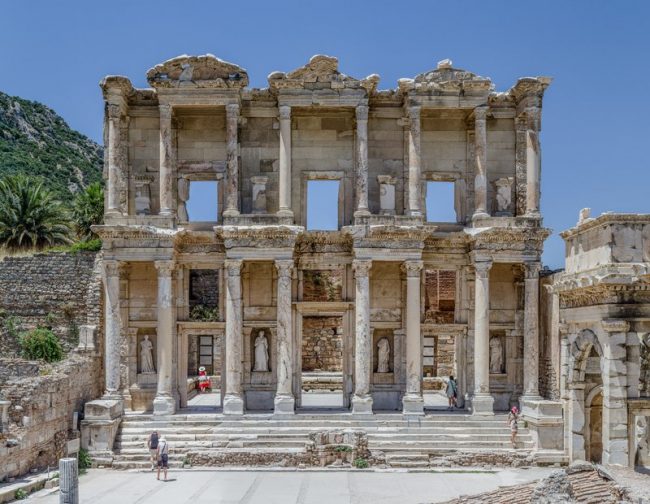
Celsus Library Ephesus Ancient City Ruins
It is the church in Bülbüldağı, where it is believed that Mary, the mother of Jesus, spent her last years with John. It is a place of pilgrimage for Christians and has also been visited by some popes. Although it is thought that Mary’s dead grave is on Bülbül Mountain, it is believed that Mary’s grave is in today’s Silifke, in the Seleucid of the time, as described in the Bible.
Seven Sleepers (Ashab-i Kehf)
This place, which was converted into a burial church during the Byzantine period, is believed to be the cave where seven Christian youths who escaped from the persecution of the pagans during the reign of Decius, one of the late Roman emperors, took refuge on the skirts of Panayır Mountain. Although there are 33 cities in the world claiming that the cave is within their borders, according to most of the Christian sources, the city is Ephesus, which is considered sacred by Christians. The most known and visited cave in Turkey as the Seven Sleepers cave is an important center of the period and St. It is in Tarsus, the birthplace of Paul. Afşin, whose old name was mentioned as Efsus in Arab sources, increased its claim with a report prepared by a committee of scientists and an exploration case they filed in the local court. The other Ashab-i Kehf in Turkey is in Lice.
A church built on top of this cave in the Ancient City of Ephesus was unearthed during an excavation between 1927-1928, and tombs belonging to the 5th and 6th centuries were also found as a result of the excavation. Inscriptions dedicated to the Seven Sleepers are found both in the tombs and on the church walls.
Hadrian’s Temple
It was built as a monumental temple in the name of Emperor Hadrian. Corinthian is regular and the foundation legend of Ephesus is embroidered on its friezes.
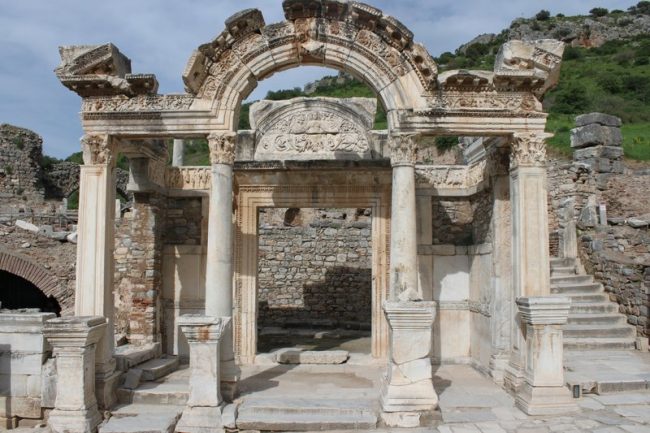
Hadrian Tempel Ephesus Ancient City Ruins
The temple, which was built in the name of Emperor Domitianus, which is thought to be one of the largest structures in the city, is located opposite the Traianus Fountain. It has been determined that there are columns on the sides of the temple, of which only the foundations have survived to the present day. What remains of the statue of Domitianus is the head and an arm.
Temple of Serapis
The Temple of Serapis, one of the most interesting structures of Ephesus, is right behind the Celsus Library. It is thought that the temple, which was converted into a church during the Christian era, was built by the Egyptians.
Virgin Mary Church
The Church of the Virgin Mary (Consul Church), where the Consul Meeting was held in 431, is the first church built in the name of the Virgin Mary. It is located to the north of the Harbor Bath. It is among the first Seven Churches in Christianity.
st. Jean’s Basilica
In the central part of the basilica with 6 domes, one of the largest structures of that period and built by the Byzantine Emperor Justinian the Great, at the bottom, St. It is claimed that the tomb of Jean (John) has been found, but no finds have been found yet. Here St. There is also a monument erected in the name of Jean. This church, which is considered very important for Christians, is located in Ayasuluk Castle and there is a treasury building and a baptistery in the north. The ancient city of Ephesus is an important place to be seen.