by Arthipo | 10 September 2021 | History of Art
The French Art History: An Iconic Cultural Heritage in the Modern World
The history of French Art has hosted countless renowned artists across various disciplines over centuries. Among these artists are painters, sculptors, and writers. Monet, Cezanne, Renoir, Rodin, Zola and many others have contributed to the richness of French art history. In this article, we will take a theoretical look at the development of art in France and understand how they shaped this impressive art history.
French Art in the Middle Ages and Renaissance Periods
Starting from the courts and monasteries of the Middle Ages, the French made their mark in art, architecture, music, and literature. However, like the rest of their neighboring countries at the time, they did not give much place to experimental approaches by staying within traditional boundaries. The period that changed this was the Renaissance.
The Renaissance period helped France become a cultural power center. Artists, especially, began to incorporate French traditions into their works, initiating the process of self-definition of the French identity. The rest of Europe watched this process carefully and admired France’s artistic evolution.
Baroque and Enlightenment Periods
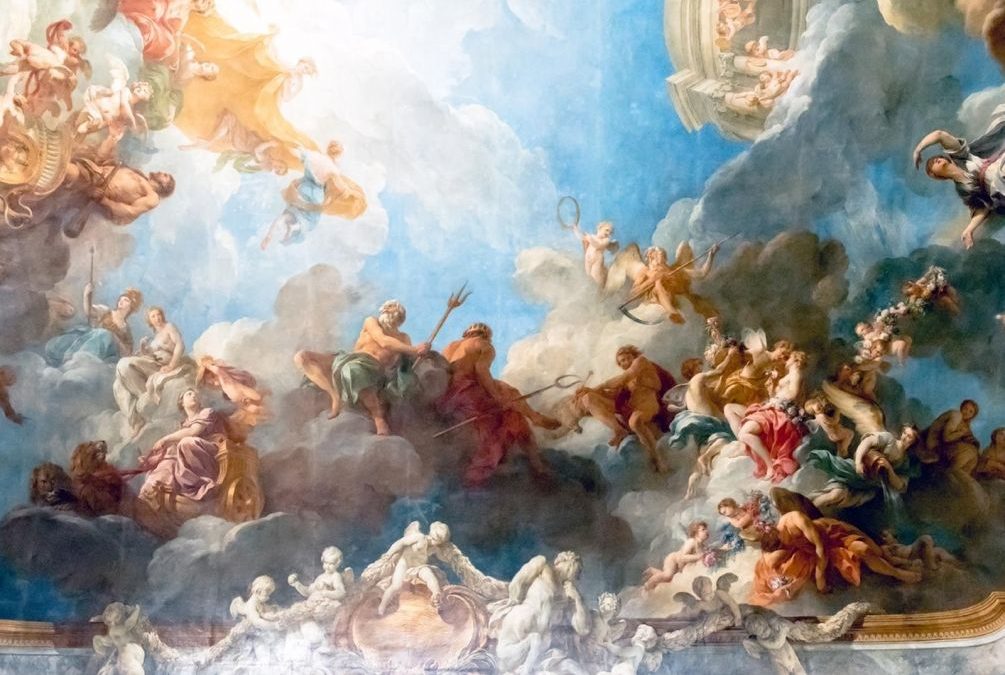
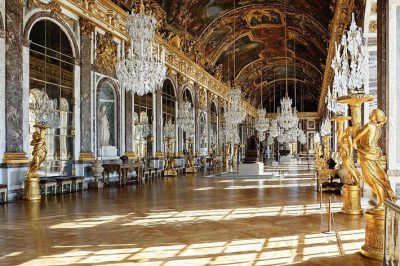
From the beginning of the Baroque period, the focus of the French scene shifted to the fine arts. The establishment of the art school named Academie Royale de Peinture et de Sculpture provided a significant contribution to this process. The exhibitions, known as “salons”, organized in Salon Carre, opened a new space for the display of art pieces and allowed the public to see these artworks.
This period of French art also includes the Romantic and Realist periods. In the Romantic period, artists usually dealt with dramatic and emotional themes, whereas in the Realist period, artists preferred a more realistic and honest reflection of society.
Modern Period: From Impressionism to Contemporary Art
Impressionism developed in the late 19th century and is considered the beginning of modern art. This movement represents the tendency of artists to depict nature and human activities from a subjective and emotional perspective. Important artists active in this period include Monet, Renoir, and Cezanne.
Throughout the 20th century, French art was influenced by various currents and movements. These include Fauvism, Cubism, Dadaism, Surrealism, and Contemporary Art. These movements reshaped and diversified the ways of thinking and expressing art.
Contemporary art generally includes art movements that began after World War II and extend to the present day. In this period, art has become more philosophical and conceptual. Contemporary French artists include Christian Boltanski, Annette Messager, and Sophie Calle.
This chronological overview highlights the original and diverse character of French art. Due to its role in shaping modern art, French art continues to be seen with special interest and respect by artists and art lovers worldwide. Paris, in this context, bridges both the past and the future; it guides contemporary art while carrying the traces of history. The fact that some of the biggest names in art are French proves that this country is the decisive leader of the art scene and shows that it will continue this leadership.
French Art History, France Art
20th Century and Beyond: Modernism and Postmodernism
The 20th century marks a significant turning point for French art. Two world wars greatly influenced the nature and direction of French art. In the first half, movements such as Dadaism and Surrealism challenged the traditional understanding of art, allowing for the emergence of a new language and forms of expression in art. Artists pushed the boundaries of art by using surreal and subconscious elements in their works.
In the second half of the 20th century and in the 21st century, French art diversified increasingly. Postmodernism transformed art by seeing it as a tool to express ideas and concepts. In this period, there was a move towards new forms of expression beyond traditional art disciplines, such as photography, video, installation and performance art. Also, during this period, the activity of female artists increased, and the issue of gender equality in art gained importance.
The Future: New Boundaries of Art
Today, French art is still innovative and impressive. Advancing technology offers new tools and methods that artists can use to create their works. Digital art is gaining popularity, especially among young artists. Also, the sensitivity of art to social and political issues is increasing. Issues such as environmental problems, migration, gender equality are increasingly featured in the works of artists.
The future of French art is being shaped by its rich and diverse history. The legacy of the past feeds and inspires future innovations. France will continue to contribute to the development and transformation of art by maintaining its leadership in the art world. After all, the constant evolution of art is an integral part of French culture and identity.
Understanding French art history helps us not only understand the artistic development of a country but also how modern art has been shaped and evolved. This history shows the magnitude and continuity of the impact of French art on the world art scene. This impact stems from France’s ability to bring together the past, present, and future of art.
by Arthipo | 9 September 2021 | History of Art
Çatalhöyük History
Çatalhöyük is within the borders of Küçükköy, eleven kilometers north of Çumra district of Konya province in Turkey. British archaeologist James Mellaart (Ceyms Melart) initiated the first excavation in 1958. In Çatalhöyük excavations, important findings that shed light on the history of humanity were reached. Çatalhöyük, dating back 9 thousand years, is accepted as one of the largest and most crowded settlements of that period with a population of eight thousand.
Çatalhöyük ancient settlement is one of the oldest Neolithic settlements in the world. It is a very important place for Anatolian and world history. Because it changed almost everything we know about the lifestyle of early Neolithic communities. The striking features of Çatalhöyük are its size, the location of the houses and residences and the duration of the settlement. The modern first city.
Çatalhöyük Architectural Structure
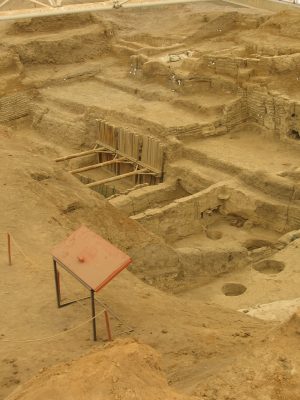
Çatalhöyük is part of a huge ancient settlement. For now, only 5% of the settlement is thought to have been discovered. Çatalhöyük consists of two mounds, east and west. The eastern mound Between 7400 and 6200, there are 18 different layers of settlement. The remains of the western mound belong to the Chalcolithic period.
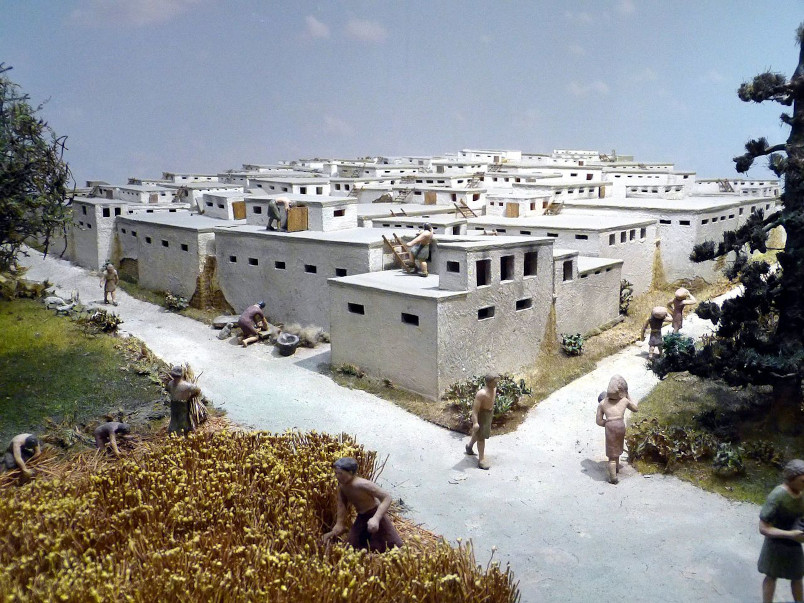
The residences or houses at Çatalhöyük have an interestingly similar construction style to the traditional one as we see it today. The only difference for Çatalhöyük is the layout of the settlement. Çatalhöyük houses were a living space/room with a flat roof and a single cellar with an area of approximately 25 square meters. Each house had a stove, an oven and a bench. The room is also furnished with different materials such as wood for sleeping and sitting. Some of the blocks used to build the houses today are still intact today, despite the weather. The researchers thought that the burning in the city hardened the block, giving them resistance to weathering.
The houses were built on the same plan as adjacent to each other and with flat roofs. However, the walls of each house were separate, and there were no streets between the houses because the walls were adjacent. Each new house was built a little higher than the one next to it, and the entrance to the houses was provided by the doors opened on the roofs. People used the stairs installed on the roofs to enter and leave their homes. Mud brick, wood, clay and reed were used in the construction of their single-storey houses. The roofs are placed on adobe walls and wooden poles obtained from the forest south of the city. The roofs covered with reeds were covered with compressed clay soil and strengthened.
Çatalhöyük Archaeological Ruins
The people of Çatalhöyük plastered the inside of their house, which consists of two parts as a room and a warehouse, and painted it white, and then painted its walls. These paintings featured rug patterns, interlocking circles, stars and hunting scenes, and animals such as vultures, leopards, birds, and deer. On the floors of the houses, they laid mats made of grain straws and marsh reeds. On the other hand, they built benches and high platforms at the bottom of the walls to facilitate domestic life. They buried their dead under these platforms with tools made of bone, colored stones, cutting tools, stone axes, beads made of seashells.
Wooden vessels, boxes, jewelry made of bones, flint daggers and knives, and obsidian arrows and spearheads were found during the excavations. Among the materials found during the excavations, the most striking ones are the terracotta pots and the statues of the goddess of fertility. The superior craftsmanship and decorations in the finds indicate the existence of a developed understanding of art in Çatalhöyük.

Çatalhöyük Archaeological Ruins
by Arthipo | 9 September 2021 | History of Art
Aspendos
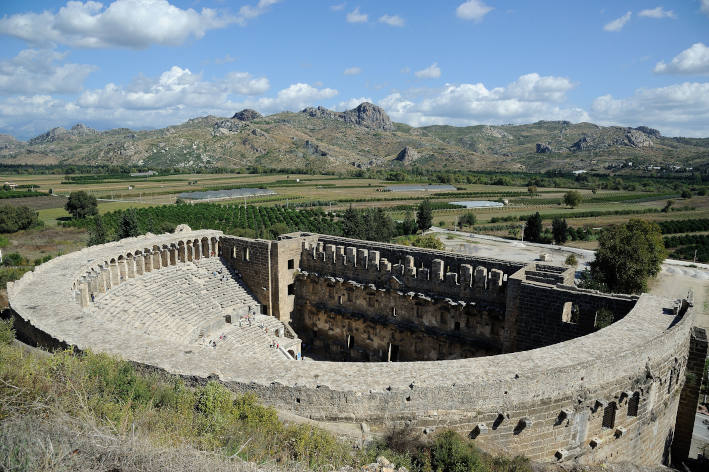
The ancient city of Aspendos is within the borders of Antalya Province in the south of Turkey. It is located in the Pamphylia region, on the banks of the Eurymedon (Köprüçay) river. The Acropolis is approximately 60 meters above sea level. It sits on a flat-topped hill with many surviving monuments such as the Nymphaeum, Basilica, Market Hall, and Odeion.
Thanks to the Eurymedon River in ancient times, Pamphylia was a trading area. It was ruled by the Greeks, Persians and Romans. It is widely considered to be the best preserved ancient theater in the world.
Aspendos Architectural Structure, Construction
Built
The Roman emperor Marcus Aurelius (160-180) had the Aspendos amphitheater built. Thanks to the inscriptions on its walls, we know exactly who designed it. Zeno, son of Theodorus. The inscriptions tell that Zeno was born in Aspendos. The financiers of the theater are the Curtius Crispinus brothers.
Despite being built during the Roman period, the theater displays many Greek features. Traditionally, the audience tribune is raised from the eastern slope of the acropolis. The remainder, the stage, the back wall and the side towers were built with a system of stone arches and vaults.
Aspendos Amphitheater Architectural Structure
Aspendos Amphitheater Architectural Structure
The size of the Aspendos Theater is impressive. The total width of the theater is 96 meters, other elements follow the general proportions: the width of the stage is half the width of the building, and the diameter of the orchestra is half the width of the stage.
Amphitheater Size
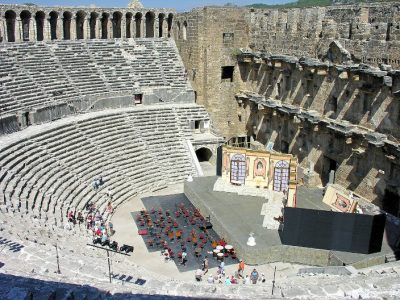
The audience tribune is divided into two by a horizontal walking path called a diazoma. The lower section has 20 rows of seats, while the upper section has 21 rows. The capacity of the theater is estimated to be at least 7,300 to 7,600 people and would have reached 8,500 if the stairs were used as seating.
The theater is also known for its excellent acoustics and elegant architectural ornamentation. The two-story stage building is particularly impressive and, like most of the theatre, is extremely well preserved. This is largely due to the settlement of the city, which continued until the Byzantine and Seljuk periods. The Seljuks used the theater as a caravanserai and restored the building in the 13th century.
In 1909, British archaeologist David George Hogarth was stunned by the theatre. He wrote: “This is unlike anything I’ve seen before. You may have seen amphitheaters in Italy, France, Dalmatia and Africa; temples in Egypt and Greece; palaces in Crete; You may be saturated with antiquity, or you may despise it. But you haven’t seen the Aspendos theater. “
The siphons at Aspendos allow researchers to further explore how it might have worked. In addition, the standing aqueducts of Aspendos are longer than those of Segovia and Pont du Gard.
It is still used for its original purpose today. Aspendos Theater has been hosting the Aspendos International Opera and Ballet Festival every year since 1994.

by Arthipo | 23 February 2020 | Painting Materials
Acrylic paint brushes are the main topic of this article. Types of acrylic paint brushes, their use, features, which brushes are used where.
Types of Acrylic Paint Brushes Usage, Features, Properties
Acrylic paint brushes are generally hard bristle brushes. It can be used in common with oil paint brushes. This article has shared some basic and useful information about acrylic paint brushes. Here’s everything you need to know about the different types of brushes. For acrylic paint, as well as some examples of why and how you can use each brush.
There are no strict rules about what brushes you can or should use first. At other times, I find it very helpful to go beyond just using one or two brushes. Using different genres can give you different results and help you grow as a creative artist.
This list includes the 7 most used different acrylic paint brushes. But keep in mind that these are general recommendations only.
1. Acrylic wash brush, Large Surface Brushes
It is a very large paintbrush. If you buy a set of paint brushes and notice one huge brush compared to the others. it’s most likely a wash brush. Acrylic wash brushes are best known for quickly covering large sections of surface. Washing Brush, Large Surface Brushes

Acrylic wash brush, Large Surface Brushes
It can be applied using a dry brush. Most artists will use a wash brush by first dipping it in some water to achieve maximum coverage quickly. You may notice that these brushes are also thicker than other brushes. It allows the brush to take a large amount of paint and water. These are great brushes to use when you need to get some extra paint.
2. Shortcut Brush, Cut Angle Brush, Acrylic paint brush,
This type of painting brush has an angled or curved tip, so they are sometimes also known as curved brushes. A slanted tip for bristles is particularly useful for curves and for creating lines and shapes that vary in thickness and coverage.

Shortcut Brush, Cut Angle Brush
If you like the flexibility of going from thin to thick with just one brush. This is the brush for you! Angled paint brushes are useful for many artists who paint on an upright canvas at an easel.
3. Flat Brush
The flat brush is very similar to a wash brush. That it is not quite thick and the bristles are typically not rounded at the edges. Flat brushes are great for wide strokes. If you’re working on a surface where a wash brush might be too large. The flat brush will give you a great finish while also giving you a little more control over the wash brush.

Acrylic Flat Brush
Flat brushes can also be used for thick and thin lines. An angled type will probably provide a little more comfort and control when working.
4. Fan Brush
The fan brush is the most useful brush for painting trees, grasses, shrubs. You can use abstract watery designs with acrylic paints. Fan brushes, as the name suggests, have a fan-shaped tip. These brushes are perfect for blending backgrounds and skies: as well as adding subtle highlights to darker areas.

Fan Brush
You can draw many different textures using a fan brush. Depending on how you create long brush strokes, you get a different effect. We often use these brushes to paint elements and landscapes in nature with acrylics.
5. Round Tip Brushes
Round brushes are usually much smaller than flat and soft rounded edge. These brushes give you maximum control over different details in your acrylic painting. The handle of these brushes has a narrower design. Therefore is similar to the feeling you have when holding a pen or pencil.

Round Tip Brushes
Use these brushes when you want to add detail and precisely control the size and flow of paint. You may also want to try using these brushes, both wet and dry, for different effects when creating.
6. Line Brush
The line brush is a very thin brush with very long bristles. It is similar to a round brush except that it is small. Line brushes are best used for fine details in your artwork. Line brushes are great for creating very fine details. You can also use a line brush to write text and add words to your pages. The brush tip is very small, making it easy to write letters, numbers and words.

Line Brush
Many artists who sign works of art use a line brush when writing their signatures. Line brushes can be used wet, but of course they can also be used dry. Soaking in water before painting can help the paint run and spread a little more evenly.
7. Spatulas, Pallet Knives
Spatulas or palette knives are technically not actually brushes. But they are a very common and popular way of applying paint to a canvas. Many artists use palette knives in various ways to create different effects. Plastic knives are useful for beginners and your first experience exploring acrylic paints. But if you really like using them, it’s wise to get metal spatulas. The advantage of a metal spatula is that it is usually much easier to clean. Metal pallet knives are less likely to snap and break if too much force is accidentally applied to them. You can use the spatula to create different textures, spread paint and create various layers.

Spatulas, Pallet Knives

by Arthipo | 26 October 2017 | Drawing Techniques, Painting Materials
What are the Properties of Acrylic Paints? What is the Drying Time of Acrylic Paints? What are Acrylic Paint Properties?
We will discuss what are the properties of acrylic paints technically. The general technical properties of acrylics such as light sensitivity, viscosity, tube, jar, and drying time of acrylic paints are explained in the article. There is almost nothing that has not worn out. Painting materials can not escape the adverse effects of nature such as moisture, heat, light. What are the characteristics of acrylic paints:
Light Sensitivity in Paints
Pigment molecules give the actual color to paints. Nowadays, color pigments are obtained by natural routes (plant roots, soil, etc.) as well as chemical routes. The color pigments had a light sensitivity in some cases. So as you are exposed to light, colors lose their vitality and gradually fade away. This is the main reason for the use of low light on museums. Photons, which are light carriers, disrupt the structure of pigment molecules. This applies to many types of paints such as oil paint, curium, watercolor, gouache, acrylic. The most durable paint in acrylic paints in paints. Secondly, oil painting takes place.
There is an agency that sets standards for light sensitivity of paints. The name of this organization is ASTM International. We can say it as an American Testing and Materials Agency. This setup tests paints and measures them based on the light effect that will come to life in a gallery over a period of 20 years. There are labs that imitate this effect. A look-up is an accelerated time test.
ASTM painting durability standards are:
ATSM I: Excellent Durability
ATSM II: Very Good Durability
ATSM III: Average Durability Standard
Other standard notation are:
AA: High Degree Permanent Colors
A: Good Degree Permanent Colors
B: Medium Degree Permanent Colors
A: Low Permanent Colors
Acrylic Paint Viscosity
Viscosity is a technical term used to describe the fluidity of liquids. A reminder refers to the density of the liquid. For paint, it can be explained as the amount, density and surface coating ratio when apply to a surface.

What are Acrylic Paint Properties? What is the Drying Time of Acrylic Paints?
Acrylic paints are more cream cheese. Oil paints are in the consistency of butter in room temperature. Of course, the viscosity of the paints can be changed by the materials that solve them. Acrylic paints can be reduced in density with water. Materials such as turpentine, thinner, naphtha are used to thin the oil. What are the Properties of Acrylic Paints?:
Tube Acrylic Paints And Jar Acrylic Paints
Acrylics are sold in two types on the market. They are the first type. Tubular shapes may be in the form of metal or plastic. The other type of sale is plastic jars. There is no difference in color between the two species. The amount and budget you will use when purchasing is important.
Acrylic Paints Drying Time
Acrylic paint drying time is not very long. After an average of 30 minutes, it starts drying. You have to be clear about the details of the painting until this time frame. The drying time in acrylic paints can only be spread over a period of time such as 1 hour completely dry. The thing to note here is that although the paint is slightly dried, you can not mix the paint with the new part. Acrylics dry like a thin surface. It looks as though the surface of the canvas is covered with a thin plastic layer.