Acrylic Paint Techniques, How to Use Acrylic Paint Acrylic, How to make acrylic paint?
What are acrylic paint techniques? How to use acrylic paint? What should we pay attention to? Nowadays, acrylic paints are a type of painting which is being used intensively. Many painters prefer this type of paint in abstract painting. The main reasons for this are: Because the colors are vivid, easy to clean, does not require in-depth perspective and the details in the drawing is preferred because it dries quickly. How to make acrylic paint?
Acrylic Painting Techniques
Let’s examine the acrylic paint techniques in more detail. The most important aspect of your paint mixing of pass-through feature that paint need to be aware that it is not as good as when using oil paints. Another important issue is that acrylic paint starts to dry after ten minutes, and the paints do not mix. This may prevent you from getting the work you want.
Acrylic Paint Techniques
The important issue is that you do not try to make too complex dye mixtures with acrylics.
Before you start making a painting with Acrylics, you should specify exactly what you are going to draw. It is not easy to change the paint after starting painting because the acrylic paint dries quickly. Although it is water based, it is not erased. So you will have to draw a layer of acrylic paint on it again to close the dyes that you have already been to the canvas. This leads to the formation of raised areas on the canvas. It is not easy to draw a picture like acrylic paintings or classical period paintings or Rembrant portraits. Because it dries quickly, you can not draw the details as you like.
The most abstract paintings of acrylic are suitable to work. Many artists who have abstract paintings already use these paints.
After drying on the canvas surface, it is not removed from the canvas by wiping. The first method is scraping or swimming. Because this kind of paint is peeled like a skin. A number of solvents may be used, but these also have no definite solution. The paint remains on the canvas. These solvents include: Isopropyl alcohol, toluene and acetone, etc .; If the paint has not dried yet, it can be wiped with warm water and a sponge or cloth.
How to Use Acrylic Paint Acrylic, How to make acrylic paint?
How to Use Acrylic Paint
How to use acrylic paints, let’s examine the painter’s eyes. In ancient times, painters would usually use the paints themselves. They mixed a number of fillers and pigments from plants or soil. They painted until they got the color they wanted. Acrylic paints are a type of material with more specific standards. There are a number of factors such as fast drying, intermingling, hardness. For example, the only solvent is water and the water only works for 15-20 minutes. The application surfaces used for watercolor and oil painting are less. It is used on surfaces such as paper, canvas, wood, wall. However, acrylics can be used on almost any surface and easily attached to the desired surface.
Acrylics can be used like other water-based paints. It can be used as a watercolor or gouache. All you need to do is add more water to the paint. If a layered and embossed structure is to be formed on the canvas, acrylic paints are used for this purpose. It can be applied to almost any surface and colors do not lose their vitality. They can be used in toy construction, hobby, wood painting, train, building, ship, airplane model.
Acrylic Paintings A Video Related to Painting Techniques, Drawing, Use
You can watch videos of the acrylic techniques on Arthipo Youtube channel.
Acrylic Paint Flower Drawing, How to Make Acrylic Paintings
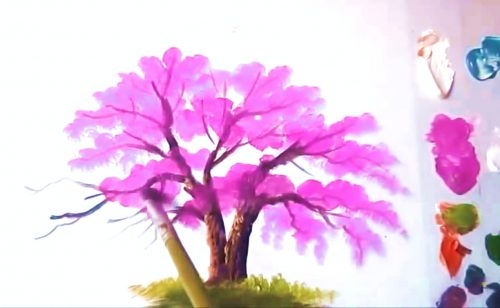
Acrylic paints, flower painting, acrylic paint will be discussed how to do. We also added an easy acrylic flower paintings drawing video to our article. How to Make Acrylic Paintings? You can watch what is described here on the video. Let’s take a look at the painting materials we need before we start applying acrylic paint flower drawing techniques.
The painting materials needed for acrylic table flower drawing are:
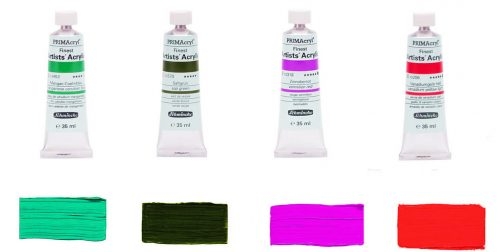
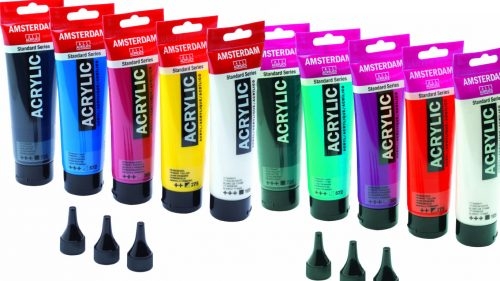
Vermillion red, titanium white, chrome green, emerald, ultramarine, lemon yellow, siena, ivory black etc. Other painting supplies include: Small drop spatula, acrylic paint brushes and large brush. Canvas, sponge, cloth and water.
Acrylic Paint Flower Drawing Techniques
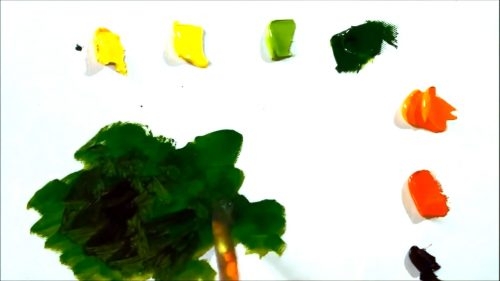
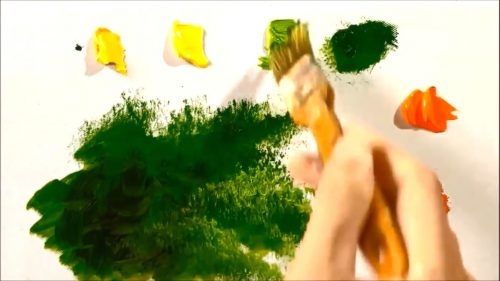
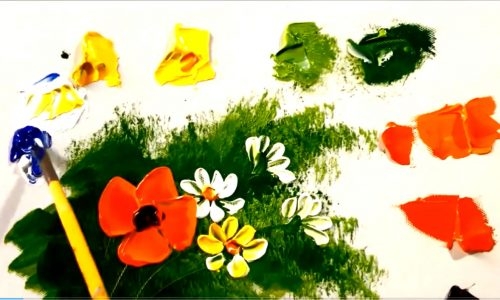
We will examine the techniques of acrylic paint flower drawing with a sample picture study. First we draw the green parts of the leaves and stems of the flowers. We will then place the flowers on this floor. We drive a little on a chrome green canvas. What you need to pay attention to when doing this is to create tone differences on the floor.
Acrylic Paint Flower Drawing
Acrylic Paints Flowers Drawing
Acrylic Paint Flower Drawing
We have to draw sections with different tones (light, dark green) indented a lot by a straight green. We must use dark green for the bottom part and light green for the upper tones. If we do not have a spatula or spatula then we can define the outline of the leaves and stems with the brush handle.
We make a real leaf, we will never make it. A leaf we make is to create imagination. In reality there is no leaf there. That is to say, “This is not a Pipe”, which is a famous leaf, written under Pipo Resminin, so this is not a leaf. Do not try to make leaves, create a leaf symbol.
We make white petals of chrysanthemum flower by taking some white paint with a drip spatula. We avoid using extreme paint here. The creation of a light layer on the green background of the dyes will create brighter colors and a sense of reality. After drawing the crown, we paint yellow colored pollen (usually the pollen area of the flowers) or red colored pollen in the center. Some paint does not reach the middle parts.
How to Make Acrylic Paintings
How to draw Acrylic Paintings
How to do Acrylic Paintings
Easy Drawings Acrylic Paintings
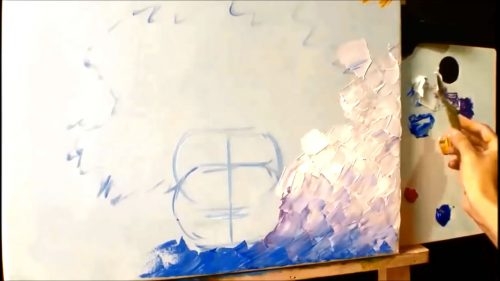
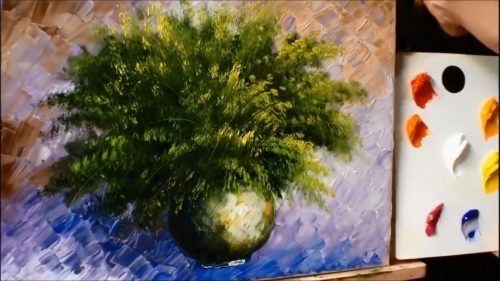
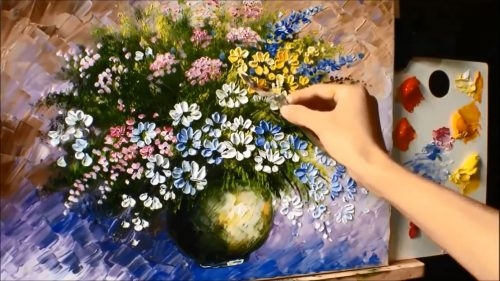
After a preliminary study, you can now start doing our actual painting. Here you will apply the simple technique you have learned on a large scale canvas. You’ll start by drawing a simple vase. The colors and shapes that will remain on the back panel when using acrylic paint are drawn first. You can create the perspective texture in this way.
What is acrylic paint? How to make acrylic paint? In general, we will discuss this in writing. This type of paint is new to the others. Quality acrylic paint is the liquefaction of dyes of pigments into the hands of silicone molecules (polymer). It is a quick and quick-drying kind. Acrylic paints are water based. In other words, it is soluble in water. but when it dries it becomes water resistant. It is possible to dilute the paint with water and it can be used like watercolor. Unlike the dyes used with other water, acrylic can not be dissolved again with water after drying. Because it is like a kind of plastic surface on the layer it covers.
Acrylic paint is a water-based paint type. It’s kind of like silicon. It features high closure and vibrant colors. The water-based feature works only as a paint dryer. Acrylic paint dries quickly and after drying shows some kind of plasticized solid. It will not be able to dissolve again with water. The paints of the artists can be diluted with water and water is used for cleaning.
What Should You Do to Buy High Quality Acrylic Paints?
If you want to buy quality acrylic paints for artists, you will notice that some colors are more expensive than others. For this reason, it is very difficult to obtain some color pigments. In terms of color, the colors are classified as “1” least expensive and “7” the most expensive. Cadmium colors can be four times more expensive, or for example the colors of the earth are the cheapest. Some brands use synthetic pigments to obtain cheap dyes, but these dyes will have a lower retention and less color intensity. Some brands are better, but the choice of which paint is a financial and personal issue.
When you want to study depth and detail in the picture, painters become the first preferred oil painting. Because acrylic is dried quickly, it is not possible to work in this way. It is possible to retard the drying of acrylic paint. This gives you the ability to work like oil painting. It can slow down drying time by several weeks. Occasionally oil can be mixed with oil to slow down the acrylics. Open acrylic is a suitable solution for those who want to replicate oil with acrylic.
How to make acrylic paint?
How to make acrylic paint?
Acrylic paints are initially designed for use in homes. Silicone-based plastics paints your walls are also produced with similar techniques. Suspension of polymer microparticles (small colored silicone particles) in water is a process. They are waterproof. Exterior paints are also acrylic. The first varieties were produced around 1940’s. If you look carefully, the chemistry industry has taken a course parallel to the development of the industry.
In Perspective Drawing You Draw What You See From A Specific Viewpoint, Not Your Idea Or Mental Image Of The Subject
We think of a table, generally, as being rectangular with parallel sides, and of dishes as round. Children, beginners, and some sophisticated artists will draw them this way regardless of viewpoint (left) — children because they lack visual perception, artists because they wish to express the true essence and primary % nature of the subject. Both, though, are doing the same thing — they are drawing their idea or mental image of the subject. The true appearance of dishes on a table would be elliptical shapes on a converging, foreshortened surface (right).
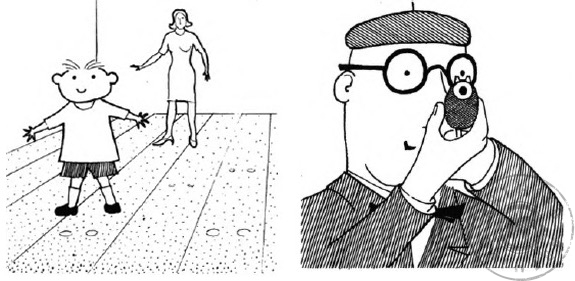
The beginner, drawing a front view of the face, would tend to draw the idea of a nose (left) instead of its foreshortened appearance. The same tendency created this unrealistic eye in side view (right). Again the idea was drawn instead of the true appearance.
Wave your fist at someone across the room, 15 or 20 ft. away. A beginner, thinking only of the true sizes of hands and people, would probably tend to draw the scene this way (left). But the careful observer would notice that the hand was almost one- third the height of the figure, and so draw it. Overlapping and value perspective help to dramatize the respective nearness and farness of these elements.
To a seated observer, a child close by and an adult further away might appear this way, and should be drawn this way. Your intellectual idea of the relative heights of children and adults might suggest differently. A rifle pointed directly at your eyes might not appear very frightening at first, for you hardly see the lethal, yard-long weapon.
Examples of reality and perspective in perspective drawing
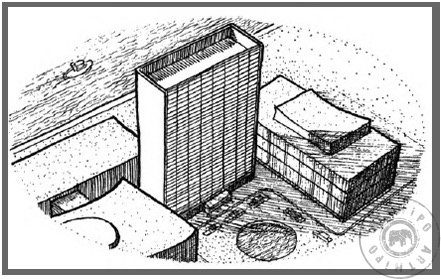
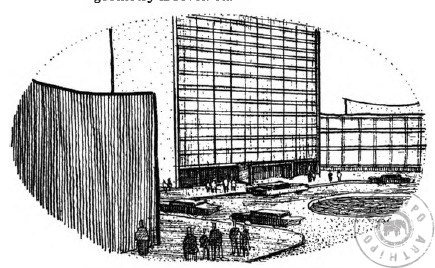
1. We all know that the U.N. tower is a simple rectangular prism whose facades are all pure rectangles. When it is viewed directly from a distance, say from across the river, this pure geometry is revealed.
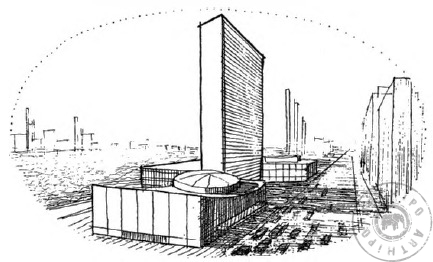
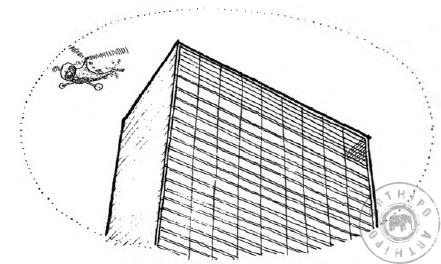
2. But when it is seen from up the river or the avenue, its facades appear foreshortened and the roof and window lines seem to converge. Only the vertical lines maintain their true directions
3. If we now come closer, and look straight ahead, we see the bottom of the building, the entrance, and the foreground. From this viewpoint the horizontal window lines still converge.
4. Upon looking up we notice that for the first time the vertical lines appear to converge (upwards). Also, the roof and window lines now converge downwards to the left and right.
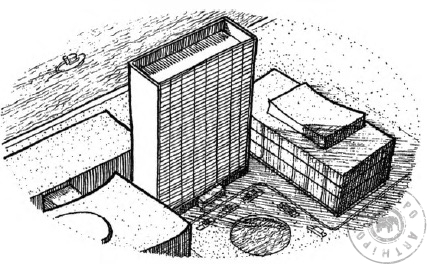
Viewed from a helicopter, the roof and facade rectangles again converge and foreshorten. But here vertical lines converge downwards, while horizontal lines point upwards.
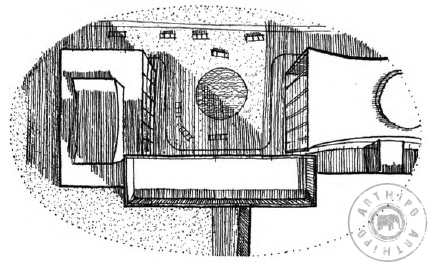
From directly above, only the rectangle of the tower’s roof is seen. This barely expresses the building’s form. Adjacent buildings with converging facades are more comprehendible.
Reality And Appearance Example: Park Bench From Different Viewpoints
1.In reality, this bench is composed of simple rectangular prisms. A boy climbing a tree would have this rare view of its true geometry
2. His parents at ground level might have this view. The horizontal and vertical lines appear to converge and all surfaces are foreshortened. (The vertical lines give a sense of vertically but they are not actually parallel to the edge of the page.) Note that this viewpoint is more revealing than the first
3. Junior, who is only 3 ft. tall, would see it still differently. The verticals now appear truly vertical, while the horizontal lines still converge.
4.If Junior walked around the bench and looked at the end head-on, the true geometry of the end rectangle would appear. The bench top, though, would strongly converge and foreshorten. Notice that the horizontal as well as the vertical lines of the end maintain their real directions.
5.This “worm’s eye” view, which one might get by falling on the ground and looking up, offers a unique picture of the bench. The subject is rarely drawn from this (or the first) viewpoint since it is rarely seen this way.
OVERLAPPING: This obvious and very simple technique not only shows which objects are in front and which are in back — it’s also a very important way of achieving a sense of depth and space in drawings. Notice the depth confusion when overlapping does not exist {right).
Overlapping SHADES AND SHADOWS:
Naturally the shape and structure of three-dimensional objects can be understood only when viewed in some form of light. But it’s really the shades and shadows created by this light that render the shapes “readable” and discernable. So working with light, shade and shadow will dramatically help to give a drawing form and a sense of the third dimension.
Color And Value Perspective
Values (black to white range) and colors are bright and clear when seen close up but become grayer, weaker, and generally more neutral as their distance from the observer increases. Detail And Pattern Perspective Details, textures and patterns, such as blades of grass, the bark of trees, leaves, the distinguishing features of people, etc., are also clear and discernable when close but become “fuzzier” and less sharp when further away. These principles are rarely discussed in perspective books yet they suggest useful techniques for increasing the sense of depth and space in a drawing.
Focus Effect
This principle is worth noting despite the fact that only a few artists apply it in their work. The eye looking at a distant object will focus at that object’s range; things in the foreground, consequently, will be “out of focus” and therefore blurred. For example, a distant steeple seen through a window might appear something like this. Such a blurred foreground-clear background effect might be used to emphasize the center of interest as well as the sense of depth.
Conversely, when the eye focuses on foreground objects the background will appear blurred and unclear. (This principle is rarely used because artists drawing a view such as this will focus back and forth in order to see and draw all parts clearly. Yet if emphasis or a “spot light” effect were desired this “truth” of seeing could well be applied.)
No Passing, by Kay Sage. Collection of Whitney Museum of American Art, New York
Two professional examples, a painting and a landscape drawing, employing the fundamentals of DIMINUTION, FORESHORTENING, CON- VERGENCE, OVERLAPPING, SHADE AND SHADOW, VALUE PERSPECTIVE, PATTERN PERSPECTIVE, etc., to achieve a sense of space and depth.
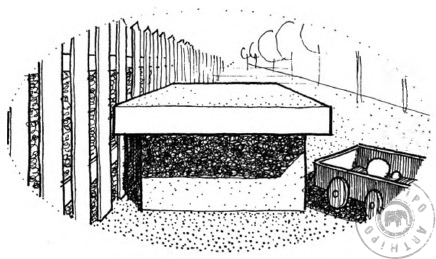
Memorial Park. Joseph D’Amelio, Architect. Don Leon, Associate. Rendering by Joseph D’Amelio