


Hellenistic art history has led to many works and currents of thought in Europe and Anatolia. Hellenistic (Ancient Greek) art history is a culture that includes many important people from Socrates to Pythagoras, from mathematics to philosophy.
Hellenistic (Ancient Greek) Art History
Hellenistic (Ancient Greek) art history; It is the period denoting Ancient Greek art, covering the period beginning with the death of Alexander the Great in 323 BC and ending in 146 BC, when the Greek mainland was taken by the Romans. It follows the period of classical Greek art. The Greco-Roman art that followed was largely a continuation of Hellenistic trends. The term Hellenistic refers to the spread and expansion of Alexander’s ideas after his death. The concept of the Hellenistic World covers a large time span at the same time, with Athens and Sparta, the focused cities of classical Greece, rather than the area spanning both sides of the Aegean. From an artistic point of view this means that there is great variety, often put under the heading “Hellenistic Art” for convenience.
One of the defining features of the Hellenistic period was the division of the empire founded by Alexander into small dynastic states.
Alexander was surrounded by three artists: the sculptor Lysippus, the painter Apelles, and the jewel-cutter and engraver Pyrgoteles.
After Alexander’s death, the Greek wealthy were in the midst of prosperity and waste. All the rich were spending their money on art and aesthetics. Sculpture, painting and architecture flourished. Vase painting was of great importance. Metalwork and a wide variety of luxury arts produced beautiful works. So much so that some types of popular art have become more and more complex.
There is a tendency in historiography to portray Hellenistic art as a decadent style following the Golden Age of Classical Greece. The terms 18th century Baroque and Rococo were sometimes applied to the art of this complex and individual period. In addition to the interest in historiography, some new discoveries such as the tombs of Vergina may provide a better appreciation of the period.
Hellenistic (Ancient Greek) Architecture
In the architectural realm, the dynasties that followed Hector gave rise to vast urban plans and large complexes that mostly disappeared from city-states in the 5th century BC. The Doric Temple city model is almost abandoned. This urban planning was quite innovative for the Greek world, instead of correcting mistakes and manipulating the space, they made building plans suitable for the natural environment. In city planning, the appearance of many entertainment and entertainment venues, especially the proliferation of theaters and parks, has drawn attention. Hellenistic monarchies were advantageous in this respect as they had large areas on the Tigris where they could build large cities such as Antakya, Pergamon and Seleucia.
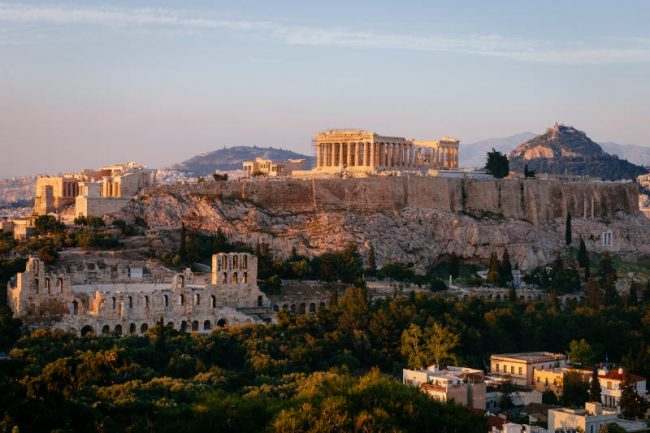
Acropolis
Hellenistic (Ancient Greek) Architecture Hellenistic (Ancient Greek) Art History
This was the time of gigantism: Miletus in Ionia (twenty kilometers from Didyma) was for the second temple of Apollo. It was designed by Daphnis, the city of Miletus, and Paionios, the city of Ephesus, at the end of the fourth century BC, but the construction, which was never completed, was only finished in the 2nd century AD.
This sanctuary is one of the largest ever built in the Mediterranean region and is surrounded by a double colonnade, about 20 meters high in a wide court, consisting of 108 lyon pillars with rich sculptural bases and capitals. The Corinthian order was used for the first time in a full-scale building with the Temple of Olympian Zeus.
Olynthus
The ancient city of Olynthus was one of the architectural and artistic keystones for connecting the Classical and Hellenistic worlds. More than 100 houses were found in the Olynthus city area. Interestingly, the houses and other architecture are incredibly well preserved. This allows us to better understand the activities that take place in the homes and how the space inside the homes is organized and used.
Houses in Olynthus were generally more square. The desired home was not necessarily large or extravagant, but rather comfortable and practical. This was a sign of civilization that was highly prominent in Greek culture during the Hellenistic period and beyond. Leading a civilized life involved maintaining a solid habitat. For this reason, many brick-like materials were used in the construction of houses. Stone, wood, adobe and other materials were generally used to construct these dwellings.
Another element that was increasingly popular during the Hellenistic period was to add a courtyard to the house. Courtyards acted as a source of light for the house, as Greek houses were sealed from the outside to maintain a level of privacy. Windows were found on some of their sites, but they are usually high above the ground and small. Due to the privacy issue, many people have had to compromise on light at home. Private areas of the house are dark and closed, while well-lit areas were used for entertaining or more public events.
Courtyards were often the focal point of the house, as they provided a fun space for the house and a source of light from within the house. It is most often paved with cobblestones or pebbles, but there have been discoveries of courtyards with mosaics. Mosaics were a great way for the family to express their interests and beliefs, as well as a way to add decor to the home and make it more visually appealing. This artistic touch to the homes in Olynthus also brings another element of civilized life to this Hellenistic society.
Pergamon, Hellenistic (Ancient Greek) Art History
Especially Bergama is a characteristic example of Hellenistic architecture. Starting from a simple castle located on the acropolis, various Attalid kings built an enormous architectural complex. The buildings are ventilated around the Acropolis to account for the nature of the land. Located to the south on the lowest terrace, the agora is bordered by galleries containing pillars (columns) or stoai. It is the beginning of a street that crosses the entire acropolis: it separates the administrative, political and military buildings on the east and top of the rock from the sanctuaries to the west, the most prominent among them, at mid-height. It houses the monumental Pergamon Altar. Known as the “twelve gods” or “gods and giants”, one of the masterpieces of Greek sculpture. A huge theater that can hold around 10,000 spectators has benches embedded in the sides of the hill.
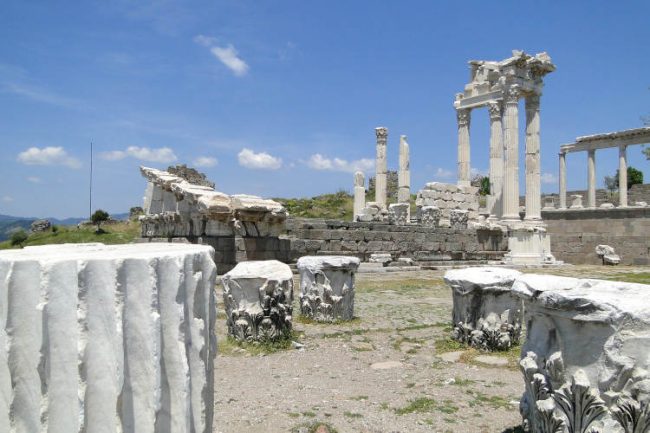
Hellenistic (Ancient Greek) Art History
Pergamon
Hellenistic (Ancient Greek) Sculpture Art
According to Old Pliny’s assessment, Cessavit deinde ars “then art disappeared”, in his book where he describes sculpture from the classical period, the sculpture declined significantly after the 121st Olympiad (296-293 BC). This was followed by a period of stagnation, a brief revival after 156 (156-153 BC), but nothing remained by the standard of previous times.
During this period, sculpture became more natural and expressive, and there was an interest in depicting extreme emotions. The Hellenistic artist sought to represent the character of his subject, including themes such as pain, sleep, or old age, along with anatomical realism. Ordinary people, women, children, animals, and types of domestic scenes became acceptable subjects for sculpture commissioned by wealthy families to adorn their homes and gardens.
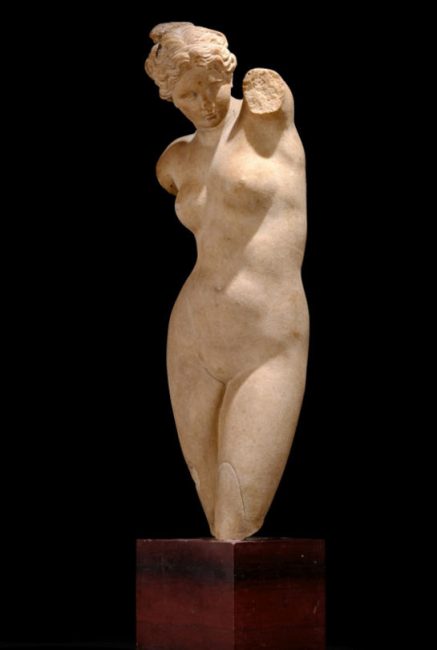
Hellenistic (Ancient Greek) Sculpture Art Aphrodite
Realistic portraits of men and women of all ages were produced, and sculptors no longer felt compelled to portray people as ideals of beauty or physical perfection. But seldom full-size sculpture, previous vase painting and figurines had been depicted. Many artifacts specific to Hellenistic art can be seen in the Istanbul Archeology Museum.
The drunken Munich woman was animated by the reservation without being old, thin, exhausted, holding herself a jar of wine.
For this reason, he draws attention with his period portraits. One of them is the Barberini Faun of Munich, which represents a sleeping satyr, perhaps the prey of nightmares, with a relaxed posture and a worried face.
Another famous Hellenistic portrait is Demosthenes of Polyeuktos, with a well-made face and wiped hands. Another phenomenon of the Hellenistic age, privatization occurs in sculpture. This technique is seen in the repetition of old public patterns in decorative sculpture.
The portrait is full of naturalism under the influence of Roman art. The new Hellenistic cities were spreading all over Egypt, Syria, and Anatolia, requiring statues depicting the gods and heroes of Greece for their temples and public places. Again, The Statue of Zeus at Olympia is an important work of Hellenistic sculpture. This has made ceramics sculpture like an industry, with consequent standardization and some quality declines. For these reasons, more Hellenistic sculptures have survived than in the Classical period.
Second Classicism Period
Hellenistic sculpture repeats the innovations of the “second classicism”. The nude statue inside this tour was enhanced by the effects of the transparency of the veil and clothing, and the flexibility of poses, while allowing the statue to be admired from every angle. Thus, Venus de Milo is distinguished by the bending of her hips, even when echoing a classic model.
Baroque
The multifigure sculpture group was a Hellenistic innovation, possibly dating from the 3rd century, that took the epic battles of earlier temple pediment reliefs from their walls and installed them as life-size groups of sculptures. Their style was often referred to as “baroque”, with exaggeratedly bent body poses and intense facial expressions.
Hellenistic (Ancient Greek) Art History Article.