Leonardo Da Vinci, The Last Supper
- Categories: Art Movements, Classicism
- Fashion, Historical, Mystic, Renaissance Paintings, Canvas Prints
- Stock: In Stock
- Model: LDV1-ht5025-ayzld
- MPN: 340000414314

Leonardo Da Vinci, The Last Supper
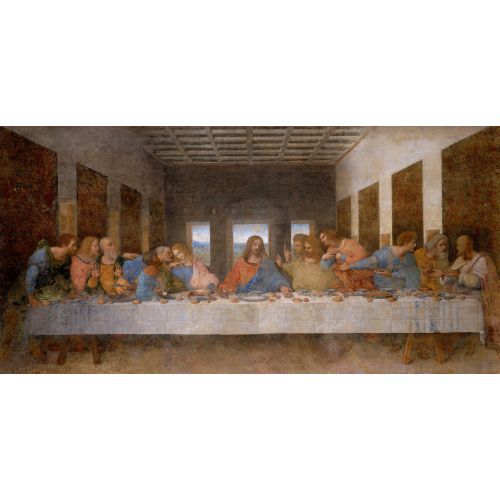
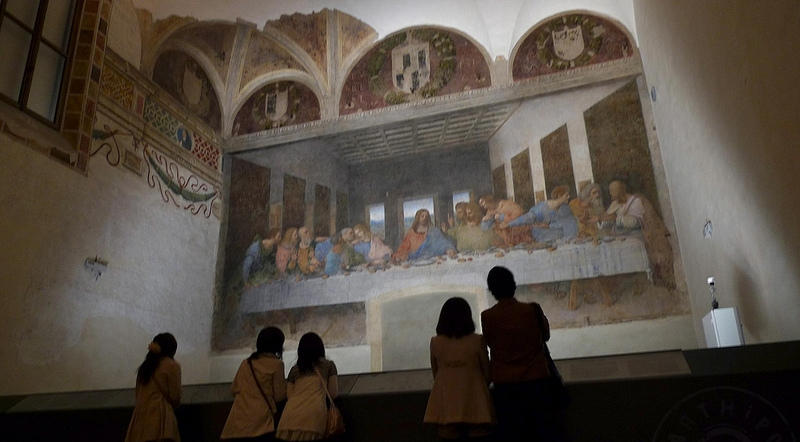
Leonardo da Vinci's Last Supper (original name Cenacolo, English The Last Supper) painting is the most mysterious work in the history of world art. Leonardo da Vinci, who was often assigned to Milan, the period coincides with the 1480s, his works in this period revealed painting, three-dimensional proportions, transitions, use of light, and paintings with a slight aurora in works such as the Virgin of the Rocks. In 1495, Ludovico commissioned Leonardo da Vinci to paint "The Last Supper" on the back wall of the refectory in Milan's Santa Maria delle Grazie Monastery.This fresco of the Last Supper (Cenacolo), located in the dining hall of Santa Maria delle Grazie in Milan, measures 9.10X4 20, cracked all over half a century later, the paint was peeled off, and the work fell into a utterly terrible state with the repairs of incompetent hands. Today, nothing but shadow-like figures can be seen in this work in its final form. However, on the other hand, there are copies made by Marco d'Oggione, one of Leonardo's apprentices, in 1510, when the original was in all its glory; The copy in the Louvre museum in Paris and the copy in the Fine Arts School in London are forgiven to this painter.
The Story, Secrets of The Last Supper By Leonardo Da Vinci
At least as famous and talked about as the Mona Lisa, Leonardo Da Vinci's work called The Last Supper. The story of the last supper . The people at the last supper , who is who . Which is Judah? What is the secret of the last supper? We will touch on subjects such as the examination of the behavior and attitudes of Jesus Christ and his Apostles at the Last Supper.
The Last Supper depicts Jesus Christ's last supper with his 12 Apostles before his capture by Roman soldiers. In front of a long dinner table, we see the 12 Apostles in groups of three each to the right and left of Jesus. Christ said: Truly I say to you, one of you will betray me; This word had a profound effect on the apostles. The echoes of this influence can be seen in the movements that break from left to right and in the different expressions of the faces. Each apostle took a different attitude according to his temperament. Someone: Oh, am I the Messiah? he put his hands on his chest, as if to say; another bends over to ask if he can hear well, some repeat Jesus' word to one another with suspicion and fear.
Group immediately to the right of Jesus, from left to right: Thomas, James the Great, and Philip. Thomas's hand is probably a reference to the event of Jesus' ascension. James the Great spread his arms in disbelief at the announcement that Jesus would be betrayed before nightfall. Here, he caught the moment when they asked, "Lord, you didn't mean me?" mentioned in the Bible (Matthew 26:22).
From left to right; Matthew, Judas, and Simon. Matthew tells Simon that he was amazed at Jesus' words and did not want to believe it, by showing him with his hands. Judas is of the same mind. Leonardo Da Vinci has reflected the atmosphere of these people, who are talking, shouting, and telling each other excitedly, with their facial expressions, in this painting.
Finally, instead of walking away crouching pitifully like Giotto's frail little Jew, Judas casts a deep evil eye on those sitting around the table, trying to understand whether the word that fell from Jesus' mouth was understood, whether there was any danger to him. The word that fell on the table like a lightning bolt turned into rebellion in some faces, trust and sadness in others, and doubt and fear in others. In the work, an organic unity stands out in a great change.
Jesus
Leonardo wanted to show the different reactions that the word falling from Jesus' lips aroused in the souls of the Apostles of different creation, with facial expressions and body movements, and then to keep each Apostle alive in the most beautiful form that suited his character. As a matter of fact, in Trattato della Pittura: "The figures should be formed in such a way that it is possible to easily understand what they are thinking and feeling from their postures." it certainly sums up the compositional understanding that dominates The Last Supper.
In this work of Leonardo, Jesus is seen in the middle. He is in deep sadness with his head bent forward and his hopeless hands falling on the dinner table. The head of Jesus falls into the large window at the back, which opens to a supernatural landscape. Thus, Leonardo not only got rid of that luminous circle, which is customary to put on the heads of prophets and saints, but also gave him the distinguished place worthy of the Messiah, by enclosing the head in a frame of light, without doing anything.
Ghirlandajo had separated Judah from the Apostles like a plague, as if he did not know about the betrayal, and seated him on the opposite side of the table. Yet, with astonishing courage, Leonardo puts Judas next to Yohanna. We understand that he is a traitor, not from his being left alone as in Ghirlandajo, but from his head thrown into the shadow. Judas turning away from the light is not the result of an invention, but of a very natural act, a startle in the face of Saint Peter's violence. Leonardo knew how to prepare a very natural reaction while shading the abomination of Judas so as not to cloud the sanctity of Jesus. Thus, the head of Jesus, framed by the light, and the head of the traitor, covered by shadow, provide a unique balance, both dramatic and plastic.
What is the Secret of Leonardo Da Vinci's Last Supper Painting?
Does the lineage of Jesus continue? This is the mysterious debate about the painting. It is a topic that has become very popular with the novels of Dan Brown. Is it the apostle John sitting to the right of Jesus, or is it Mary who is allegedly married to Jesus? The Catholic Church claims that this person is John the Apostle. As a matter of fact, it is clearly seen that Saint John is in all the other Last Supper paintings depicted by other artists. So the person is different in Leonardo da Vinci painting? Twelve dedicated male apostles could be the perfect story for a patriarchal church narrative. However, da Vinci seems to have drawn a woman in radical movement, and this woman looks like Jesus. They are like a couple in love. You will find that there is an equilateral triangle between Jesus and this person. It's like he's on the same familial level as Jesus. There is also a baby figure of Judas' shoulder and arm. Is all this a coincidence? Maybe. However, these coincidences were drawn by one of the most genius names in world history, Leonardo da Vinci. Of course, these inferences are strongly rejected by the church.
Leonardo Da Vinci, Why Was The Last Supper Drawn?
The story of the Last Supper painting: In the painting are Christ and his Twelve Apostles. One of his disciples whispers in his ear that he is about to be betrayed. It takes Da Vinci three years to finish this work, and it captures the drama of the last supper in an extraordinary way. The expressions and stances of those present at the hall and dinner, which gives the impression of being somewhere in the sky, seem to sense what is going to happen. Da Vinci designed many works for holy places: a dome design for Milan Cathedral is one of the highlights.
The Last Supper painting is known as the last supper of Jesus before his capture and crucifixion. However, the positions and body languages of the apostles gathered around show that the situation is not so simple. It is felt that the apostles will betray him or, in other words, leave him alone. The presence of wine and bread as food on the table symbolizes that this will result in rebirth.
Features of the Last Supper in Terms of Painting Techniques
His narrative of simultaneous activity culminated in Leonardo's masterpiece The Last Supper. Explaining the movement so perfectly was not only a task to be done by observing nature, but also knowledge of mathematics and physics was equally necessary. In The Last Supper, he applied the rules of linear perspective, in which objects appear proportionally smaller as if they were in the eye of the audience, distant objects gradually lose their effect, blend into each other and gradually take on a gray tone.
Normally frescoes at that time were painted on wet plaster, but Leonardo Da Vinci rejected this traditional technique for various reasons. The main reason for rejecting this technique was that he wanted more vivid colors. In order to draw every detail perfectly, da Vinci invented his own technique, used tempera paints on stone, developed a special primer against moisture. But this technique failed, after fifty years the rotting paint flaked off and the Last Supper lost its former glory. Restoration operations made the situation worse. The bombardment that took place during the 2nd World War left serious damage on the artifact. The restoration, which started in 1980, took twenty years.
Restoration
For the work found on the wall of a monastery in Milan, frescoes were normally painted on wet plaster, but Da Vinci rejected this traditional technique for various reasons. The main reason for rejecting this technique is that he wanted to achieve more vivid colors. In order to draw every detail perfectly, da Vinci invented his own technique, used tempera paints on stone, developed a special primer against moisture. But this technique failed, after fifty years the rotting paint flaked off and the Last Supper lost its former glory. Restoration operations made the situation worse. The bombings that took place during the 2nd World War left serious damage to the painting. As a matter of fact, the restoration that started in 1980 took twenty years.

Details in the Painting
Thomas stands with his index finger raised. Some thought it made sense that this movement was portrayed so strongly. Is he trying to tell you that he has only one day left? This raises strong doubts that Jesus himself knew what was to come. Immediately in front of him, the hand of the apostle reaches Jesus' shoulder for comfort. Of course, the dignity of Jesus is striking.
Where Is Leonardo Da Vinci's Last Supper Painting?
First of all, let us state that the Last Supper is not a painting, but a fresco on the wall. So where was it drawn on the wall? Where is the last supper? This fresco of the Last Supper (Cenacolo), in the dining hall of Santa-Maria delle-Grazie in Milan, measures 9.10X4 20, cracked all over half a century later, the paint was peeled off, and the work fell into a utterly miserable condition with the repairs of incompetent hands.
Other Versions of The Last Supper by Other Painters
Today, nothing but shadow-like figures can be seen in this work in its final form. However, on the other hand, there are copies made by Marco d'Oggione, one of Leonardo's apprentices, in 1510, when the original was in all its glory; The copy in the Louvre museum in Paris and the copy in the Fine Arts School in London are forgiven to this painter.
Giotto, Andrea del Castagno and Ghirlandajo had also dealt with this subject before Leonardo. Although all three of these three painters are valuable separately, as it can be understood from the comparison of their works, the artistic power of none of them is in a position to overcome the difficulties required by this subject. Giotto's solemn and magnificent composition was rigid; The apostles, standing upright and lifeless on a single line, do not show an excitement that will resonate with the souls, neither with their movements nor with their expressions; each seems immersed in his own world, as if he had not heard the words of Jesus. In Ghirlandajo's work, the noblely dressed persons are somewhat different, but there is not yet psychological unity.
If these works are compared with Leonardo's Genacolo, the miraculous progress achieved by the art of painting is immediately striking. Leonardo breaks all ties with the traditional painting of the fifteenth century, without mistake or surprise; without exaggeration, in one leap, he moves away from both blind imitation and an empty and fanciful idealism, arriving at a realism based on observation and creativity, which we can call psychological.
In Leonardo's work, as in the works of Giotto and Ghirlandajo, the people are on the same horizontal line against the audience. As such, Leonardo showed great ingenuity, while remaining in the same plane.
What Makes The Last Supper So Famous?
To some of us, why is Last Supper so famous? A question may arise. In The Last Supper, not a single person can be shown who plays a simple decorative role, muddying the dramatic air. The more people there are, the more tragedies there are. Emotions that clash with each other and intensify each other create a collective excitement. Few works of art show that the composition is as organic as The Last Supper.
Leonardo Da Vinci, The Last Supper Painting Oil Paint Reproduction, Canvas, Drawing Paper Printing, High Resolution Image Download
Leonardo Da Vinci‘s works are drawn by master painters as oil painting reproductions. We also sell canvas prints, art drawing paper prints, and high resolution image (picture). Canvas is printed on high quality linen using original interior paints; prints have vibrantly colored and realistic. Optionally, oil paint brush effects are made on canvas sales. Drawing paper prints is done on 250 grams thick paint paper. Our art experts perform quality control for artistic aesthetics before products are shipped to the customer.
MUSEUM PRINTS

Canvas Prints
Canvas print artworks are created by printing high-resolution images onto linen canvas fabric. They offer a long-lasting, aesthetic, and economical alternative. Arthipo produces famous paintings with high-quality materials and paints, staying true to the original. For those who wish, an oil painting effect can be added with brushstrokes. The artworks are delivered ready to hang, with wall-mounting hardware included.

Reproduction Painting
A reproduction painting is a hand-made recreation of a famous artwork, crafted in fidelity to the original. Each piece is drawn by a professional artist. The artists use high-quality canvas and oil paints to create each painting individually. After completion, the artwork is reviewed by art consultants. These paintings are museum-quality and shipped worldwide.

Fine Art Poster Print
Fine art prints on paper require special techniques to closely match the colors and details of the original artwork. For this process, high-GSM textured art papers and pigment-based inks of archival quality are used. The prints are produced using state-of-the-art digital machines, applied flat without bending or damaging the surface of the paper. The result is both aesthetically pleasing and suitable for archival purposes.

Framed Artworks
Framed canvas and fine art posters are the most elegant way to bring artistic style to your walls. Produced with high-quality printing techniques, these products add a refined artistic touch to your decor. They are offered with a variety of frame styles to suit both modern and classic tastes.

High-Resolution Digital Files
Files in 300 DPI or higher resolution are color-corrected, light-balanced, and contrast-adjusted by graphic specialists. High-resolution artwork or poster files can be purchased via Arthipo by selecting “download” on the product page and are delivered via email after purchase.
Packaging
Products are securely packaged. Framed and canvas artworks are shipped in protective boxes, while fine art posters are rolled and shipped in sturdy cardboard tubes.

Delivery
Fast delivery worldwide with "DHL Express". Arthipo guarantees delivery and product quality.