

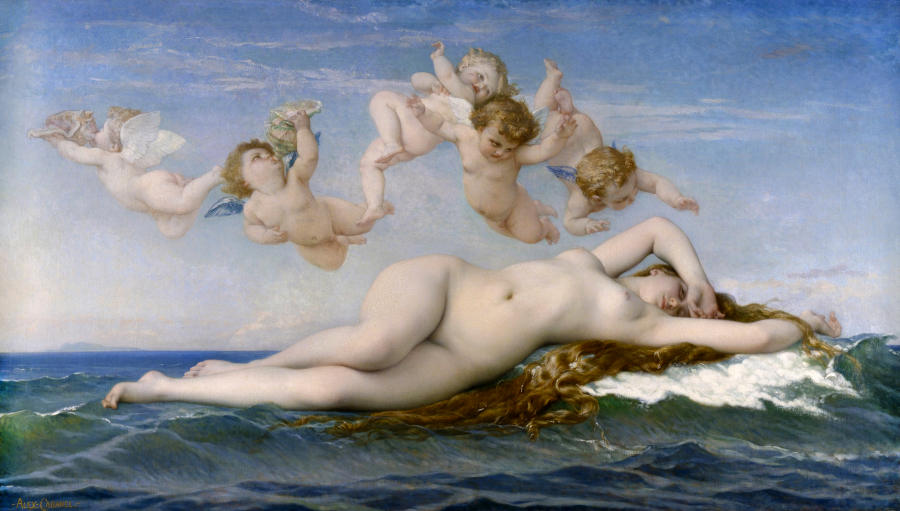
Venus Goddess, Aphrodite
The Venus Goddess was a major Roman goddess primarily associated with fields and gardens as well as love, beauty and fertility. He was considered the ancestor of the Roman people through his mythological ancestor Aeneas and therefore played a very important role in many Roman religious festivals and myths. Venus is very similar to Aphrodite, the goddess of love in the Greek pantheon, as many of the figures in Roman mythology are largely taken from Greek tradition.
The Story, Birth and Other Names of the Venus Goddess
Venus, or first called Aphrodite in Ancient Hellenistic culture, was a primordial creature said to have been born from an eternal black night before the beginning of the world. Ancient Greek poets and mythmakers told this gruesome tale of its origins; The earth goddess Gaia, fed up with her eternal, joyless mating with her husband and son, the sky god Ouranos, persuaded one of her other sons, Kronos, to take action. Kronos frantically cut off his father’s phallus and testicles with a sickle, then threw them into the sea. When the bloody organs hit the water, the water began to boil with foams. And then something magical happened. From the bubbling sea smoke “a terrible and beautiful girl” rose, the goddess Aphrodite, the birth of Aphrodite. This scorching, bloody mass began to roam the Mediterranean, from the island of Kythera to the port of Paphos in Cyprus. But despite her violent and salty beginning, the young goddess witnessed a miracle as she emerged from the sea to the barren, dry land, green shoots and flowers sprouting from under her feet.
This is a story with some variations. This supreme power, born of abuse and suffering, is described to us not only as the goddess of mortal love, but also as the god of both the cycle of life and life itself. Associated with gardens and fields, she began as a minor agricultural god of ancient Italy. Temples were built for Venus in several Latin cities.
As the ancient Romans became familiar with the Greek myths of Aphrodite, they increasingly identified Venus with this goddess. They also associated Venus with other foreign goddesses such as the Babylonian Ishtar. One consequence of this connection was the naming of the planet Venus, which Babylonian astronomers previously associated with Ishtar.
Early in the Middle Ages, European Christians began to view Venus as a symbol on the dark side of sensual and sexual pleasure. But in the centuries that followed, a more balanced view of Venus emerged. Like literary and artistic works, Botticelli’s Birth of Venus (c. 1482) depicts her as the embodiment of feminine beauty and fertility.
Venus in Roman mythology, Aphrodite (Aphrodite) in Greek mythology, Turan in Etruscan mythology. Inanna in Sumer, Ishtar in Akkad, Astarte, the goddess of fertility of Canaan in Palestine, Asheret, Astorah and Asere in Israel are the names of Venus carrying the fertility cult in history.
The Story of Venus Goddess, Birth of Aphrodite and Other Names, The Importance of Venus and Its Effects on Art

Venus Goddess Aphrodite, The Story, Birth and Other Names of the Venus Goddess The Importance of Venus and Its Effects on Art
The Importance of Venus and Its Effects on Art
Although Venus is no longer widely worshiped, it has had a lasting impact on the Western world. As a goddess of love and lust, Venus remains in the Western consciousness as another important link in the historical chain of erotic female figures in ancient mythology, which includes the Scandinavian goddesses Frigg and Freyja, the Mesopotamian Ishtar, the Syro-Palestinian Astarte. As the personification of beauty, Venus has inspired a number of famous images throughout history as well as many contemporary ones, and as such has become one of the most identifiable images of the goddess in the western world.
Considering Venus is the personification of beauty and sexuality, it is not surprising that Venus is a common subject of classical, medieval and modern art. Roman and Hellenistic art produced many variations on the goddess, often based on Praxiteles’ most famous statue, Aphrodite of Cnidos. Many female nudes from this period of sculpture, whose original subjects are unknown, are traditionally referred to as “Venuses” in the history of modern art. Examples of such work include the famous Venus de Milo (130 BC), Venus de’ Medici, the Capitoline Venus, and Venus Kallipygos, a form of the goddess popular in Syracuse. Over time, the generic term venus came to refer to any post-classical artistic depiction of a nude woman, even when there was no indication that the subject was a goddess.