


The Hermitage Museum is an art and culture museum located in Saint Petersburg, Russia. The Hermitage Museum, one of the largest and oldest museums in the world, was founded in 1764 by Czarina II. It was founded by Katerina and opened to the public in 1852.
Hermitage Museum History, Architectural Structure, Artifacts
It was founded in 1764 by Catherine the Great as a court museum. It was adjacent to the Winter Palace and served as a private gallery for art collected by the empress. During the reign of Nicholas I, the Hermitage was rebuilt (1840–52) and opened to the public in 1852. After the October Revolution of 1917, the imperial collections became the public domain, and the museum was expanded in the 1920s as artworks were solicited from private institutions. collections. In 1930-34, during the pressure of rapid industrialization, some masterpieces were sold by the Soviet government to secure purchases of industrial machinery from the West. The museum’s collection of European art from the late 19th to the early 20th centuries, It was significantly expanded immediately after World War II. The museum is now housed in five interconnected buildings, including the Winter Palace (1754–62) and the Small, Old, and New Hermitage Sites.
The Hermitage collections include nearly three million items dating from the Stone Age to the present day. Among them is one of the world’s richest collections of Western European painting since the Middle Ages, including many masterpieces by Renaissance Italian and Baroque Dutch, Flemish and French painters. Russian art is well represented. The Hermitage also has extensive collections of Asian art; Particularly noteworthy is the Central Asian art collection.
Hermitage Museum Architectural Structure, Interiors
The complex consists of the Menshikov Palace Building, the General Staff Building, the Great (Old) Hermitage, the Hermitage Theatre, the New Hermitage, the Small Hermitage and the Winter Palace buildings.
Menshikov Palace
Menshikov Palace on Vasilyevsky Island was one of the first buildings in Saint Petersburg. Construction began in 1710 and was completed in 1727 due to a multi-stage construction process. Many Western European architects and masters have been involved in projects, including Francesco Fontana, Johann Gottfried Schädel, Domenico Trezzini, Carlo Bartolomeo Rastrelli, Georg Johann Mattarnovi and Jean-Baptiste Leblond.
The palace is an outstanding example of Petrine Baroque architecture, with its characteristic symmetry and simplicity of dimensions, high gabled roofs, two-tone façades and small glass windows. The outer walls are adorned with columns, and at the top of the risalites of the central building are shields with enormous magnificent crowns. The grand entrance takes the form of a stone portal accentuated by a portico with a balcony above it.
The rooms are decorated using marble, decorative paintings and moldings, sculptures, carved and inlaid wood, Dutch cobalt tiles and Russian glazed tiles, painted and embossed leather, and expensive drapery and tapestries. A. D. Menshikov, the first governor of Saint Petersburg, placed his collections of painting, sculpture, applied art, books and numismatic works in his grand palace.
The original Petrine interior of the Menshikov Palace was recreated in the exhibition “Russian Culture in the First Third of the 18th Century” using decorative and applied art from the State Hermitage collection.
Dvortsovaya Square. General Staff Building View
One of the most famous architectural monuments in Saint Petersburg, the General Staff Building was designed by architect KI Rossi and was built between 1820 and 1830. The project revolved around the architect’s idea of combining two separate buildings with a triumphal arch, a monument. To the victory of Russia in the war of 1812. This magnificent arch is a symbol of Russia’s glory and military glory; Forms an ax symmetrical with the central part of the Winter Palace.
The appearance of the General Staff Building has a certain strictness and conciseness. The lower floor is interpreted as a rustic basement, while the walls of the upper two floors are smooth. Modest cornices and architraves surround the windows of the third floor (Pass floor). Smooth walls clearly accentuate the raised frieze, and three Corinthian colonnades divide the building’s 580-metre length.
The eastern wing of the General Staff Building originally housed the Ministry of Finance, the Ministry of Foreign Affairs and several other ministries of the Russian Empire. From 1917, different institutions and organizations occupied the building, including the People’s Commissariat for Foreign Relations; The General Staff was located in the western flank, but nowadays it is the headquarters of the Western Military District.
Reconstruction of the General Staff Building started in 2008 and ended in 2014. The five large atriums were enclosed with glass roofs, thus creating the New Great Enfilade. After the restoration, the building displayed collections of Russian and European decorative art, paintings and sculptures from the 19th and 20th centuries (including Impressionist and Post-Impressionist paintings, Matisse and Picasso), and contemporary art. The exhibition includes the renovated historic interiors of the Ministry of Foreign Affairs of the Russian Empire and the personal apartments of Chancellor Count Karl Nesselrode.
The Great Hermitage Front. View from the Dvortsovaya embankment
In 1771-1787, by order of Empress Catherine II, a new building was built next to the Small Hermitage on the Neva River embankment. It was called the Great Hermitage because it was larger than the Small Hermitage and was supposed to house the palace collections and the library. Architect Yuri Velten managed to fit the new building into the existing palace complex. The simplicity and simplicity of the Great Hermitage followed the canons of 18th century Classicism. Although there are no elements showing the order such as columns and pilasters in the building, its structure is completely determined by the proportions of the classical order. The massive and rustic lower part of the building is offset by the lighter upper part. The decorative scheme of the facade is based on the rhythmic combination of horizontal partitions and vertical window openings.
In 1792, Giacomo Quarenghi, the Vatican built an extension to the Great Hermitage to house the Raphael Loggias, 18th-century copies of the original frescoes in Rome.
It is Italian Renaissance art exhibited in the Great Hermitage.
Hermitage Theatre. View from the Dvortsovaya embankment
In 1783, architect Giacomo Quarenghi was honored by Empress II. commissioned by Catherine to build the Hermitage Theatre; construction was completed in 1787. The balanced harmonic structure of the building makes it an outstanding example of late 18th century Russian Neoclassicism. The rustic windows of the ground floor are decorated with keystones with lion masks, one of Quarenghi’s favorite decorative elements. The cloisters of the second floor of the façade are surrounded by risalites with statues of ancient Greek playwrights and poets placed in exedra.
The auditorium has been interpreted as an amphitheater with six rows. Its walls are decorated with artificial marble and column capitals and theater masks. In the exedra, medallions bearing the profiles of famous playwrights are placed on the statues of Apollo and his muses. The stage is separated from the hall by a railing, behind which there are several rows of rows and two side boxes.
Since the 18th century, theatrical performances have become traditional and part of many celebrations. Today, shows are held in the theater and exhibitions are held in its foyer.
Front of the New Hermitage. View from Millionnaya Street
The New Hermitage was the first building in Russia built specifically to house museum collections. Emperor Nicholas I, I invited the German architect Leo von Klenze, whose work largely shaped the image of museum architecture in Europe, to come to Russia and build the Imperial Hermitage. Architects Nikolay Yefimov and Vasily Stasov, who were tasked with running Klenze’s project, made some significant changes to fit the new structure into the existing architectural environment.
The characteristic features of the New Hermitage, built in 1842-1851 in the style of Historicism, are the simplicity and monumentality of the building and the balance of architectural volumes. The entrance to the museum is accentuated by a magnificent portico supported by Atlantes figures cut from gray granite in Alexander Terebenev’s workshop. The building is also decorated with sculptures and reliefs depicting famous artists, architects and sculptors of the past. Classical, Renaissance and Baroque decorations give life to the massive surfaces of the building facades.
The rooms of the museum are designed in accordance with the collections to be exhibited here; For example, the Skylight Halls on the first floor, equipped with overhead light, housed the Picture Gallery, while the Classical architectural style decorated rooms on the ground floor housed collections of antiquities and sculptures, and various libraries. The ceremonial opening of the first art museum in Russia took place on February 5, 1852. Today, historically preserved rooms contain collections of ancient art, as well as European paintings, sculptures and decorative arts.
Winter Palace. View from Dvortsovaya Square
The elegant, monumental palace is a striking monument to the Baroque style of mid-18th century Russian art. The palace is a brilliant example of the synthesis of architectural and decorative plastic art. All facades are decorated with a two-tiered portico. Columns rise upward, forming an intricate rhythm of verticals, and this movement embraces the numerous statues and vases on the roof. The abundance of molded decoration – imaginary cornices and window architraves, mascarones, cartridges, arugula and various pediments – creates an extremely rich play of light and shadow, adding splendor to the building’s appearance.
Developing on the same architectural motif, Rastrelli brought a different structural rhythm to each of the four facades of the palace. The south façade facing the square has an official splendor. Here the architect pierced the building with three arches to create a grand entrance to the courtyard and accentuated it with vertical elements of double columns. The majestic north façade, which gives the impression of an endless row of columns, overlooks the vast expanse of the Neva. The west façade, opposite the Admiralty, resembles a rural palace composition with a small courtyard. The monumental east façade, with its massive side blocks, forms a grand presidential office and turns into Millionnaya Street, where the nobles’ mansions are located.
For 150 years, the palace served as the imperial residence. It was declared a museum after the October Revolution in November 1917.
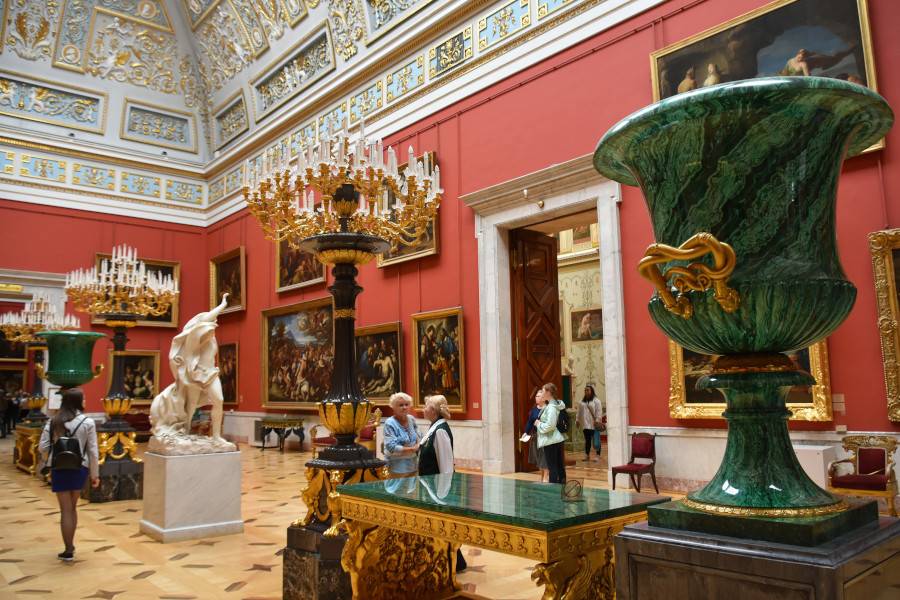
Hermitage Museum Interior
Hermitage Museum Important Artifacts
Antiquity, Eastern European and Siberian Archaeological Artifacts, Imperial Porcelain Factory Museum Collection, Treasure Gallery Collections, Arsenal Collection, Russian Art and Culture, oriental art, Numismatics, Mesopotamian Written Records in the Hermitage, collections are on display.
Some of the important works of the museum are as follows; Leonardo da Vinci – Mary and Child Jesus, Antonio Canova – The Three Graces, Camille Pissarro – Montmartre Avenue on a Winter Morning, Rembrandt – The Return of the Prodigal Son, Vincent Van Gogh – Spectators in the Arena at Arles, Rembrandt – Flora, Edgar Degas – Place de la Concorde, Leonardo da Vinci – Benois Madonna, Vincent Van Gogh – White House at Night, Giorgione – Judith
Where is the Hermitage Museum, How to Get There, Directions, Visiting Hours, Entrance Fee
Address: The State Hermitage Museum Russia, 190000, St Petersburg, Dvortsovaya Naberezhnaya 34
Museum, Tuesday, Thursday and Sunday 11:00 – 18:00
It is open on Wednesday, Friday and Saturday from 11:00 to 20:00. It is closed on Mondays.
Subway Admiralteyskaya, Nevsky Prospekt, Gostiny Dvor stations
Lines 7, 10, 24, 191 can be used by bus.
Entry must be obtained through the website.
Electronic entrance ticket 500 RUBLE
Heroes of the Soviet Union, Heroes of the Russian Federation, Full Members of the Order of Honor, Veterans of the Great Patriotic War*, members of ICOM*, staff of Saint Petersburg museums* are free for children under 7 years old.
Third Thursday of the month; Free for under-18s, students and cadets, families with three or more children under 18.