


The Sistine Chapel in the Vatican, the official residence of the Pope, was built by the architect Giovanni dei Dolci by Pope IV. The papal chapel in the Vatican Palace, built for Sixtus. It is famous for its Renaissance frescoes by Michelangelo.
Sistine Chapel History, Architectural Structure, Artifacts
The Sistine Chapel, whose real name is Cappella Magna, is named after Pope IV, who restored the chapel by architect Giovanni dei Dolci between 1473 and 1481. From Sixtus. Since then, the chapel has been a venue for religious, artistic, and civic papal events. In a religious context, the Sistine Chapel is the site of major papal ceremonies and is used by the Holy College of Cardinals to elect a new pope when there is a vacancy. Beginning in 1492, the simple brick building hosted numerous papal meetings where cardinals met to vote for a new pope. A special chimney on the roof of the chapel broadcasts the results of the meeting, white smoke indicates that a pope has been elected, and black smoke indicates that no candidate has yet won a two-thirds majority.
Sistine Chapel Architectural Structure, Interiors, Important Artifacts
The frescoes we examine here introduce us to the world of the content of Revelation. The truths of our faith speak to us in every way here. Human genius took inspiration from them to dress them in unique beauty. Holy Father John Paul II, with these words pronounced in Homily during the Holy Mass celebrated on April 8, 1994, on the occasion of the completion of the restoration of the Last Judgment, Holy Father John Paul II, St. pictures, like pictures in a book, serve to make the truths expressed in the Scriptures more understandable.
The Sistine Chapel takes its name from Pope Sixtus IV della Rovere (pope from 1471 to 1484), who restored the old Cappella Magna between 1477 and 1480. The 15th-century decoration of the walls includes: false curtains, Tales of Moses (south and entrance walls) and portraits of Jesus (north and entrance walls) and the Pope (north and south and entrance walls). It was originally made by a team of painters consisting of Pietro Perugino, Sandro Botticelli, Domenico Ghirlandaio and Cosimo Rosselli, supported by their own shops, and closer assistants among whom Biagio di Antonio, Bartolomeo della Gatta and Luca Signorelli stand out. On the Ceiling Pier Matteo d’Amelia painted a starry sky. Work on the frescoes began in 1481 and ended in 1482. This is also the history of the following works in marble: the screen, the choir stalls (where the choirmen took their places), and the papal crest door above the entrance. On August 15, 1483, Sixtus IV blessed the new chapel and dedicated it to Our Lady of the Assumption. Sixtus IV’s nephew, Julius II della Rovere (pope from 1503-1513), decided to partially change the decoration and entrusted the work to Michelangelo Buonarroti, who in 1508 painted the Ceiling and the lunettes at the top of the walls.
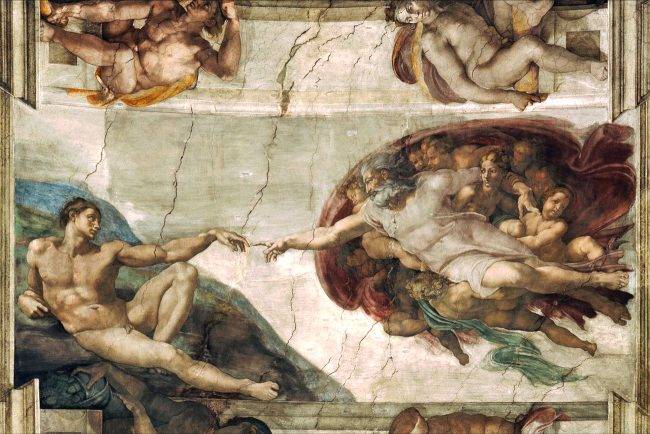
Michelangelo, Creation of Adam, Sistine Chapel
The work was completed in October 1512, and on the Feast of All Saints (November 1), II. Julius inaugurated the Sistine Chapel with a solemn Mass. Nine central panels show Stories of Creation from the Creation to the Fall of Man. The Flood and subsequent rebirth of humanity with Noah’s family. In it, the flood water is seen as a prophetic sign of the water of Baptism, from which a new humanity emerges from those saved by Christ. In the spaces between the corners, we see five Sibyls and seven Prophets seated on monumental thrones. On the pendentives at the four corners are the Miraculous salvation of Israel, and on the brackets and lunets (north and south and entrance walls) are the Ancestors of Jesus. Towards the end of 1533, Clement VII de’ Medici (pope from 1523 to 1534) commissioned Michelangelo to further alter the decoration of the Sistine Chapel by painting the Last Judgment on the altar wall. This resulted in the loss of 15th-century frescoes, namely the altarpiece of the Virgin, considered among the Apostles, and the first two parts of the Stories of Moses and Jesus painted by Perugino. In this fresco, Michelangelo wanted to show the glorious return of Christ in the light of the New Testament texts. The artist, to his powerful work, in 1536 III. It began during Paul’s pontificate and was completed in the autumn of 1541. Using his extraordinary artistic talents, Michelangelo sought to translate God’s unseen beauty and majesty into visible forms and was guided by the words of Genesis. He made the Sistine Chapel “the temple of the theology of the human body”.

Sistine Chapel Interior
The frescoes of the entrance wall were repainted in the second half of the 16th century: Hendrik van den Broeck repainted the Resurrection of Christ by Ghirlandaio, while Matteo da Lecce demolished the door in 1522. The frescoes of the Sistine Chapel underwent a complete restoration between 1979-1999. The intervention also IV. Marble pieces such as the cantoria, screen and coat of arms of Sixtus were also discussed. It is held in the Conclave Chapel for the High Pontiff selection.
Where is the Sistine Chapel, How to Go, Directions, Visiting Hours, Entrance Fee
Address: 00120, Vatican Museums, Vatican City, Rome
You can reach the Vatican museums on foot, by metro or by bus. Metro stops are Ottaviano and Cipro. The museum can be accessed with a short 8-10 minute walk.
Monday – Thursday 10:00 – 20:00, Friday – Saturday 10:00 – 22:00
closed on sundays
Entry: 17 Euro, you do not need to make a separate reservation for the Sistine Chapel ticket, you can enter the Sistine Chapel with the Vatican Museum ticket.
The Vatican has a strict dress code, no shorts, no hats, no cleavage, no bare shoulders. If you are there in the summer, there is no air conditioning and it can feel overwhelming.