


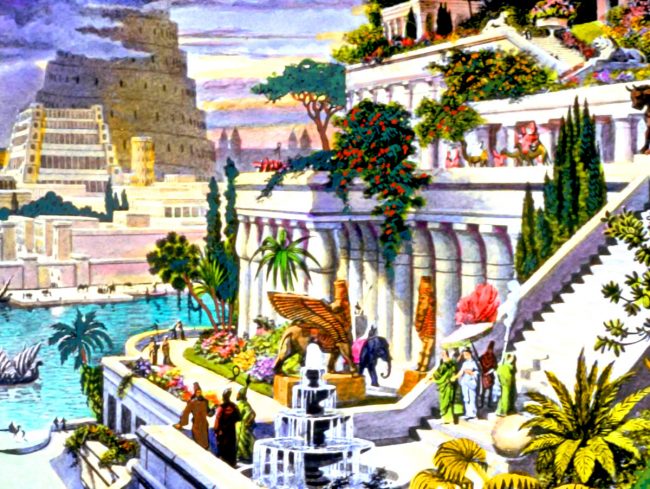
Hanging Gardens of Babylon, beautifying the capital of the Neo-Babylonian Empire, its greatest king II. They were legendary gardens built by Nebuchadnezzar (605-562 BC). One of the Seven Wonders of the Ancient World, the only ones whose existence is disputed among historians.
Where Are the Hanging Gardens of Babylon?
Concerning the whereabouts of the Hanging Gardens of Babylon, some scholars argue that the gardens were not in Babylon but in Nineveh, the capital of the Assyrian Empire, while others stick to ancient writers and expect archeology to provide positive evidence. Still others believe that gardens are only a figment of their imagination. Archeology in Babylon and ancient Babylonian texts are silent on the matter, but ancient writers describe the gardens as if they were in Nebuchadnezzar’s capital and still existed in Hellenistic times.
Where Are the Hanging Gardens of Babylon?
About 80 km (50 mi) south of modern Baghdad in Iraq, Babylon was an ancient city whose settlement dates back to the 3rd millennium BC. The greatest period in the city’s history dates back to World War II, when the city was the capital of the Neo-Babylonian Empire. It was during the reign of Nebuchadnezzar in the 6th century BC.
The Story of the Hanging Gardens of Babylon, Why Was It Made? Who Made it?
II. Nebuchadnezzar would go on to do even greater deeds, including the capture of Jerusalem in 597 BC. The Babylonian king then proceeded to make his capital one of the most magnificent cities in the world. The Ishtar Gate was built in honor of Ishtar, the god of war and love. In 575 BC, with its beautiful towers and depictions of both real and imaginary animals, its 7-20 km long brick double wall added the largest ever built and world-renowned pleasure gardens surrounding the city.

The Story of the Hanging Gardens of Babylon, Why Was It Made? Who Made it?
Babylonian king II. Nebuchadnezzar is said to have built the luxurious Hanging Gardens in the sixth century BC as a gift to his wife Amytis, who yearned for the beautiful vegetation and mountains of her hometown of Media (the northwestern part of modern-day Iran). It would take a marvel of irrigation engineering for the desert to bloom. The scientists speculated that a system of pumps, waterwheels, and cisterns would be used to extract and convey water from the nearby Euphrates River to the top of the gardens.
The Hanging Gardens of Babylon Archaeological Remains, Photos, Features
Greek and Roman texts paint vivid pictures of the luxurious Hanging Gardens of Babylon. Lush vegetation cascading like waterfalls from the terraces of the 73-meter-high garden amidst the warm, arid landscape of ancient Babylon. Exotic plants, herbs and flowers were dazzling and scents emanated from the high botanical oasis adorned with statues and tall stone pillars.
In the writings of Philo, a Greek engineer who lived around 225 BC: The Hanging Gardens were placed on a wide platform of palm beams rising on stone pillars: This trellis of palm beams was covered with a thick layer of earth and planted with all kinds of trees and flowers. a cultivation job that hangs over their heads. The wonderful nature of the gardens, besides its hanging appearance, lay in part in the diversity. All kinds of flowers, whatever is most tasteful, whatever is pleasing and pleasing to the eye, is there. The water collected high in many large vessels reaches the entire garden.”
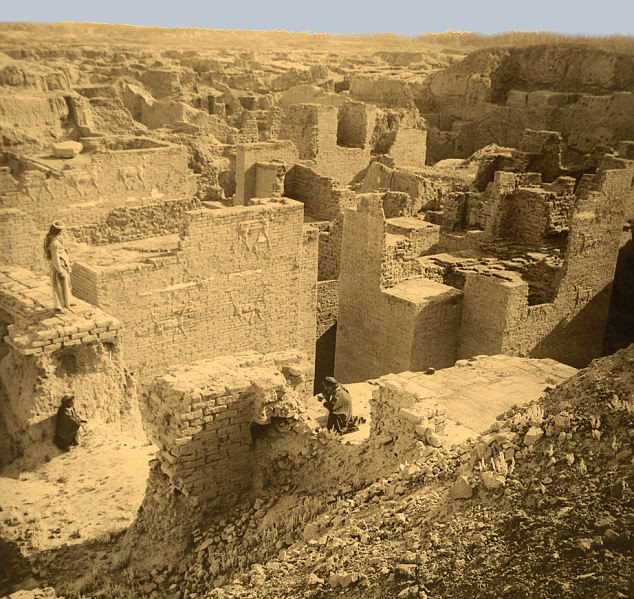
The Hanging Gardens of Babylon Archaeological Remains, Photos, Features
Diodorus, a Sicilian Greek writer, left one of the most detailed descriptions of the gardens as part of his 40-volume monumental world history Bibliothecahistoria. Like Philo, he detailed an elaborate support system for the “beams”: they “consisted of a layer of reed laid with large quantities of bitumen. On top of that, two rows of baked bricks are laid, combined with cement, and as a third layer, it is covered with lead so that moisture from the soil does not get under it. According to Diodorus, these strata rose in ascending strata, “heavyly planted with trees of all kinds which, by virtue of their great size or other attractiveness, might delight the beholder” and were irrigated by “machines which raise a great deal of water from the river.”
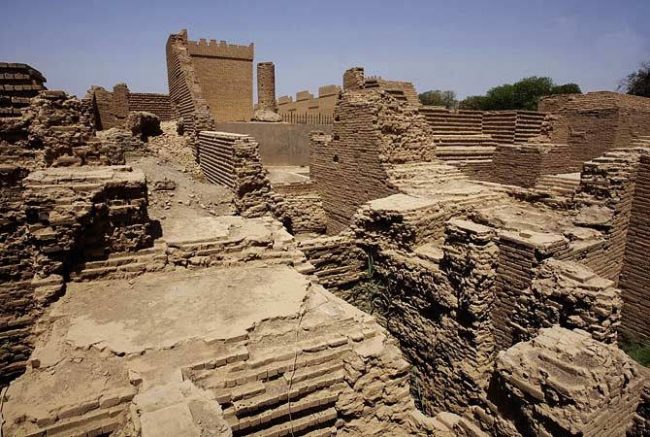
The Hanging Gardens of Babylon Archaeological Remains, Photos, Features
We know where the 7 wonders of the ancient world are, except for one. His artistic visions are inspired by the writings of various classical authors.
The exotic nature of the Gardens, their location, and the mystery surrounding their disappearance have made the Hanging Gardens of Babylon the most fascinating of the Seven Wonders.