
Wassily Kandinsky, Circles In A Circle
- Categories: Art Movements, Abstract
- Geometric
- Stock: In Stock
- Model: vk5-tp3030
- MPN: 340000345096

Available Options
Wassily Kandinsky, Circles In A Circle
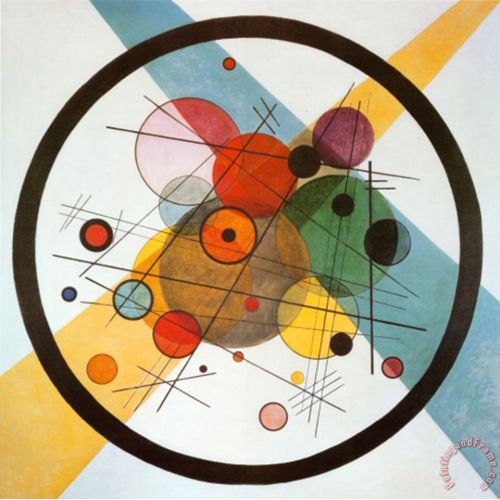
Created by renowned abstract artist Wassily Kandinsky, 'Circles in a Circle' is one of his most popular works. Developed using oil paint on canvas, this piece showcases various circles placed within an overarching circle. This geometric illustration represents Kandinsky's innovative use of forms and colours to express complex emotions.
'Circles in a Circle' was created around 1923 when the artist embraced the principles of Bauhaus design - simple shapes and primary colors. The simplistic appearance belies its deeper meaning; it explores unity (the large encompassing circle) containing diversity (different coloured smaller circles). The spectrum from cool blues to warm reds could potentially symbolize transition or evolution.
If you are interested in owning this masterpiece, 'Circles In A Circle,' high-resolution images are available for purchase as well as reproductions such as poster prints or recreated oil paintings on canvas pieces.
The Style Of Wassily Kandinsky’s Artwork
Kandisky primarily identified with two significant art movements – Der Blaue Reiter (The Blue Rider) and Abstract art.
Der Blaue Reiter movement emphasized spiritual values over materialistic perspectives capturing abstract thoughts through symbolic visuals like horses and riders.
However, ‘Circles In A Circle’ reflects more closely the latter phase: absolute abstraction devoid of recognizable imagery but still carrying strong emotional impact.This period saw him experiment extensively with geometrical figures(like squares , triangles & especially circles), lines & their relationship based on color theory--with each holding specific emotional connotations according to him.
In conclusion,Kanadinksy was indeed instrumental
in pioneering non- objective painting & communicating profound concepts through shape,color placements leading many to consider him father figure for European Abstraction.