Edouard Manet, Pifferino
- Categories: Art Movements, Impressionism
- Stock: In Stock
- Model: edma182-tp2550-ayzld
- MPN: 340000438819
Available Options
Edouard Manet, Pifferino
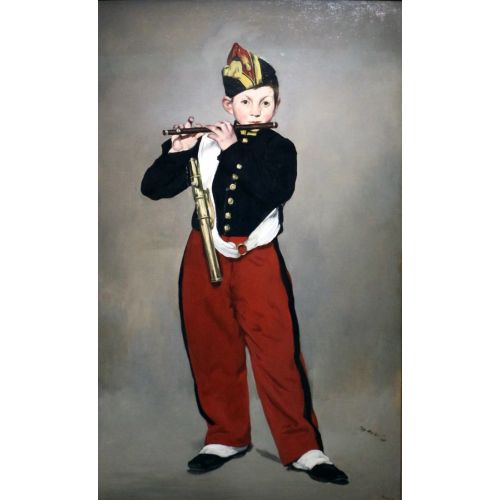
Édouard Manet's painting titled The Fifer, depicts a young regimental fifer dressed in the uniform of the Spanish Imperial Guards, playing his flute. Inspired by a trip to Spain in 1865, the painting is one of the most notable works by French artists. Manet remarked that the background of the piece appears to vanish, and despite the figure wearing black, it is full of life. Upon his return to Paris, Manet began working on the painting of the fifer. Also known in French as Young Flutist and Le Fifre, the painting was created in 1866 and is located in the Musée d'Orsay in Paris. The original oil painting measures 160 x 97 centimeters or 63 x 38 inches. It shows a fifer wearing the uniform of the Spanish army. The composition mirrors Velázquez's court portraits by using a static, neutral, and flat background. In doing so, Manet opposed established hierarchies of how figures were represented. It is up to the viewer to understand the real size and condition of the figure. The depth of the painting is shallow, making it difficult to distinguish between vertical and horizontal planes. This figure is created with a limited color palette, and tones such as dark black shoes and jacket are sharp.
In 1866, The Fifer was rejected by the jury of the Salon art exhibition of the Académie des Beaux-Arts. The decision angered Émile Zola, a famous French novelist and playwright who was also a champion of Manet's work. Zola wrote articles in L'Évenement newspaper praising the artist's realistic style. His articles also celebrated the painting's seemingly modern approach and feel. In 1867, Manet financed his own exhibition to display his work near the International Exhibition in Paris. The Fifer was included in the exhibition, but at the time the press criticized what they perceived as strange brushwork and an enigmatic atmosphere. Manet's other paintings have a style similar to 'The Fifer'. Examples include The Boy Carrying a Sword (1861), Dead Matador (1864-65), Woman with Parrot (1866), The Guitar Player (c. 1866), Philosopher (Beggar with Oysters) (1864-67), and Ragpicker (1865-70), Tragic Actor (Rouvière as Hamlet) (1866). All of these paintings feature singular figures with simplified features and a limited color palette. Like 'The Fifer', they too have a relatively imperceptible past.
Manet was associated with early Impressionism and was friends with Edgar Degas, Claude Monet, Pierre-Auguste Renoir, Paul Cézanne, and other Impressionists. His work also influenced the Impressionists, especially Monet and Berthe Morisot. This influence is especially noticeable in how Manet used lighter colors. In the early 1870s, he increasingly used lighter colored backgrounds. At the same time, unlike many Impressionist works, he continued to use black in his paintings. In addition to portraits and outdoor scenes, Manet painted café scenes to reflect social life in Paris in the nineteenth century. These paintings were typically based on sketches he made of people reading, listening to music, drinking, flirting, or simply waiting. Other depictions of modern life included war paintings. Later in life, Manet focused primarily on small-scale paintings of fruits and vegetables. He also painted vases with flowers. His last major work was The Bar at the Folies-Bergère, completed in 1882.
MUSEUM PRINTS
Canvas Prints
Canvas print artworks are created by printing high-resolution images onto linen canvas fabric. They offer a long-lasting, aesthetic, and economical alternative. Arthipo produces famous paintings with high-quality materials and paints, staying true to the original. For those who wish, an oil painting effect can be added with brushstrokes. The artworks are delivered ready to hang, with wall-mounting hardware included.

Reproduction Painting
A reproduction painting is a hand-made recreation of a famous artwork, crafted in fidelity to the original. Each piece is drawn by a professional artist. The artists use high-quality canvas and oil paints to create each painting individually. After completion, the artwork is reviewed by art consultants. These paintings are museum-quality and shipped worldwide.

Fine Art Poster Print
Fine art prints on paper require special techniques to closely match the colors and details of the original artwork. For this process, high-GSM textured art papers and pigment-based inks of archival quality are used. The prints are produced using state-of-the-art digital machines, applied flat without bending or damaging the surface of the paper. The result is both aesthetically pleasing and suitable for archival purposes.

Framed Artworks
Framed canvas and fine art posters are the most elegant way to bring artistic style to your walls. Produced with high-quality printing techniques, these products add a refined artistic touch to your decor. They are offered with a variety of frame styles to suit both modern and classic tastes.

High-Resolution Digital Files
Files in 300 DPI or higher resolution are color-corrected, light-balanced, and contrast-adjusted by graphic specialists. High-resolution artwork or poster files can be purchased via Arthipo by selecting “download” on the product page and are delivered via email after purchase.
Packaging
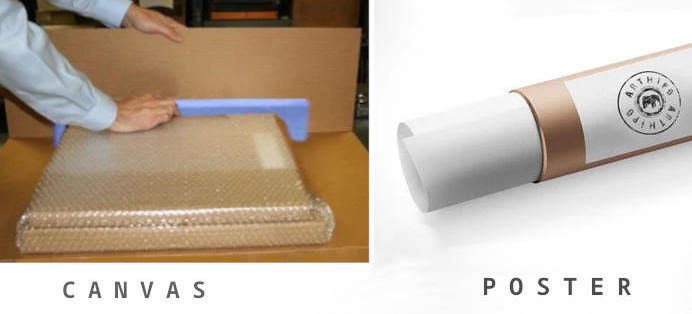
Products are securely packaged. Framed and canvas artworks are shipped in protective boxes, while fine art posters are rolled and shipped in sturdy cardboard tubes.
Delivery
Fast delivery worldwide with "DHL Express". Arthipo guarantees delivery and product quality.