


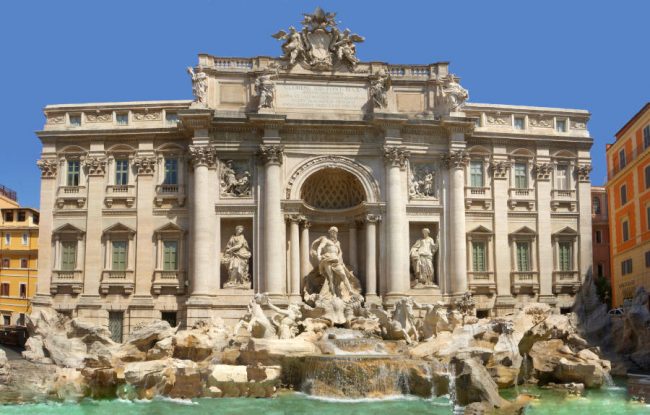
Trevi Fountain, Italian La Fontana di Trevi, is perhaps the most famous in the world and certainly the most beautiful fountain in Rome. The Trevi Fountain, built in the 18th century, with a width of 20 meters and a height of 26 meters, is also the largest fountain in the city of Rome. The baroque fountain in Piazza di Trevi square was first built by Bernini in the XII century. Designed for Pope Clemens. However, it wasn’t built until 50 years later, after a cheaper redesign by architect Nicola Salvi. Construction lasted from 1732 to 1762. The fountain’s reputation is partly the result of many movies featuring the Trevi Fountain, such as La Dolce Vita, Angels and Demons, and Roman Holiday.
The Story of Trevi Fountain (La Fontana di Trevi)
The Trevi Fountain is Rome’s most famous fountain and takes its name from the words tre vie (meaning three ways), which refers to the roads that converge where the fountain is now located. It was designed by Pietro da Cortona and Bernini, but in the VIII. Fountain due to the death of Pope Urban, XII. It wasn’t completed until 100 years later, when Clement held a competition for the design. Nine sculptors and several stonemasons worked on the fountain until it was completed.
Trevi draws water from the Acqua Vergine Antica aqueduct, which is almost entirely underground. This aqueduct was brought to Rome in 19 BC by Agrippa and the Pantheon from a spring about 20 km east of the city to provide water for their baths. It was medieval and still feeds the fountains of Piazza Farnese, Piazza di Spagna and Piazza Navona.
Architect Salvi’s design includes a background entirely composed of Palazzo Poli’s Neo-classical façade, completed in 1730. The fountain itself was completed in 1762 after Salvi’s death and was restored for the first time between 1989 and 1991.
The Story of Trevi Fountain Architecture Where is the Trevi Fountain
Trevi Fountain Architecture
The façade of the fountain and the sea reef are made of travertine, a type of limestone deposited by mineral springs. The statues are carved from Carrara marble. It is a Baroque style fountain that represents the sea god Oceanus in his act of taming the waters. The center of the fountain, carved by Pietro Bracci, is a chariot made of seashells, driven by two tritons commanding the sea horses. The central figure is Oceanus, the commander of the sea and a mythological personification of water. He drives two triton-winged chariots that surround him, one of which explodes the seashell. Horses, one calm and the other restless, mean constant movement and represent the choppy moods of the sea. To the right of the niches are “Salubrity” or “Health” and to the left is “Abundance” or “Blessings”. These statues depict the legend of Agrippa, who approved the aqueduct project to the virgin or Roman girl who showed the thirsty soldiers the source. The theatrical representations of the sculptures are characteristic of the more recent Baroque styles.
Representing the sea at street level, the basin is home to several rock structures made of tufo. The artistically carved fountain is never visible until you can see it fully from the street, creating an exciting contrast to the city around it. The apparent randomness of the rocks contrasts with the solid form of the structure behind them. Rocks, flowers and running water add an organic element to the sculpture, helping the architecture, sculpture and water to fuse as a whole, rather than separately. Fontana di Trevi fountain
Where is the Trevi Fountain (La Fontana di Trevi)
La Fontana di Trevi masterpiece is located in Rome, Italy, in the city’s Trevi District. It is in the city centre. It’s also one of the city’s most recognizable landmarks and probably tops any Roman itinerary list.