


Spanish Art History
Spanish art history encompasses many famous artists over the centuries, from painters to architects to sculptors. Spanish art is recognized internationally by those studying Spanish in Spain and abroad as an important part of Spanish culture and history. Due to its geographical and historical location, Spain has been the recipient of many different artistic influences over the centuries.
Seven centuries of Moorish rule left its mark on the Spanish people. This can be clearly seen in the buildings produced by some of the most famous Spanish architects. The Catalan Spanish architect Lluisi Domenech often used Moorish ornaments to decorate his creations. Being part of the European continent also meant that Spain was subject to many European cultures and arts. Numerous Spanish painters have spent time in France, and particularly in Paris, where the art scene is booming. If you want to learn about art, Paris was the place to go. Pablo Picasso spent most of his time in Paris, where he met Spanish sculptor Pablo Gargallo. Spain also owes much thanks to the sculptors of Italy and its capital, Rome. Without them, one of the most famous Spanish sculptors would never have continued to sculpt. Mariano Benlliure was convinced that he would only concentrate on sculpture after seeing Michelangelo’s sculptures in Rome.
Prehistoric Spanish Painting
Both France and Spain are extremely rich sites for prehistoric cave paintings. In Spain, most of these paintings tend to be found in the Cantabrian region of the north of the country. Some of the earliest paintings from the Aurignacian period have been found here. One of the most famous and best examples of prehistoric cave paintings can be found in the Altamira cave in Cantabria, Spain. The paintings there date from about 12,000 BC.
Animals were the main subject of the art of these early peoples. The most frequently painted animals are bulls, horses, deer, goats, bears and mammoths. Animals began to be drawn during the Solutrean period, but they became much more common during the Magdalenian period, when drawings and pictures of animals were found in almost every cave. But human and human-like images have also been discovered. Images tended to be painted with black and ocher paints.
Other notable prehistoric Spanish paintings include those that can be seen at the Cingle de la Mola in Castellón. These paintings were painted using a technique that involves the artist blowing or spitting color pigments in the rock. These paintings appear to be highly stylized due to the overlapping of the figures, but they do not represent a 3D view. The paintings in the Cingle de la Mola have been dated to between 7000 and 4000 BC.
Romanesque, Spanish Art History
In the Romanesque period, the main type of painting was manuscript illumination. Manuscript lighting consists of highlighting certain letters on a page by painting them in detail. Such images were most common in handwritten editions of the Bible. Again in this period, architecture provided many opportunities to Spanish painters. Wide, bare walls abounded in the vaults of churches, and so frescoes and murals began to become a common place. The best place for the study of this type of painting is in the Basilica of San Isidro in Leon. The Crypt has some of the best preserved Romanesque paintings from the 12th century in the world. The paintings on the ceiling of the cellar depict scenes from the New Testament of the Bible, as well as some scenes from rural life of the 12th century. Other similar examples you can see in Spain include the frescoes in San Baudelio de Berlanga and Santa Cruz de Maderuelo.

Romanesque, Spanish Art History
Gothic
Gothic painting began much later than its precedent style in architecture, beginning around 1200 AD. Moreover, it was difficult to get rid of Romanesque traditions. Romanesque-style murals continued to be used in churches during the Gothic period. However, the figures in Gothic paintings began to have more expression and movement, and also became smaller relative to the background of the paintings. However, illuminated manuscripts are the most widely found pieces of Gothic painting and are a good record of the different styles that can now be found throughout Europe. Other Gothic artworks included panel paintings, frescoes, and stained glass. Oil on canvas painting became much more popular in the 15th and 16th centuries, at the very end of the Gothic period and the beginning of the Renaissance.
Spanish Art, Cubism
Pablo Picasso was one of the great Spanish artists who is considered by many to be the Father of the modern art style, Cubism. Picasso was the influence of other important Cubist painters such as Georges Braque and Juan Gris. Antoni Gaudi was another Spanish artist who was revolutionary in his own way. Gaudi furthered the Catalan Modernist movement in the 19th and 20th centuries, influencing many other young Catalan Spanish architects of the next century. Many painters used their artwork as a protest against certain events in Spanish history. Picasso showed his anger at the bombing of the small town of Guernica during the Spanish Civil War by painting ‘Guernica’.

Spanish Art, Cubism, Pablo Picasso Guernica, Spanish Art History
Renaissance Spanish Painting
The Renaissance was a time of great change as well as great art and paintings. It took about three centuries, from the 14th to the 17th century. Although the artistic focus was mainly on Italy, Spain also got its fair share of Renaissance painters. The paintings of the Renaissance period reflect the innovation that took place in the world at that time, such as the developments in science and technology. The development of the easel meant that painters had their own tools to work with and therefore no longer depended on architects for the spaces they would paint. The 15th and 16th centuries saw the rise in popularity of more portable panel paintings that could be easily hung and moved around the house. The High Renaissance period also gave birth to the artistic movement known as Mannerism, around the year 1490. Since this style is a particularly important style in Spain, its section is given below.
Mannerist
Mannerism was a style developed by artists, sculptors, and architects between 1510 and 1520, mainly in Italy and especially in Rome. Mannerism was a particularly intellectual style of art and therefore appealed to people of the higher Hispanic classes. However, Mannerism was more extravagant than previous styles because Mannerist paintings were not as natural as paintings from the previous Renaissance period, but instead aimed to be artificial and unbalanced. There are many famous Mannerist artists, including Michelangelo, who painted the ceiling of the Sistine Chapel in Italy. The most famous Spanish Mannerist painter is El Greco, originally Greek. El Greco was accepted into Spanish culture as he spent most of his life living and working in Toledo, Spain. Toledo was also where he produced his best works, such as ‘The Tomb of the Count of Orgaz (El entierro del Conde de Orgaz) and ‘The Intercession of Christ’ (El Espolio).
Baroque Influences for Spanish Art History
Baroque art also originated in Rome, Italy, and its development spanned two centuries, from 1590 to 1720. The Baroque style was present in painting, sculpture and architecture. Baroque artworks were commissioned mostly by Catholic monarchs to enhance the wealth of the expanding Catholic Church. For this reason, Baroque art became an important part of the Counter-Reformation. Baroque painting, unlike the rational paintings of the previous Renaissance period, was designed to evoke a kind of emotion in the viewers of the painting. The most famous Baroque painter is, of course, Carvaggio. But Diego Velazquez is undoubtedly the best known Spanish painter of this style. Diego Velazquez was a Spanish painter active during the Spanish Golden Age. Velazquez was a court painter and therefore made many portraits of the Spanish Royal Family in Madrid, the most famous being the interesting painting ‘Las Meninas’.
Romance Spanish Painting
Romanticism became a fully developed art at the end of the 18th century. Romantic paintings contain elements of nature, heroism, humanity and emotion. Romanticism marked a move away from the scientific approach to painting towards a more expressive form. Romanticist paintings enabled the painter to become free with his paintings and colors. Romantic painters also used their art to convey their feelings into their own lives. Francisco Goya was a master of Spanish Romantic painters. Goya produced several series of paintings, prints and engravings that conveyed his dark, distorted feelings. Goya’s ‘Los desastres de la guerra’ (The Disasters of War) was made as a protest against violence during the Dos de Mayo uprising of 2 May 1808. The ‘Black Paintings’ (Las pinturas negras) was also an expression of Goya’s dark inner feelings and troubles. Spanish Art History.
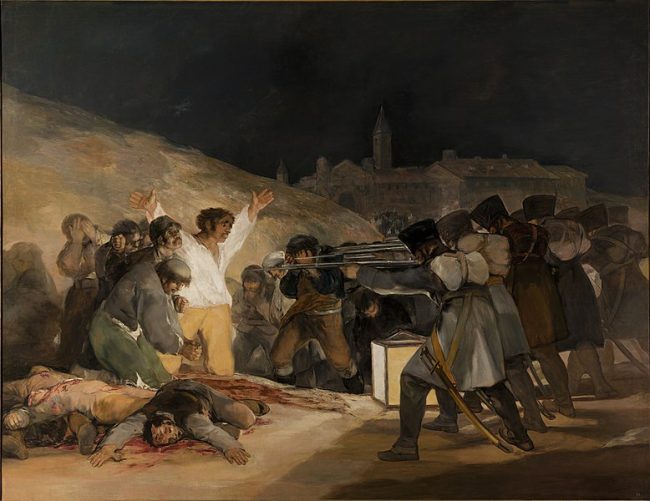
Romance Spanish Painting Spanish Art History, El Tres de Mayo, Francisco de Goya