

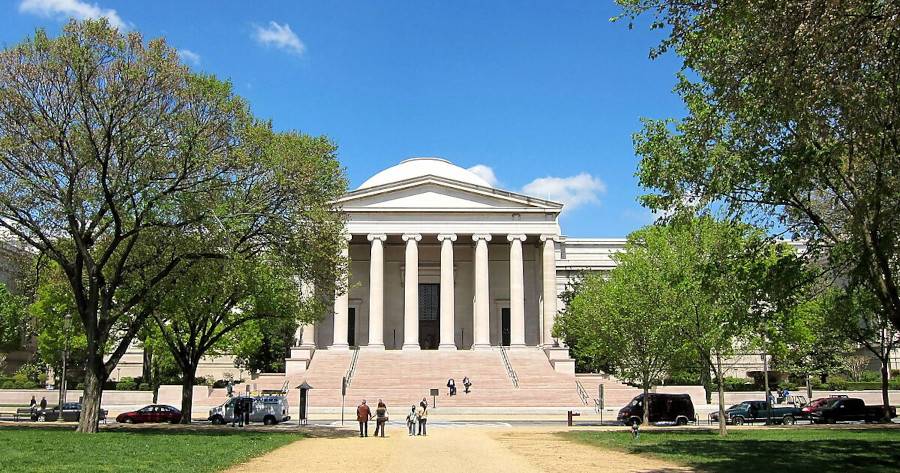
One of the world’s leading museums, the National Gallery of Art Washington preserves, collects, exhibits and develops works of art to the highest possible museum and scientific standards. The gallery’s collection includes approximately 141,000 paintings, drawings, prints, photography, sculpture, decorative arts and new media that trace the evolution of Western art from the Middle Ages to the present. Temporary exhibitions covering the world and art history, and free programs including lectures, tours, concerts, films and family events are offered throughout the year.
National Gallery of Art Washington History, Architectural Structure, Works
The National Gallery lacked a permanent building after a fire at Smithsonian Castle in 1865, causing the Smithsonian to be reluctant to have art collections there. Much of the collection is on loan to the Corcoran Gallery of Art and the Library of Congress. When the National Gallery was leased, the Smithsonian National Gallery was renamed the National Collection of Fine Arts and was renamed the National Museum of American Art again in 1980.
Before the National Gallery of Art was established, Washington had private collections that became public museums. By the 1930s, Washington was home to the Corcoran Art Gallery, the Phillips Collection, and the Smithsonian’s Free Gallery. But these collections were somewhat modest when compared to national art museums in London, Paris and Berlin. Andrew Mellon’s gift of his art collection in 1937 and the opening of the gallery in 1941 “gave the city an instant status in the museum world and helped draw attention to its growing cultural appeal.
National Art Gallery Architectural Structure, Interiors
Andrew Mellon chose American architect John Russell Pope (1874–1937) to design the building of the new museum. The building, now called the West Building, was designed in a neoclassical style, reflecting elements of the Pope’s designs for the nearby National Archives building and the Thomas Jefferson Memorial. The exterior was built with Tennessee pink marble, and Pope noted that skylights had to cover nearly the entire three-acre roof to illuminate and unify the galleries.
Mellon and Pope died within 24 hours of each other in August 1937, shortly after excavation for the foundations of the West Building began, but the museum was built according to their concept. The National Gallery was dedicated on March 17, 1941, when Paul Mellon presented the museum on behalf of his father to President Roosevelt, who accepted the gift for the nation.
When the National Gallery was first established, an adjacent plot of land was reserved for future use. On its 25th anniversary, expansion plans began to take shape. Architect IM Pei (1917-2019) was chosen to design it. The modernist structure he designed was inspired by the trapezoidal shape located between Pennsylvania Avenue and the National Mall and between Third and Fourth Avenues NW. To adapt to the unusual shape of the plot, Pei designed the East Building as two triangles. One houses a library, offices, and academic community, and the other houses the public gallery for permanent collections and exhibitions. Pei associated his design with John Russell Pope’s neoclassical design, requesting that the exterior be covered with the same Tennessee pink marble used for the West Building.
Construction of the East Building began in 1971. A newly formed Collectors Committee commissioned artists such as Henry Moore and Alexander Calder to produce works for the East Building. This committee has continued to give modern art gifts to the National Gallery ever since, including work by Joan Miró, Louise Bourgeois, Yayoi Kusama, Tony Smith, and others.
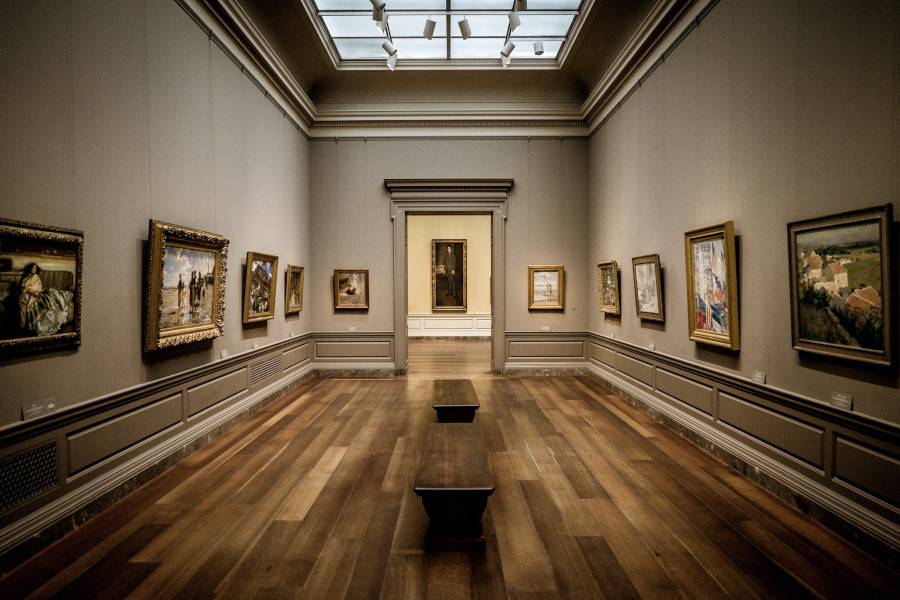
National Gallery of Art Washington Interiors
National Art Gallery Notable Works
When the National Gallery opened to the public, the core of its world-class collection were 126 paintings and 26 sculptures by Andrew Mellon – from Raphael‘s Alba Madonna to Francisco de Goya’s Marquesa de Pontejos and Giovanni Bologna’s Mercury, which now adorns the central fountain. .
The National Gallery has become a “collectibles collection” thanks to the generosity of its founding philanthropists. Samuel H. Kress, Rush Kress, PAB Widener, Joseph Widener, Lessing J. Rosenwald, Chester Dale, Ailsa Mellon Bruce and Paul Mellon.
In the years since Andrew Mellon’s first gift, the National Gallery’s collection has grown to more than 150,000 works, thanks to the generosity of other individuals and organisations.
Where is the National Gallery of Art, How to Get There, Directions, Visiting Hours, Entrance Fee
Located on the National Mall between Third and Ninth Avenues on Constitution Avenue, NW, the National Gallery of Art and Sculpture Garden is open Monday through Saturday from 10:00 am to 5:00 pm and Sunday from 11:00 am to 6:00 pm. Closed on 25 December and 1 January. Entrance is free.