

American Art History
The main topic of the American art history article is to examine the development of art in the United States. The subject does not cover continental America in general.
Native American Art
Rich, complex artistic traditions developed among the many indigenous tribes who used intricate geometric patterns and developed a highly stylized vocabulary that used almost abstract forms that both evoked the natural world and symbolized ancestral and mythological stories. The objects were often utilitarian and also imbued with ritual significance. However, the first Native American art movement included more than 25 Iroquois artists who used drawing, painting, and printmaking to realistically depict their tribe’s beliefs, history, fashion, and lifestyle. In the early 1900s, Native American art began to gain national and international attention. Kiowa Six, Spencer Asah, James Auchiah, Jack Hokeah, Stephen Mopope, Lois Smoky, and Monroe Tsatoke all used Ledger drawings using strongly outlined, dark flat areas.
American Art History Folk art
Much of American folk art is utilitarian in nature; Various works and painting were made, from framed embroideries and velvet paintings for wall decorations. Early American folk painters were called “Limiters,” from the term calcification meaning “to draw outlines in clear, sharp detail.” Often self-taught sailors would travel from town to town and make a living by offering to paint everything from signage to farm implements and cars for local merchants. While the colonies reflected British cultural values that saw the portrait as a sign of social standing, fine art portraitists such as French-born Henrietta Johnston, who immigrated to Charleston, South Carolina, around 1705, were drawn to the cities.
American Architecture
Thomas Jefferson, the third president of the United States, was an innovative architect, and his design for his Virginia home, Monticello (1772-1809), exemplified the Neoclassical style using a Palladian portico with four colored columns. Benjamin Henry Latrobe initiated what is known as the Federal style of choice for official buildings.
Beaux-Arts architecture, which developed around 1830 in the context of Neoclassicism, rejected the formality of Neoclassicism to include elements from Renaissance, Baroque, and Late Gothic architecture. In the United States, the Beaux-Arts style, led by Richard Morris Hunt, became known as the “American Renaissance” or “American Classicism”. The highly influential Art Nouveau movement, which began in 1890 and was influenced by the British Arts and Crafts movement and Japonism, included organic, flowing, floral motifs.
Hudson River School (1826-1870)
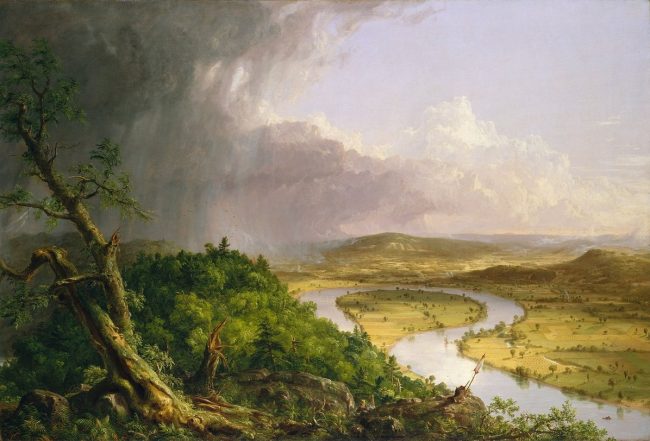
Led by the Hudson River School, Thomas Cole was born in England but immigrated to the United States at the age of seventeen, the first recognized American art movement. Centered in the then-wild upper New York state, artists associated with the movement emphasized the sublime and unique beauty of the American landscape. Influenced by Romanticism’s sublime concept and Naturalism’s emphasis on precisely observed detail, Cole’s landscapes such as Kaaterskill Upper Fall, the Catskill Mountains (1825) and Dunlap Lake with Dead Trees (Catskill) (1825) depicted American scenes to evoke the boundless possibilities of the new. American Art History.
American Art History
Hudson River School
Thomas Cole (1801–1848), The Oxbow, View from Mount Holyoke, Northampton, Massachusetts, after a Thunderstorm (1836), Metropolitan Museum of Art
Luminous (1850-1875)
The term luminism was coined by art historians in the 1950s to describe a style that developed among a number of American landscape painters between 1850 and 1870. John Frederick Kensett, who led the movement, emphasized the landscape itself rather than human presence.
Tonalism (1870-1915)
Tonalism emerged in the early 1870s in James McNeill Whistler’s Nocturnes series, which often emphasized tonal harmonies of muted greens, blues, and darks to depict landscapes at dusk. While contemporary artist Inness emphasized spiritual expression in works such as Sunrise (1887), using gold and brown tones to depict a landscape at sunrise or sunset, another artist of the period, Ryder, incorporated a mythological narrative element into his mysterious landscapes, often forerunners of Symbolism.
American Impressionism (1880-1920)
It was the French Impressionists who primarily inspired and influenced American Impressionism. Mary Cassatt became America’s first recognized Impressionist. When he moved to Paris in 1866, he became close friends with Edgar Degas and became associated and exhibited with many of the leading Impressionists. Her work, full of vibrant colors and expressive brushstrokes, often depicted many depictions of a mother and child as well as intimate gatherings in relaxed bourgeois settings, and was immensely popular in the United States.
Ashcan School (1900-1915)
The Ashcan School was a group of artists, including John Sloan, George Luks, Everett Shinn, and William James Glackens, all of Robert Henri’s students in Philadelphia at the time. Drawing on old masters, including Diego Velazquez, Francisco de Goya, and later Realists such as Édouard Manet, the group used classical methods to create realistic and gritty scenes of modern, working-class life, or what Henri called “art for life.”
Synchroism (1912-1924)
Synchronism emphasized abstract paintings that primarily used the color scale to create a visual “symphony” or musical effect. Young Americans Morgan Russell and Stanton Macdonald-Wright, both living in Paris, founded America’s first avant-garde movement in 1912.
Harlem Renaissance (1920-1940)
The term Harlem Renaissance describes a time when music, literature, theatre, painting and sculpture flourished within the rich and vibrant culture of New York’s Harlem neighborhood. Known for different styles, the movement was developed by author Alain Locke.
Fourteenth Street School (1920-1940)
The term Fourteenth Street School was coined in the 1950s, 1920s, and 1930s to describe the works of Kenneth Hayes Miller, Isabel Bishop, and Reginald Marsh. Its subjects were drawn from the New York neighborhood around Union Square and Fourteenth Avenue. Known as “Poor Man’s 5th Avenue,” the area was a booming business center with retail stores offering the latest fashion at cheap prices, whose sales attracted thousands of middle-class customers. Because of its realistic take on modern life, the movement was often included in Social Realism.
American Regionalism (1928-1943)
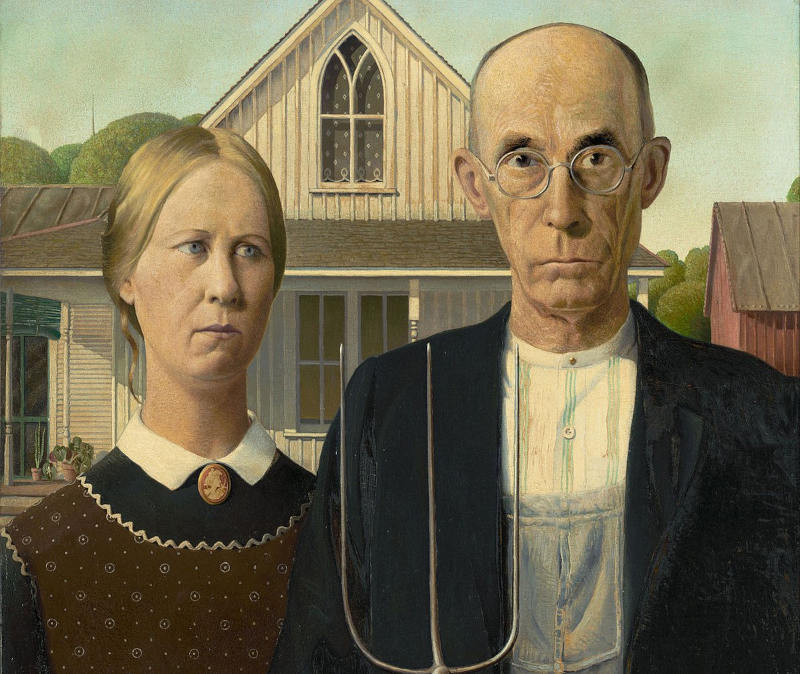
American Regionalism was not a deliberately formed movement, but a style and approach that developed organically in the works of Thomas Hart Benton, John Steuart Curry, and Grant Wood. These three artists emphasized realistic depictions of rural life and mundane situations, and each was associated with a particular region.
American Art History Social Realism (1929-1960)
Social Realism developed spontaneously among artists who emphasized realistic depictions of the lower class and working class, often in an urban setting, to radically transform society. Focusing on the plight of workers, artists associated with the movement were influenced by Jose Clemente Orozco’s murals, the rise of workers’ rights organizations, and the call for workers’ rights by left-wing organizations such as the John Reed Society.
Abstract Expressionism, Color Field Painting, Postpainting and Hard Edge Abstraction (1943-1965)
Abstract Expressionism began in New York in the early 1940s and has been led by Jackson Pollock, Clyfford Still, Willem de Kooning, Mark Rothko, and Adolph Gottlieb. While leading Surrealists fled Europe for New York during World War II, Abstract Expressionists were impressed by Surrealism’s emphasis on automatism, an art that tapped into the unconscious. As artists began their careers painting representational images, they moved towards increasing abstraction.
In 1952, influential art critic Harold Rosenberg, in his essay “The American Action Painters,” focused on the artist’s action in deciding to paint, thus coining the term Action Painting in favor of Abstract Expressionism. Rosenberg has associated Franz Kline, Willem de Kooning, and Jackson Pollock with the term, as their work emphasizes the event and process of painting itself.
In the San Francisco Bay Area around 1950, David Park, Richard Diebenkorn, and Elmer Bischoff rejected pure abstraction in favor of figurative subjects. Bay Area Painters also included Manuel Neri, Nathan Oliveira, and Joan Brown.
He also rejected a number of second-generation Abstract Expressionist movements in the mid-1950s, including Jack Beal, Jane Freilicher, and Nell Blaine, and turned to figurative art. A loose association of New York artists, including Fairfield Porter, Alex Katz, and Lois Dodd, put a new emphasis on realism known as Contemporary Realism.
Neo-Dada (1952-1970)
Beginning in 1952, Neo-Dada flourished as Jasper Johns, Allan Kaprow, and Robert Rauschenberg began using “readymades”, mass media, and performances. Artists rejected the existentialist heroes associated with Abstract Expressionism in favor of mundane subjects and blurred the traditional boundaries between media.
Allan Kaprow created “environments” using sculptural collages to create installation pieces, and later added auditory components after taking Cage’s class. He developed the term “events” to describe semi-theatrical events in which the Futurist concept of event transcends all boundaries and, under the influence of Dada’s emphasis on the role of chance, the boundary between event and audience is broken.
Many Fluxus artists were interested in Neo-Dada and events, including George Brecht, Robert Whitman, and Robert Watts. Described as an “anti-art” movement, Fluxus had utopian goals such as changing one’s relationship with art and emphasizing the mastery of everyday objects and actions. American Art History Dick Higgins, Jackson Mac Low, and leading members of the Al Hans group met in Cage’s 1959 class at the New School. Fluxus artists often used humor to underline and reject high art. Fluxus was an international movement that also included Yoko Ono, Nam June Paik, and Joseph Beuys.
Pop Art and Photorealism (1950-1970)
Pop Art was an international movement that started in England in 1952 under the leadership of the Independent Group, which included Richard Hamilton, Eduardo Paolozzi, and architects Alison and Peter Smithson, but the American version became the trend-setting and dominant form. Artists led by Andy Warhol, Roy Lichtenstein, Claes Oldenburg, and James Rosenquist used images from mass media and popular culture to challenge the distinction between “high” and “low” art and to criticize and celebrate consumer culture. Warhol, Rosenquist, and Ed Ruscha were influenced by their early work as graphic designers and illustrators.

Pop Art, Photo Reality American Art History
Minimalism and Post-Minimalism (1960 to Present)
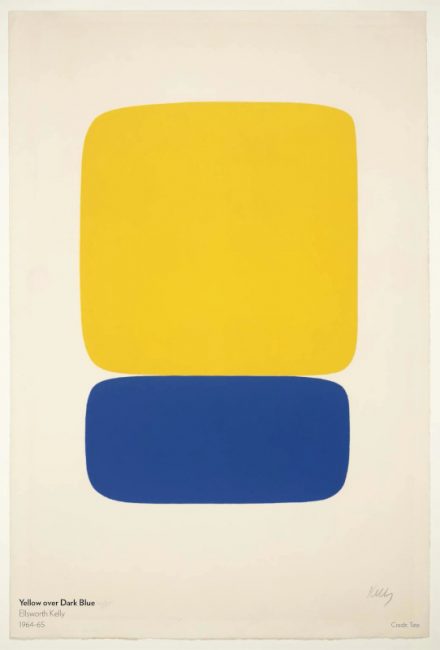
In New York City in the early 1960s, minimalist artists such as Donald Judd, Carl Andre, Sol LeWitt and Robert Morris created works from industrial materials using a cool and anonymous approach. Influenced by Russian Constructivism, Minimalists emphasized the importance of media perceived by the audience and preferred by industrial materials and fabrication.
Post-Minimalism included a number of trends, including Process Art, Performance and Body Art, Domain-Specific Art, and some aspects of Conceptual Art. Art critic Lucy Lippard curated Eccentric Abstraction in 1968, an exhibition featuring work by Louise Bourgeois, Eva Hesse, and Bruce Nauman. While some Minimalism-associated artists expanded Minimalist interest in anonymous and abstract objects to other areas, others reacted to Minimalism’s cold anonymous approach in favor of emotional expression. Lynda Benglis, Eva Hesse and Louise Bourgeois used resins and latex, while Nancy Graves used materials to simulate animal skins, and the resulting work created an organic expressive effect. Sol LeWitt, Richard Serra, and Vito Acconci were also among the Post-Minimalists.
Minimalism, Post-Minimalism
Based in California and influenced by Minimalism, Robert Irwin began creating large installations using light sources in 1969 and pioneered what is known as the Light and Space movement. Larry Bell, James Turrell, John McCracken, and Helen Pashgian became associated with the movement, using industrial materials including neon and argon lights, cast acrylic and polyester resins to create perceptual experiences. Using new scientific research and technologies, they created works that emphasize the interaction of light and space.
American Art History, World Art, and Environmental Art (1960s – Present)
Earth Art, also called Land Art (earth art) or Earthworks, was a result of Minimalism, as the earth itself became both the material object and the art-specific space, and artists used the site’s available natural materials such as mud, earth, and stone to create large-scale projects appropriate to the importance of the Site. designed it. Nancy Holt, Richard Long, Agnes Denes and Andy Goldsworthy were prominent Earth Work artists.
The movement influenced the development of Environmental Art, also known as ecological art. Emphasizing a non-intrusive approach, Environmental artists saw themselves collaborating with the environment and exploring human interaction with natural environments.
Postmodernism; Conceptual, Feminist, Performance Art (1960s – Present)
In the 1960s, a violent atmosphere of experimentation reigned that led to the development of Conceptual Art, Feminist Art, Body Art, and Performance Art. Although these art movements were international, they played an important role in the development of American artists and subsequently in shaping a range of trends.
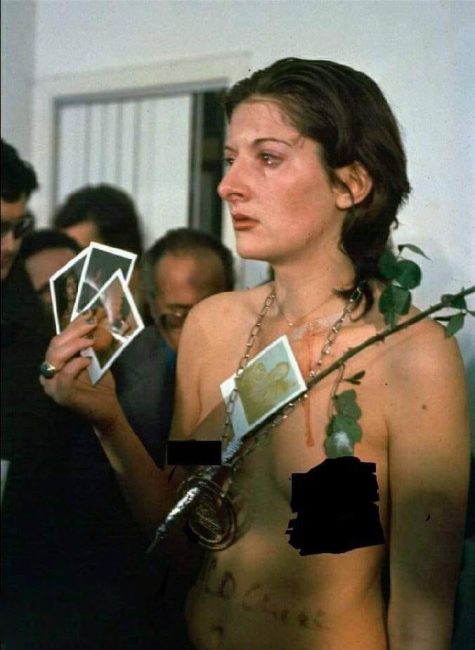
Influenced by the reductionist simplicity of minimalism, Conceptual art emphasized that a business concept is more important than its form or even its completion. Walter de Maria, Ed Ruscha, Marina Abramovic, Dan Graham and German artist Joseph Beuys are just a few of the prominent artists who are part of the movement.
Postmodernism; Conceptual, Feminist, Performance Art, Marina Abramovic
Apart from Feminist Art, the Civil Rights movement, the emerging Gay Pride movement, and anti-war enthusiasm, women’s arts organizations such as the Art Workers Coalition and Women Artists in the Revolution were formed in the late 1960s to address gender inequality and other feminist issues in the arts community. Judy Chicago and Miriam Schapiro founded the California Institute of the Arts’ Feminist Art Project and Womanhouse, a project where women artists can collaborate and create major installations. Mary Beth Edelson, Lynda Benglis, Martha Rosler, Carolee Schneemann, Suzanne Lacy, Leslie Labowitz, Bia Lowe, Barbara Kruger were prominent feminist artists. Judy Chicago became famous for her Dinner Party (1974-79), an iconic example of both Feminist Art and Installation Art, while Carolee Schneemann’s performances spearheaded the Feminist, Body Art, and Performance movements.
Performance art in the 1960s emphasized live events where the artist, sometimes with collaborators or performers, erased all boundaries between artist and work of art. The international movement was based on a number of early avant-garde trends, including Dada, Futurism, and Surrealism. Performers often faced the audience by staging what are sometimes called “acts”.
The subject of American Art History is explained in detail in the article.