Vincent Van Gogh, Starry Night

- Categories: Art Movements, Post Impressionism
- Fashion, Landscapes, Canvas Prints
- Stock: In Stock
- Model: vg2-ht4535-ayzld
- MPN: 340000346767
Available Options
Vincent Van Gogh, Starry Night
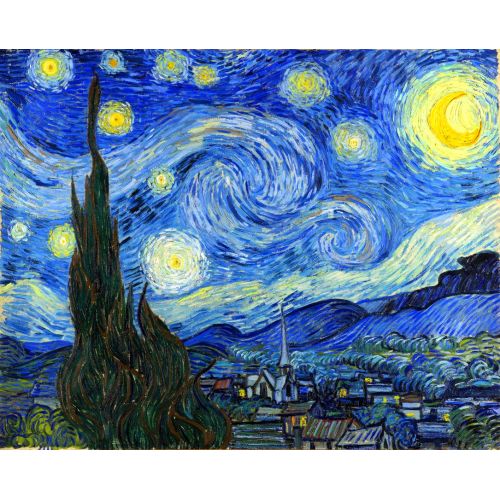
The Starry Night is a moderately abstract landscape painting (1889) of an expressive night sky over a small hillside village, one of Dutch artist Vincent van Gogh’s most famous works.
The oil on canvas painting is dominated by a night sky roiling with chromatic blue swirls, a glowing yellow crescent moon, and stars rendered as radiating orbs. One or two cypress trees, often described as flame-like, tower in the foreground on the left, their dark branches curling and swaying to the movement of the sky, partly obscuring it. Amid all this animation sits, in the lower right corner of the canvas, the structured and motionless village. Straight controlled lines make up small huts and the slender steeple of a church, which rises as a beacon against rolling blue hills. The glowing yellow squares of the houses bring peaceful, domesticated light to the painting, forming a stable corner amid the tumult, reminiscent of the comforting lights of home.
Van Gogh painted The Starry Night during his 12-month stay at the Saint-Paul-de-Mausole asylum near Saint-Rémy-de-Provence, France. While at the asylum, he painted during bursts of productivity interspersed with moods of despair. As an artist who preferred working from observation, Van Gogh was limited to the subjects that surrounded him—his own likeness, views outside his studio window, and the surrounding countryside that he could traverse with a chaperone.
Though van Gogh’s subjects were restricted, his style was not. He experimented with the depiction of various weather conditions and changing light, often painting nearby wheat fields under blazing summer sun or dark storm clouds. Van Gogh was particularly preoccupied with the challenges of painting a night scene, and wrote about this not just to his brother Theo, but also to fellow artist Émile Bernard and his sister Willemien. In a letter to the latter, he claimed that the night was more colourful than the day and that stars were more than simple white dots on black, instead appearing yellow, pink, or green. By the time van Gogh arrived in Saint-Rémy, he had already painted a few night scenes, including Starry Night (Rhône) (1888). In this work, stars appear as yellow bursts against a blue-black sky, competing with both the glowing gas lamps below and their reflections in the Rhône River.
In the asylum, van Gogh observed the night sky from his barred bedroom window and wrote a letter to Theo early one morning in the summer of 1889 about the spectacular view of the morning star. Since he was not allowed to paint in his bedroom, he worked from memory, or possibly drawings, and used his imagination for the small village that did not actually exist in the view. Using the expressive style that he developed during his stay in Paris from 1886–88, he applied paint directly from tube to canvas to create thick, dark lines and intense colours. Despite his initial uncertainty about working from imagination, van Gogh eventually came to see the finished The Starry Night as a failure, and Theo frankly indicated his preference for the style over substance.
The painting is one of van Gogh’s late works, created the year before he committed suicide. His career as an artist was brief, lasting only 10 years, but it was remarkably productive. He left to his brother more than 800 paintings and between 700 and 850 drawings. When the Museum of Modern Art (MoMA) in New York City purchased The Starry Night in 1941 from a private collector, it was not particularly well known, but it has since grown into not just one of van Gogh’s most famous works but one of the most recognized pieces in the history of Western art.
MUSEUM PRINTS
Canvas Prints
Canvas print artworks are created by printing high-resolution images onto linen canvas fabric. They offer a long-lasting, aesthetic, and economical alternative. Arthipo produces famous paintings with high-quality materials and paints, staying true to the original. For those who wish, an oil painting effect can be added with brushstrokes. The artworks are delivered ready to hang, with wall-mounting hardware included.

Reproduction Painting
A reproduction painting is a hand-made recreation of a famous artwork, crafted in fidelity to the original. Each piece is drawn by a professional artist. The artists use high-quality canvas and oil paints to create each painting individually. After completion, the artwork is reviewed by art consultants. These paintings are museum-quality and shipped worldwide.

Fine Art Poster Print
Fine art prints on paper require special techniques to closely match the colors and details of the original artwork. For this process, high-GSM textured art papers and pigment-based inks of archival quality are used. The prints are produced using state-of-the-art digital machines, applied flat without bending or damaging the surface of the paper. The result is both aesthetically pleasing and suitable for archival purposes.

Framed Artworks
Framed canvas and fine art posters are the most elegant way to bring artistic style to your walls. Produced with high-quality printing techniques, these products add a refined artistic touch to your decor. They are offered with a variety of frame styles to suit both modern and classic tastes.

High-Resolution Digital Files
Files in 300 DPI or higher resolution are color-corrected, light-balanced, and contrast-adjusted by graphic specialists. High-resolution artwork or poster files can be purchased via Arthipo by selecting “download” on the product page and are delivered via email after purchase.
Packaging
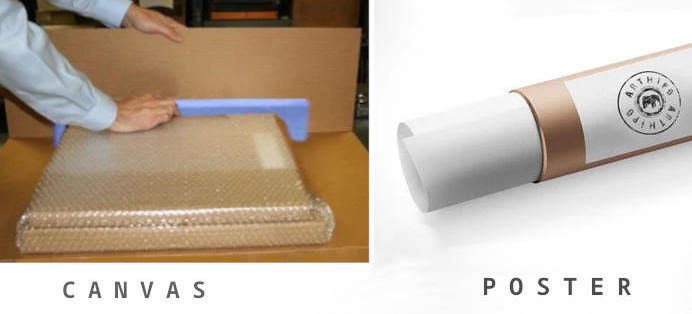
Products are securely packaged. Framed and canvas artworks are shipped in protective boxes, while fine art posters are rolled and shipped in sturdy cardboard tubes.
Delivery
Fast delivery worldwide with "DHL Express". Arthipo guarantees delivery and product quality.