


Since 1985, Saatchi Gallery has been presenting contemporary art exhibitions showcasing the work of emerging artists. Exhibitions drawing on Charles Saatchi’s collection have led to the Saatchi Gallery becoming a globally recognized authority in contemporary art. The gallery has built a strong reputation for promoting artists who would later gain worldwide recognition. In 2019, Saatchi Gallery became a registered charity and opened a new chapter in its history.
Saatchi Gallery History, Architectural Structure, Works
Born in Iraq in 1943 and raised in London, Charles Saatchi co-founded the successful advertising agency Saatchi & Saatchi with his brother Maurice.
The company grew into the world’s largest advertising company in the 1980s. The company’s success meant that Charles Saatchi could immerse himself in his passion for contemporary art collection.
In 1985, Saatchi opened a gallery to share his art collection with the public. The first gallery was in a former paint factory in St John’s Wood and featured works by American pop artist Andy Warhol on display.
For the first few years of its existence, the gallery predominantly showcased new American art, but that abruptly changed in 1992 when Saatchi launched the first of a series of shows featuring Young British Artists (YBAs).
The first show showcased an impressive work by Damian Hirst called ‘The Physical Impossibility of Death in the Mind of a Living Person’, featuring a shark preserved in formaldehyde.
In 2003 the gallery moved to County Hall on the South End of the Thames, then again in 2008, this time to Duke of York‘s headquarters on King’s Road, Chelsea. The historic building has been completely renovated with 15 equally sized gallery spaces.
Saatchi Gallery aims to provide an innovative forum for contemporary art, presenting works by largely unseen young artists or international artists whose work has rarely or never been exhibited in the UK.
With the development of general awareness and interest in contemporary art both in the UK and abroad, the audience for contemporary art exhibitions has increased greatly in recent years.
Saatchi Gallery Architectural Structure, Interiors
This iconic building was designed by John Sanders, who also built the Royal Military Academy in Sandhurst in 1801. It was designed as a school for the children of military widows and was called the Royal Military Asylum. In 1909 the school moved to Dover and the building became the Duke of York Barracks.
In WWII, it was the site of treason trials by high-profile German spies. The site was sold by the military and redeveloped as a mix of residence, school, shops and the Saatchi Gallery space. The building was built in 1998 due to its historical value. Listed in degrees.
The Saatchi Gallery has a philosophy of showing contemporary art that other London galleries do not. Or in other words, they’re looking for the next Damien Hirst! The gallery is the largest free exhibition space for contemporary art in the world.
The exhibits change regularly and there is always something new and exciting from different cultures around the world.
Sloane Square, the Duke of York’s headquarters, offers an ideal setting for viewing contemporary art, with its large, proportionate rooms and high ceilings. The gallery occupies the entire 70,000-square-foot building, providing the gallery with scope for a store, educational facilities, and a restaurant cafe/bar. In central London, Kings Road is ideally located in Chelsea.
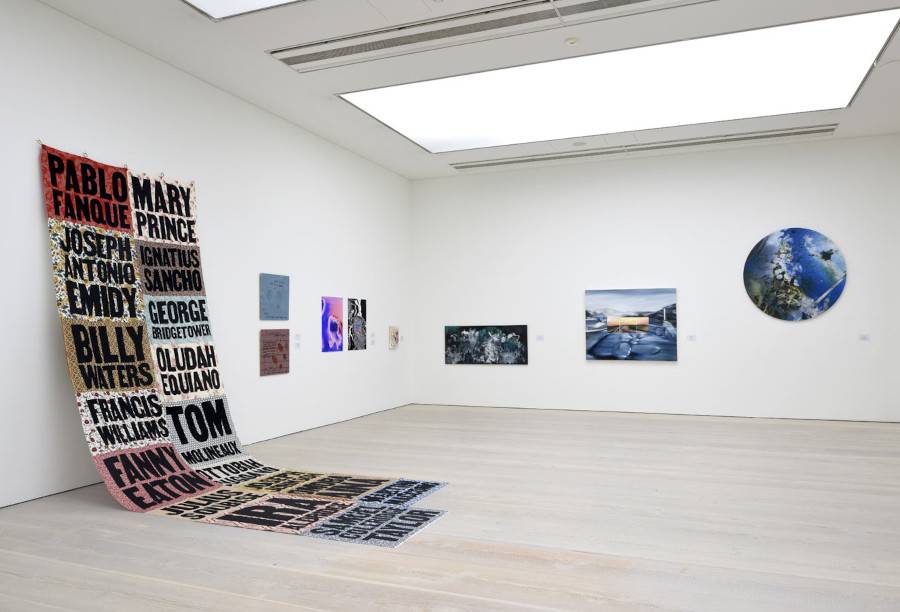
Saatchi Gallery Interior
Saatchi Gallery Notable Works
Andy Warhol – Triple Elvis, Marilyn x11, Atomic Bomb and 16 Jackies
Where is Saatchi Gallery, How to Get There, Directions, Visiting Hours, Entrance Fee
Address: Duke of York’s HQ, King’s Rd, London SW3 4RY, United Kingdom
Visiting the gallery is extremely easy. Sloane Square tube station is a very short walk to the north and the Gallery entrance is well signposted from The King’s Road.
Bus: 11.19,22.49.211.319 (King’s Road) 11.137,211 (Lower Sloane Street)
Train: The nearest mainline train station is Victoria. It is a 10-12 minute walk to the gallery.
Thursday – Sunday 10:00 – 18:00
Closed on Monday, Tuesday and Wednesday
The entrance fee differs at the exhibitions.