

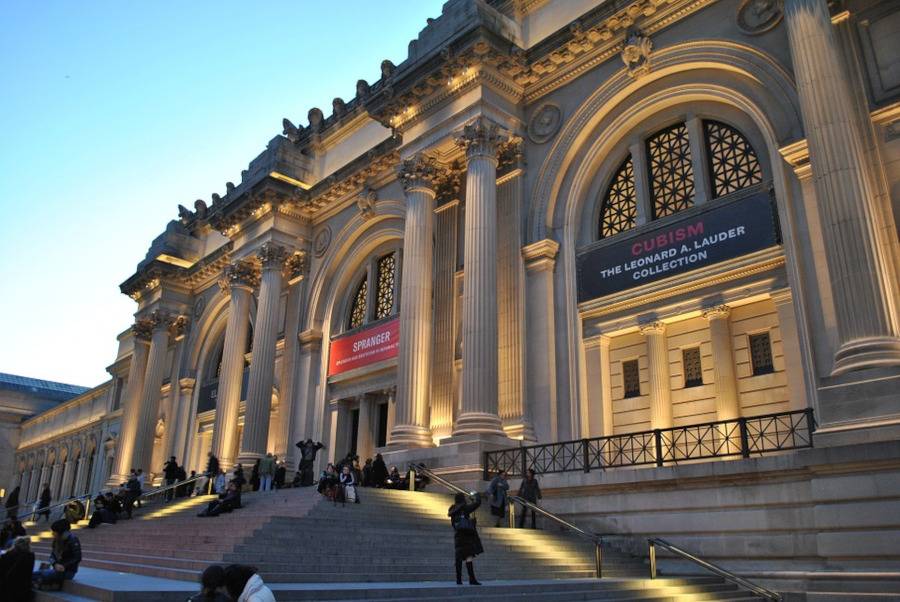
The Metropolitan Museum of Art, known as the MET, is New York’s largest and most comprehensive art museum and one of the world’s foremost art museums. The museum was founded in 1870 and opened two years later. Located at its current location in Central Park, the building complex opened in 1880.
Metropolitan Museum of Art History, Artifacts
The Metropolitan Museum of Art’s earliest roots date back to Paris, France in 1866, when a group of Americans agreed to build a “national institution and art gallery” to bring arts and arts education to the American people. The lawyer who proposed the idea, John Jay, quickly resumed the project on his return from France to the United States. Under Jay’s presidency, the Union League Club in New York has brought civic leaders, businessmen, artists, art collectors, and philanthropists to the cause. On April 13, 1870, the Metropolitan Museum of Art was established and opened to the public in the Dodworth Building at 681 Fifth Avenue. On November 20 of the same year, the Museum purchased its first object, a Roman sarcophagus. In 1871, 174 European paintings by Anthony van Dyck, Nicolas Poussin, and Giovanni Battista Tiepolo entered the collection.
On March 30, 1880, after a brief move to the Douglas Mansion at 128 West 14th Street, the Museum opened to the public at its current location at Fifth Avenue and 82nd Street. Architects Calvert Vaux and Jacob Wrey Mold designed the first Ruskinian Gothic structure, whose west facade is still visible in the Robert Lehman Wing. The building has since expanded greatly, and several additions built as early as 1888 now completely surround the original structure.
The museum’s collection continued to grow throughout the rest of the 19th century. The purchase of the Cesnola Cyprus art collection between 1874-76, works from the Bronze Age to the end of the Roman period, helped establish The Met’s reputation as an important repository of classical antiquities. When the American painter John Kensett died in 1872, 38 of his canvases arrived at the Museum, and in 1889 the Museum acquired two works by Édouard Manet.
The Beaux-Arts Fifth Avenue façade and Great Hall of the Museum, designed by architect and founder Museum Trustees Richard Morris Hunt, opened to the public in December 1902. The Evening Post reports that New York finally has a neoclassical art palace. It is one of the best in the world and in recent years the only public building that has approached the museums of the old world with dignity and grandeur.”
By the 20th century, the Museum had become one of the largest art centers in the world. In 1907 the Museum purchased a work by Auguste Renoir, and in 1910 The Met became the first public institution in the world to receive a work of art by Henri Matisse. The ancient Egyptian hippo figurine “William”, which is now the Museum’s unofficial mascot, entered the collection in 1917. Today, nearly all of the Museum’s 26,000 ancient Egyptian objects are on display, the largest collection of Egyptian art outside of Cairo. By 1979, the Museum had five of less than 35 known paintings by Johannes Vermeer, and now 2,500 European paintings from The Met, making up one of the largest collections in the world. The American Wing now houses the world’s most comprehensive collection of American painting, sculpture and decorative art.

Metropolitan Museum of Art
Metropolitan Museum of Art Museum Architectural Structure, Interiors
The main building facing Fifth Avenue, designed by Richard Morris Hunt, was completed in 1902 and has been named “The Met Fifth Avenue” as of 2016. McKim, Mead, and White designed some later additions. The American section, added in 1924, included the 1823 marble façade salvaged from the destroyed U.S. Branch Bank on Wall Street. The rest of the 20th-century additions were completed by the architectural firm Kevin Roche John Dinkeloo and Associates. Robert Lehman Wing (1975) with Old Masters, Impressionist and Post-Impressionist works; The Sackler Wing of the Temple of Dendur (1978), which houses an Egyptian-issued monument; the American Wing (1980), a four-acre addition wrapped around the old section and containing the largest collection of American art in the world; the Michael C. Rockefeller Wing (1982), featuring African, Oceanian, and American arts; Lila Acheson Wallace Wing (1987), displaying modern art; and Henry R. Kravis Wing (1990), which includes sculpture and decorative arts in Europe until the 20th century. One of the most comprehensive collections of its kind, “Art of the Arab lands, a renovated and redesigned group of 15 galleries featuring Turkey, Iran, Central Asia and later South Asia opened in 2011. The Met has expanded its Modern and contemporary art programs to a Marcel Breuer-designed building on East 75th Street and Madison Avenue (the former location of the Whitney Museum of American Art). The “Met Breuer” was designed to host exhibitions and performances on 20th and 21st century art, artist commissions and residencies, and educational programs.
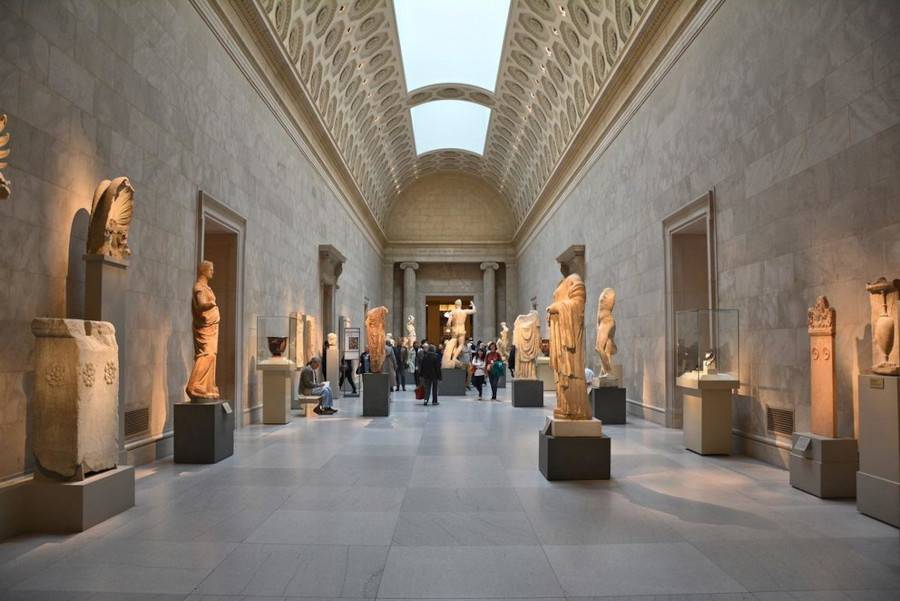
Metropolitan Museum of Art Interiors
Metropolitan Museum of Art Museum Important Artifacts
The Met has significant collections of Egyptian, Babylonian, Assyrian, East Asian pre-Columbian and Middle Eastern, Greek and Roman, European, New Guinea, Islamic and American art, including architecture, sculpture, painting, drawings, calligraphy, prints, photographs, glass, bronzes, ceramics , textiles , metalwork , polish work, furniture, period rooms, weapons and armor and musical instruments.
Where is the Metropolitan Museum of Art, How to Get there, Directions, Visiting Hours, Entrance Fee
Address: 1000 5th Ave, New York, NY 10028, United States
From Manhattan’s East Side: Subway: Take the 4, 5, or 6 train to 86th Street and walk three blocks west to Fifth Avenue. This walk is about half a mile and takes about 10 minutes. Bus: You can use the M1, M2, M3 or M4 lines.
From the West Side of Manhattan: take the 1 train to 86th Street, then the M86 intercity bus from Central Park to Fifth Avenue, or take the C train to 81st Street, then the M79 bus from Central Park to Fifth Avenue .
From Penn Station: Take the M4 bus to 83rd Street and Madison Avenue.
Sunday–Tuesday and Thursday: 10:00–17:00 Friday and Saturday: 10:00–21:00
Wednesday Closed
Entrance to the museum is by time ticket or reservation only and the capacity is limited.