

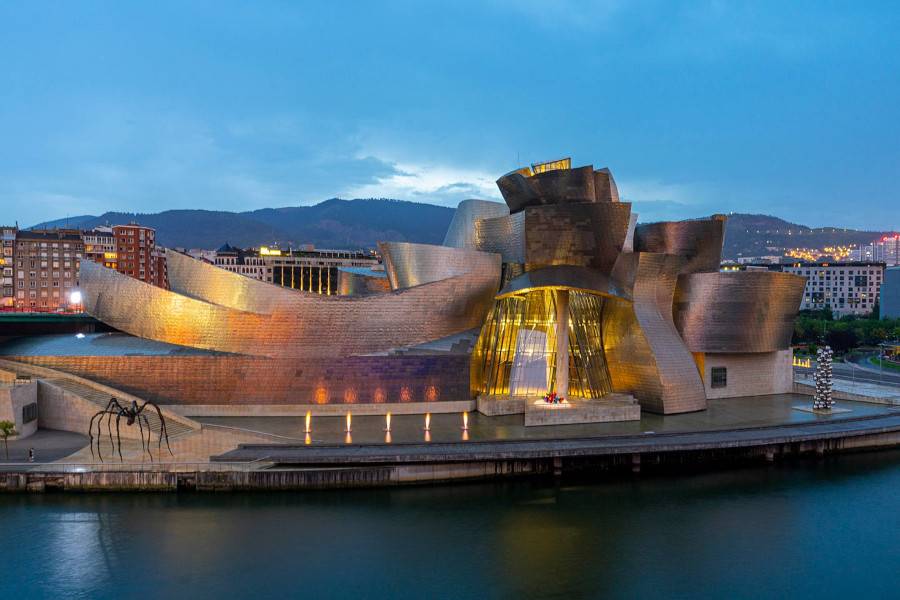
Guggenheim Museum Bilbao is a modern art museum located in the city of Bilbao, in the Basque Country region of Spain. Spreading over an area of 11,000 square meters, the museum is one of the five museums of the Solomon R. Guggenheim Foundation, an American foundation.
The Solomon R. Guggenheim Foundation collects, preserves and interprets modern and contemporary art, exploring cross-cultural ideas through educational initiatives and collaborations. With a constellation of architecturally and culturally diverse museums, exhibitions, publications and digital platforms, the foundation brings together both local and global audiences.
The Guggenheim Museum, opened in 1997, is a modern art museum that truly left its mark on the city, making Bilbao what it is today. Located by the river with its eye-catching design, the museum is one of the first stops for more than one million visitors a year.
Guggenheim Museum History, Architecture, Artifacts
The Solomon R. Guggenheim Foundation was established in 1937, and the Museum of Non-Objective Painting opened in 1939, its first venue in New York to display art. With exhibits of Solomon Guggenheim’s somewhat eccentric art collection, the gallery designed by William Muschenheim at the behest of the unconventional Foundation’s curator and director of the museum, Hilla Rebay, offers many visitors the wonderful works of Vasily Kandinsky and Rudolf Bauer, Alice Mason, Otto Nebel, and Rolph Scarlett. The need for a permanent building to house the Guggenheim’s art collection emerged in the early 1940s, and in 1943 famed architect Frank Lloyd Wright received a commission to design a museum in New York. The Solomon R. Guggenheim Museum opened on October 21, 1959.
The Solomon R. Guggenheim Foundation is dedicated to promoting understanding and appreciation of modern and contemporary art through exhibitions, educational programs, research initiatives and publications. Guggenheim international constellation of museums, Solomon R. Guggenheim Museum, New York; Peggy Guggenheim Collection, Guggenheim Museum Bilbao and future Guggenheim Abu Dhabi.
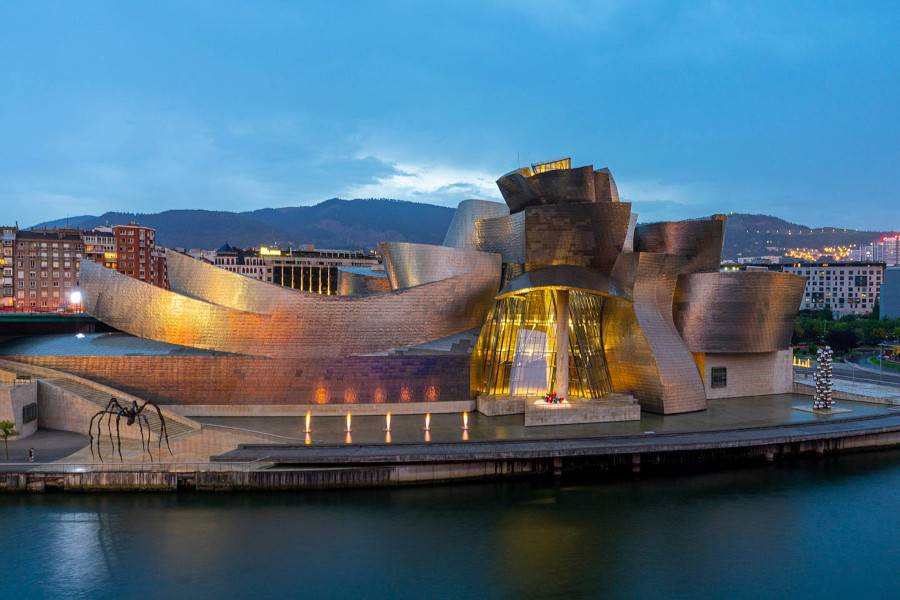
Guggenheim Museum Bilbao
Guggenheim Museum Architecture, Interiors
Plans for a new museum in Bilbao date back to the late 1980s, when the Basque Administration began to formulate a major redevelopment in the area. It wasn’t until 1991, however, that Basque authorities proposed the idea for the Bilbao Guggenheim Museum to the Solomon R. Guggenheim Foundation. As we progressed through the museum, a site was chosen and three architects—Arata Isozaki from Japan, Coop Himmelb(l)au from Austria, and Frank O. Gehry from the United States—were invited to participate in a competition. design. There were no requirements for drawings or models to be produced; instead, the architects were asked to present only what they thought would reflect their concept for the new museum.
From the moment it opened in 1997, Gehry’s Guggenheim Museum Bilbao has been hailed as one of the most important buildings of the 20th century, with its distinctive titanium curves and towering glass atrium. Gehry’s use of cutting-edge computer-aided design technology enabled him to bring poetic forms into reality. The resulting architecture is sculptural and expressive, with spaces unlike any other for the presentation of art. The museum is seamlessly integrated with the urban context, revealing interconnected shapes of stone, glass and titanium in a 32,500 square meter space along the Nervión River in the city’s former industrial centre.
Eleven thousand square meters of exhibition space are distributed to nineteen galleries. Ten of these galleries have a classical orthogonal plan and can be distinguished from the outside by their stone cladding. Nine other irregularly shaped galleries offer remarkable contrast and are externally identifiable by their swirling forms and titanium coatings. The largest gallery, 30 meters wide and 130 meters long, was used for temporary exhibitions for several years. In 2005 it became the site of Richard Serra’s monumental installation The Matter of Time, the largest sculpture commission in history. At one end of the museum area crosses La Salve Bridge, which has supported Daniel Buren’s Arcos rojos / Arku Gorriak sculpture since 2007.
The Guggenheim Museum Bilbao is the pinnacle of Gehry’s distinguished architectural career as well as museum design. It is unique in the integration of art and architecture, maintaining an aesthetic and programmatic unity.

Guggenheim Museum Bilbao Interiors
Guggenheim Museum Notable Artifacts
The Matter of Time (Richard Serra), LED installations by Jenny Holzer, works by Eduardo Chilliada, Seascape (Gerard Richter), The Renowned Orders Of The Night (Anselm Kiefer), Large Blue Anthropometry (Yves Klein), One Hundred and Fifty Multicolored Marilyns (Andy Warhol)
Where is Guggenheim Museum, How to Get There, Directions, Visiting Hours, Entrance Fee
Address: Abandoibarra Etorbidea, 2. 48009 Bilbao, Bizkaia
It is easily accessible in Bilbao’s city centre.
Lines 1, 10, 13, 18 and A7 can be used by bus,
The metro can be reached within walking distance from Moyua station.
The museum is open from Tuesday to Saturday from 11:00 to 20:00, other days of the week from 11:00 to 19:00, it will be closed on 25 December and 1 January.
The entrance fee is 15 Euros, children under 12 are free.