

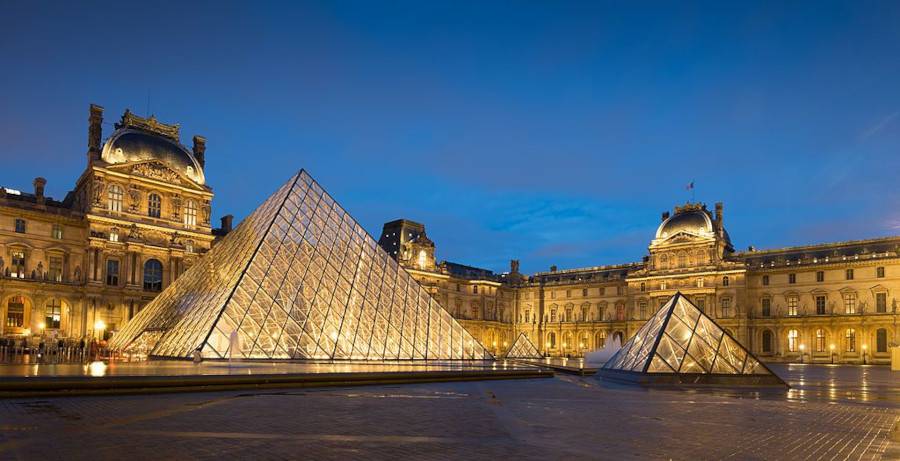
The Louvre Museum, French Musée du Louvre, officially called the Great Louvre or French Grand Louvre, France’s national museum and art gallery is located in a part of the large Louvre Palace in Paris, built on the right bank of the Seine. It is the most visited art museum in the world, with a collection ranging from ancient civilizations to the mid-19th century.
Louvre Museum History, Architectural Structure, Artifacts
In 1546 Francis I, a major art collector, razed this old castle and began building the Louvre, another royal residence added to it by almost every French monarch. During the reign of Francis I, only a small part of the current Louvre was completed under architect Pierre Lescot. This original section is today the southwestern part of the Cour Carrée. In the 17th century, major additions were made to the building complex by Louis XIII and Louis XIV. Cardinal de Richelieu, prime minister of Louis XIII, purchased large works of art for the king. Louis XIV and his minister, Cardinal Mazarin, purchased extraordinary art collections, including that of King Charles I of England. A committee of architects Claude Perrault and Louis Le Vau and decorator and painter Charles Le Brun planned the section of the Louvre known as the Colonnade.
When Louis XIV moved his palace to Versailles in 1682, the Louvre ceased to be a royal residence. The idea to use the Louvre as a public museum arose in the 18th century. The Count d’Angiviller helped build and plan the Grande Galerie and went on to acquire great works of art. In 1793, the revolutionary government opened the Musée Central des Arts in the Grande Galerie to the public. Under Napoleon, a wing was launched along the Cour Carrée and the rue de Rivoli to the north. In the 19th century, two large wings, galleries and pavilions extending to the west were completed, and the exhibition that opened them includes the III. Napoleon was responsible. The completed Louvre was a large complex of buildings forming two main quadrangles and surrounding two large courtyards.
The Louvre’s collection of paintings is one of the richest in the world and represents all periods of European art up to the Revolutions of 1848. Works made after this date, once hosted by the Louvre, were transferred to the Musée d’Orsay at its opening in 1986. The Louvre’s collection of French paintings from the 15th to the 19th centuries is unique in the world and also includes many masterpieces. Painters, including the Italian Renaissance, Leonardo da Vinci’s Mona Lisa Flemish and Dutch painters (c. 1503-1519) and works from the Baroque period.
The decorative arts section displays treasures of bronze, miniatures, pottery, tapestries, jewelry, and furniture from French kings, while the Greek, Etruscan, and Roman antiquities section features architecture, sculpture, mosaics, jewelry, and pottery. The Egyptian antiquities department was established in 1826 to organize collections acquired during Napoleon’s expedition to Egypt. The Near Eastern antiquities section is very important to the Mesopotamian art collection.
Louvre Museum Architectural Structure, Interiors
While it is the most interesting part of the museum, the building itself is an important exhibit. He said the building is primarily in the Renaissance and French Classical style. The first medieval elements of the old castle can still be seen underground, under the pyramid, around the lobby area.
In 1983, the Louvre went through a renovation plan known as the Grand Louvre. Part of the plan called for a new design for the main entrance. Architect IM Pei, who won the project, designed an underground lobby and modern glass pyramid structure in the courtyard. Inaugurated in 1988, the pyramid would become a famous element of iconic museum design. Combining traditional style with modern architecture, this building shows the timeless beauty of the Louvre.
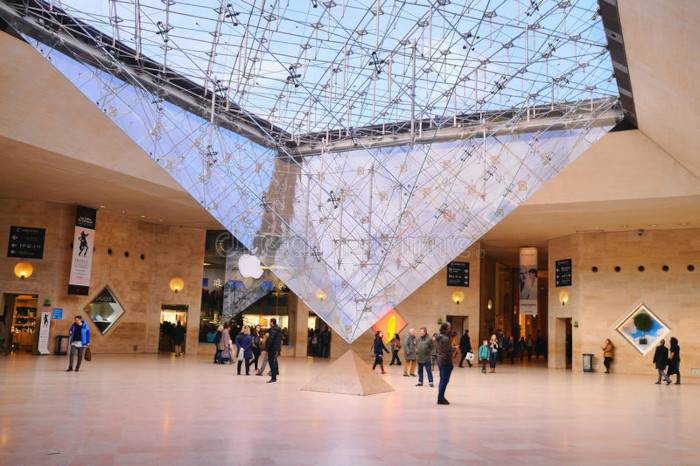
Louvre Museum Interior Inverted Pyramid
Louvre Museum Important Artifacts
The Louvre’s collection includes Egyptian antiquities, ancient Greek and Roman sculptures, paintings by the Old Masters (key European artists before 1800), and crown jewels and other artifacts from the French nobility. His works BC from the sixth century AD. It dates back to the 19th century. More than 35,000 works are on display. The exhibits are divided into eight sections: Near Eastern Antiquities; Egyptian Antiquities; Greek, Etruscan and Roman Antiquities; Islamic Art; statues; Decorative Arts; Pictures; and Prints and Drawings, according to the Louvre website.
The Louvre’s most famous work is undoubtedly Leonardo da Vinci’s “Mona Lisa”, which captivates visitors with its enigmatic smile.
Crowds also flock to see the sleeveless beauty of “Venus de Milo” and the ancient Greek sculpture “Winged Victory”, also known as “Nike of Samothrace”. Other popular works include a stele inscribed with the Laws of Hammurabi, da Vinci’s tragic sculpture “The Dying Slave” and Antonio Canova’s 18th-century sculpture “The Psyche Revived by Cupid’s Kiss.” Eugene Delacroix’s “Liberty, the People’s Leader,” depicting the bare-chested Freedom goddess leading an offensive in the French Revolution, and is thought to have inspired Victor Hugo’s “Les Misérables” and Jacques-Louis David’s “Napoleon’s Coronation”. It was built by the Flour himself and is a beautiful reminder of the history of the Louvre.
B.C. The “Archers’ Frieze” from the sixth century B.C. “Human-Headed Winged Bull” from the eighth century
Also very close to the Mona Lisa, another masterpiece by da Vinci, “The Virgin and Child With Saint Anne”
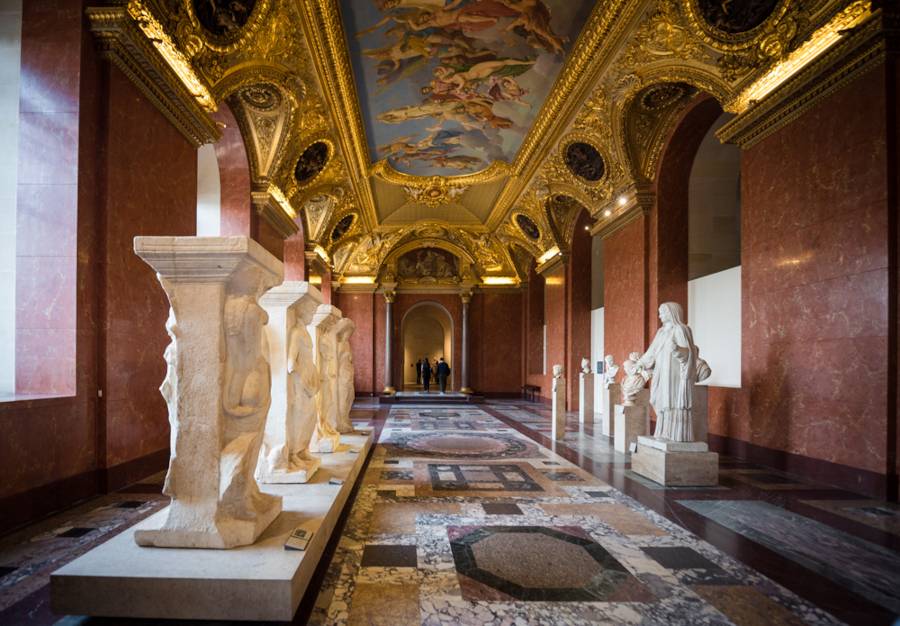
Louvre Museum Interior
Where is Louvre Museum, How to Get There, Directions, Visiting Hours, Entrance Fee
Address: Rue de Rivoli, 75001 Paris, France
By Metro: Line 1 – Palais-Royal/Musée du Louvre Metro Stop
By bus: bus n° 21,24,27,39,48,68,69,72,81,95 Paris l’Open Tour: Bus stop opposite Pyramid Velib near the museum: n°1015: 2nd place A. Malraux n °1023: 165 rue Saint-Honoré n°1014: 5 rue de l’Echelle n°1013: 186 rue Saint-Honoré
The Louvre is open every day except Tuesday and the following holidays: Christmas Day, New Year’s Day, and International Labor Day (May 1). Opening hours: Monday, Thursday, Saturday and Sunday from 9 am to 6 pm and Wednesday and Friday from 9 am to 9:45 pm.
Entrance fee 15 Euros