

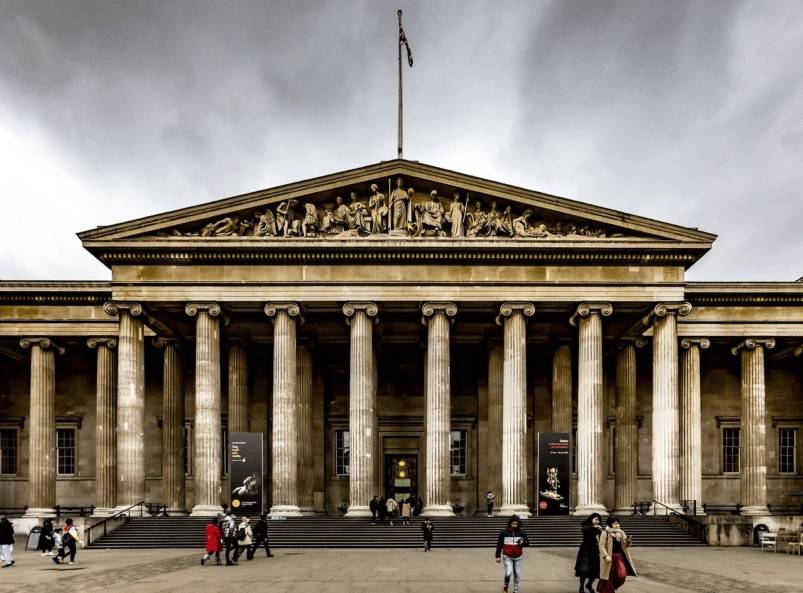
The British Museum in London is a museum of archeology and a leading institution dedicated to ancient art and human civilizations from all over the world.
British Museum History, Architectural Structure, Artifacts
An Act of Parliament in 1753 created the world’s first free, national, public museum, which opened its doors ‘to all industrious and curious persons’ in 1759. Initially, visitors had to apply for tickets to see the museum’s collections during limited visiting hours. In effect, this meant that the museum was limited to well-connected visitors who were given personal tours of the collections by its Board of Trustees and curators.

British Museum History, Architectural Structure, Artifacts
From the 1830s, regulations changed and working hours were extended. Gradually, the museum has truly become open and freely accessible to all, and we now welcome more than 6 million local and foreign visitors to the museum every year. Our extensive traveling exhibition and loan program means millions of people view the museum’s collections in venues across the UK and around the world.
British Museum Architectural Structure, Interiors
With its four expansive wings, 43 Greek temple-inspired columns, triangular pediment and massive steps, it’s not what you’d expect to see in central London.
Its splendor was designed by architect Sir Robert Smirke in 1823 to reflect ‘all the ‘wonderful objects’ inside. It imitated classical Greek architecture, a style that has become increasingly popular since the 1750s, when Western Europeans rediscovered ancient Greece.
The building was completed in 1852 using the latest technology: concrete floors, a cast-iron frame filled with London stock brick, and Portland stone in the building’s front tier.
In 1853, the rectangular building was awarded the Royal Institute of British Architects’ Gold Medal.
Since then, more recent developments include the round Reading Room with a vaulted ceiling and the Norman Foster-designed Great Court, which opened in 2000.
British Museum Important Artifacts
The British Museum’s permanent exhibition presents nearly 80,000 objects from the museum’s massive collection of 8 million pieces. The exhibition is divided into six thematic galleries.
Africa (bottom floor) offers both ancient and modern sculptures, textiles and other artifacts from the African continent (excluding Egypt).
Ancient Egypt (ground floor and upper floor) contains an extraordinary assemblage of artefacts, including sculptures, architectural ornaments, paintings, pottery, papyrus, sarcophagi and mummies from 3100 BC to the 8th century AD. II. As Bust of Ramses and the Rosetta Stone.
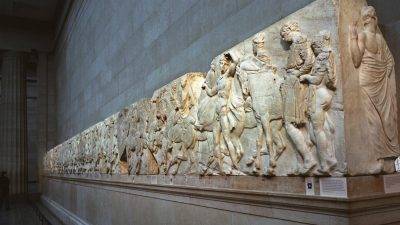
Ancient Greece and Rome (ground floor and upper floor) presents ancient Greek, Roman and Etruscan artifacts – statues, gold, vases, architectural ornaments, inscriptions, weapons and sarcophagi from the Bronze Age to the Decline of the Roman Empire, Spinario and Cyrene Including Roman statues from BC, the colossal Head of Asklepios of Milos and Greek statues in the Mausoleum of Halicarnassus, and the famous (and controversial) marbles from the Parthenon.
It is dedicated to the arts and civilizations of Asia (ground floor and upper floor) China, India, Japan, Korea and South Asia and dates from 5000 BC to BC. to present.
Europe (upstairs) mostly focused on European art from the early Middle Ages to the present – notable collections of applied and decorative art; however, it also contains artifacts related to prehistory and Roman Britain.
British Museum Important Artifacts
The Middle East gallery (ground floor and upper floor) presents artworks from a wide range of areas, including ancient Assyria, Iran, South Arabia, Anatolia, Mesopotamia, and Syria. It is one of the most impressive galleries of the British Museum, and many masterpieces of ancient civilization and Islamic art are displayed here, including colossal statues from Ashurnasirpal Palace, Balawat Gates bronzes, colossal Assyrian statues of the extraordinary Achaemenid Persians. gold and Ur Standard inlaid panel.
Finally, Themes is a gallery that aims to present a diverse and changing range of topics, divided into thematic subsections.
The seventh gallery is reserved for special exhibitions.
Albrecht Dürer, Michelangelo (Michelangelo Buonarroti), Raphael (Raffaello Sanzio), Rembrandt (Rembrandt Harmenszoon van Rijn) and Francisco Goya.
Due to their extreme fragility, pieces from this collection are rarely on display in the museum’s galleries.
Where is the British Museum, How to Get there, Directions, Visiting Hours, Entrance Price
The British Museum is located in the Bloomsbury district of London, the capital of England. Tottenham Court Road is the closest tube station to here. Admission is free, but admission to the museum’s galleries and exhibitions requires a pre-booked timed ticket. It is open daily from 10:00 to 17:30. Open until 20:30 on Fridays.