

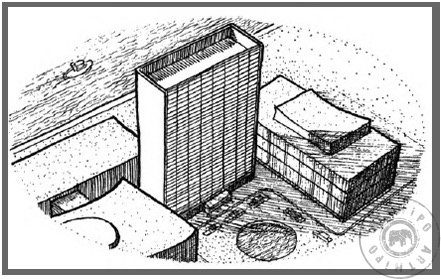
Reality and appearance in perspective drawing
In Perspective Drawing You Draw What You See From A Specific Viewpoint, Not Your Idea Or Mental Image Of The Subject

We think of a table, generally, as being rectangular with parallel sides, and of dishes as round. Children, beginners, and some sophisticated artists will draw them this way regardless of viewpoint (left) — children because they lack visual perception, artists because they wish to express the true essence and primary % nature of the subject. Both, though, are doing the same thing — they are drawing their idea or mental image of the subject. The true appearance of dishes on a table would be elliptical shapes on a converging, foreshortened surface (right).

The beginner, drawing a front view of the face, would tend to draw the idea of a nose (left) instead of its foreshortened appearance. The same tendency created this unrealistic eye in side view (right). Again the idea was drawn instead of the true appearance.

Wave your fist at someone across the room, 15 or 20 ft. away. A beginner, thinking only of the true sizes of hands and people, would probably tend to draw the scene this way (left). But the careful observer would notice that the hand was almost one- third the height of the figure, and so draw it. Overlapping and value perspective help to dramatize the respective nearness and farness of these elements.
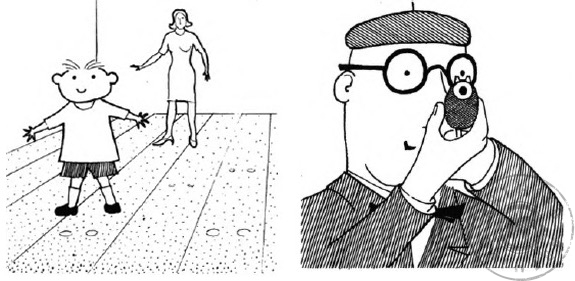
To a seated observer, a child close by and an adult further away might appear this way, and should be drawn this way. Your intellectual idea of the relative heights of children and adults might suggest differently. A rifle pointed directly at your eyes might not appear very frightening at first, for you hardly see the lethal, yard-long weapon.
Examples of reality and perspective in perspective drawing

1. We all know that the U.N. tower is a simple rectangular prism whose facades are all pure rectangles. When it is viewed directly from a distance, say from across the river, this pure geometry is revealed.
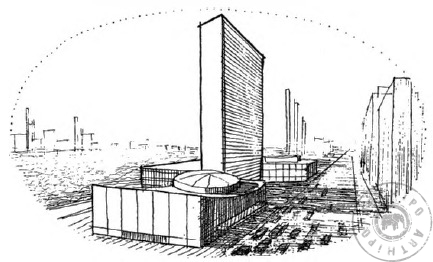
2. But when it is seen from up the river or the avenue, its facades appear foreshortened and the roof and window lines seem to converge. Only the vertical lines maintain their true directions
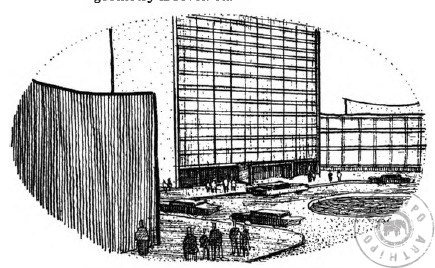
3. If we now come closer, and look straight ahead, we see the bottom of the building, the entrance, and the foreground. From this viewpoint the horizontal window lines still converge.
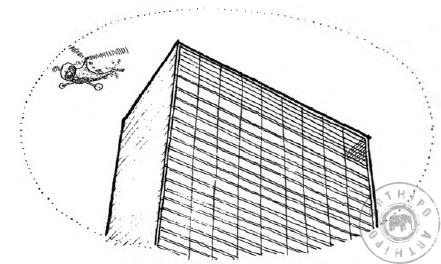
4. Upon looking up we notice that for the first time the vertical lines appear to converge (upwards). Also, the roof and window lines now converge downwards to the left and right.
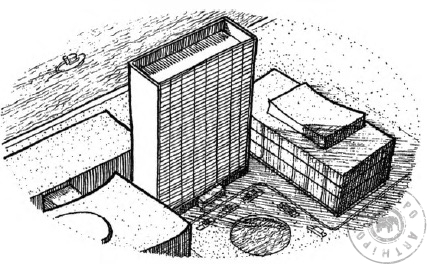
Viewed from a helicopter, the roof and facade rectangles again converge and foreshorten. But here vertical lines converge downwards, while horizontal lines point upwards.
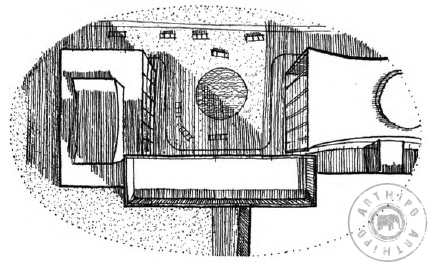
From directly above, only the rectangle of the tower’s roof is seen. This barely expresses the building’s form. Adjacent buildings with converging facades are more comprehendible.
Reality And Appearance Example: Park Bench From Different Viewpoints

1.In reality, this bench is composed of simple rectangular prisms. A boy climbing a tree would have this rare view of its true geometry

2. His parents at ground level might have this view. The horizontal and vertical lines appear to converge and all surfaces are foreshortened. (The vertical lines give a sense of vertically but they are not actually parallel to the edge of the page.) Note that this viewpoint is more revealing than the first

3. Junior, who is only 3 ft. tall, would see it still differently. The verticals now appear truly vertical, while the horizontal lines still converge.
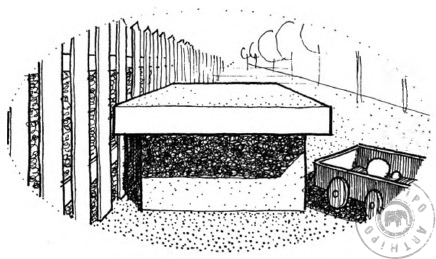
4.If Junior walked around the bench and looked at the end head-on, the true geometry of the end rectangle would appear. The bench top, though, would strongly converge and foreshorten. Notice that the horizontal as well as the vertical lines of the end maintain their real directions.

5.This “worm’s eye” view, which one might get by falling on the ground and looking up, offers a unique picture of the bench. The subject is rarely drawn from this (or the first) viewpoint since it is rarely seen this way.