


Convergence
Lines Or Edges of Objects Which In Reality Are Parallel Appear [11] To Come Together (i.e., Converge) As They Recede From Observer

When a brick Wall is seen head-on (i.e, parallel to observer’s face the top and bottom lines and all horizontal joints appear truly parallel and horizontal (level with the ground).

But if the observer shifts position and looks “down” the wall, then these lines cease to appear parallel and level with the ground and instead appear to come together (converge) as they recede.
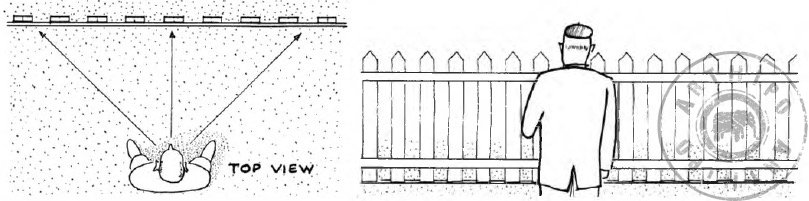
CONVERGENCE EQUALS DIMINUTION PLUS FORESHORTENING: The pickets of a fence, when viewed head-on, appear equal in height and spacing. Also, the top and bottom lines are parallel and level.

But if the observer turns his head and looks down the fence, then the top and bottom lines appear to converge. Notice that this convergence relates directly to the diminution of the pickets as they recede. Furthermore, the true length of the fence no longer appears, but instead is foreshortened. (Note how the spacing and width of the pickets appear narrower in the distance.) Therefore, convergence can be thought of as the diminution of closely-spaced elements of equal size. And it implies foreshortening since the surface is not viewed head-on.