Menu
Your Cart

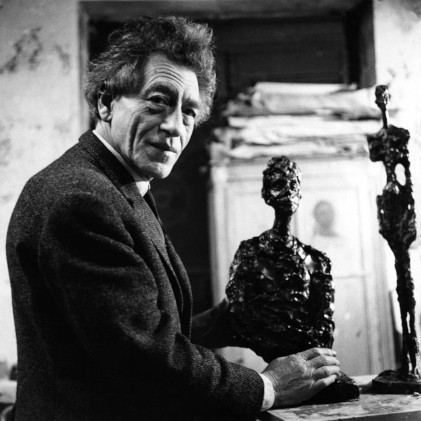
Alberto Giacometti

Alberto Giacometti

Alberto Giacometti was born in 1901 in the mountain hamlet of Borgonovo in eastern Switzerland. He was the first of four children to post-Impressionist painter Giovanni Giacometti and Annetta Giacometti-Stampa, whose family were among the region's leading landowners. In addition to his father, several members of Giacometti's extended family were artists, including Augusto Giacometti (Giovanni and Annetta's second cousin), a Symbolist painter, and a close family friend, Cuno Amiet, who was Alberto's godfather and Fauvist. Giacometti began sending pencil and crayon drawings to his godfather Amiet around that time, many of which he has saved and survived today. And he began experimenting with oils and still lifes, often using his siblings as models. He made his first painting at the age of twelve.

In 1915, Giacometti enrolled at the Evangelical School in the town of Schiers, where he continued to work in a small private studio. He then enrolled at the École des Arts Industries in Geneva and studied painting, drawing and sculpture under the tutelage of Pointillist painter David Estoppey and sculptor Maurice Sarkissoff.

In May 1920 Giacometti traveled with his father to Italy, where he studied paintings by Jacopo Tintoretto at the Venice Biennale, Giotto's frescoes in Padua, and ancient Egyptian art at the Archaeological Museum in Florence. He soon moved to Paris, where he enrolled in various art classes, and later became interested in Cubism and primitive art. In 1926 he exhibited his first major bronze sculpture work, the idol-like Spoon Woman (1926-27), at the Salon des Tuileries.

By the 1930s, Giacometti was warmly received in Surrealist circles and became close to the movement's founders, André Breton and Louis Aragon, as well as Man Ray, Joan Miró, André Masson, and Max Ernst. But he also published his work in Documents, the periodical produced by the writer Georges Bataille, who at the time posited a version of Surrealism against Breton's. Critics now believe that Bataille's ideas may have been important in inspiring several of Giacometti's Surrealist works, such as Suspended Ball (1930-1).

In 1946, after the liberation of Paris and Giacometti's three-year hiatus in Geneva, he returned to the French capital. That same year, his ex-girlfriend Annette Arm joined him, and the two were married in 1949. Arm has modeled for her many times, including for her oil painting Annette with Chariot (1950). While living in Paris during these years, Giacometti reached his mature style of tall figures after spending time drawing passersby on the streets of the city.

As Giacometti's style continued to mature in the 1950s and '60s, his bronze figures became larger and more complex, from the nearly four-foot-tall Woman of Venice II (1956) to the nearly four-foot Tall Woman II (1960). ) stretched all the way back to Tall Woman (1960), which rose close to nine. He also devoted more time to portraiture in both painting and sculpture. Among her regular models was Japanese philosophy professor and author Isaku Yanaihara, whom she befriended in 1955 with Diego and Annette.

In the 1960s, Giacometti had an international reputation, but his health declined. He was struggling with heart and circulation problems. He continued to work, however, and in his last weeks was working on a bust and painting by French photographer and close friend Elie Lotar. He died of complications of pericarditis on the evening of January 11, 1966.

Both important phases of Giacometti's career led to innovations that influenced a wide variety of artists. For example, Surrealist sculpture in the 1930s influenced Henry Moore and in part inspired Surrealism, which would become a crucial component of Moore's lifelong practice. It is certainly hard to imagine Moore's own innovative experiments in the 1930s without Giacometti's example. And Giacometti's figurative work was vital in reconstructing the figure as a viable motif in the post-war era, in an era dominated by abstract art. Pierced and fragile, their feeble bronze figures appearing compressed in space are in many ways visual manifestations of Existential thought, emblems of the suspiciously devastated state of modern humanity.


The subject of the work is "An Interior" which suggests a depiction of an indoor space. The drawing technique used by Alberto Giacometti in this artwork is precise and detailed. The colors utilized are mostly muted tones, creating a sense of somberness and introspection. It is likely that oil paint ..
$10.80
Ex Tax:$9.00
The subject of this artwork is Alberto Giacometti's model and muse, Annette. The drawing technique used by Giacometti in this piece is a combination of sketching and rendering with fine lines to create a sense of depth and dimension. The colors used are primarily monochromatic shades such as black, ..
$10.80
Ex Tax:$9.00
Subject of the work: The subject of this artwork is Annette, a close friend and frequent model for Alberto Giacometti.Drawing technique: This piece is created using a linear drawing technique. It showcases Giacometti's distinctive style characterized by long, thin lines.Colors: The colors used in th..
$10.80
Ex Tax:$9.00
The artwork titled "Annette 3" by Alberto Giacometti is a drawing created using the technique of pencil on paper. The colors used in this work are predominantly neutral shades such as grey and black. The type of paint or other medium is not applicable to this specific piece.This drawing portrays the..
$10.80
Ex Tax:$9.00
The artwork "Alberto Giacometti, Annette et la mère sous la lampe à Maloja" depicts a scene with Alberto Giacometti, his wife Annette Arm, and his mother sitting under a lamp in the town of Maloja. The drawing technique used is intricate and detailed, capturing the subjects' facial expressions and b..
$10.80
Ex Tax:$9.00
The subject of the work is "Annette reading in the cellina at Stampa." The drawing technique used by Alberto Giacometti for this artwork is pencil on paper. The colors are black and white, as it is a graphite sketch. It is not an oil painting but rather a drawing. This particular artwork depicts Gi..
$10.80
Ex Tax:$9.00
The subject of this work is a portrait of Alberto Giacometti's friend and muse, Annette. The drawing technique used is meticulous and precise, showcasing the artist's attention to detail. The color palette is predominantly subdued with hints of red in Annette's sweater. This artwork was created usin..
$10.80
Ex Tax:$9.00
Title: Alberto Giacometti, Apple on the Sideboard Subject of the work: An apple placed on a sideboard Drawing technique: Detailed and precise line drawing Colors: Black ink with shades of gray tones in cross-hatching style Type of paint used: Ink Artwork meaning: This artwork by Alberto Giacome..
$10.80
Ex Tax:$9.00
In this artwork by Alberto Giacometti titled "Atelier," the subject of the work is his studio or workshop. The drawing technique used is a combination of fine lines and expressive brushstrokes. The colors are primarily muted tones with hints of warm earthy shades. The type of paint used in this artw..
$10.80
Ex Tax:$9.00
Alberto Giacometti's artwork "Atelier II" is a drawing created using graphite on paper. The color palette used in this work is mainly shades of gray and black, reflecting the artist's characteristic focus on form and texture rather than vibrant colors. This artwork portrays the interior of the artis..
$10.80
Ex Tax:$9.00
This artwork by Alberto Giacometti is titled "Atelier III." The subject of the work is an interior view of his studio. It was created using drawing technique and showcases a limited color palette with muted tones. The type of paint used in this piece is not specified. The meaning behind this artwor..
$10.80
Ex Tax:$9.00
This artwork by Alberto Giacometti depicts the "Bergeller Berge mit Monte Disgrazia" (Mountains of Bergell with Mount Disgrace). The drawing technique used in this work is detailed and precise, capturing the ruggedness of the mountain landscape. The colors are predominantly earthy tones, reflecting ..
$10.80
Ex Tax:$9.00
This artwork by Alberto Giacometti depicts "Bouteilles dans l'atelier I" (Bottles in the Studio I). The drawing technique used is pencil on paper. The colors are monochromatic, mainly consisting of shades of gray. This work does not involve any type of paint as it is a drawing. The meaning behind t..
$10.80
Ex Tax:$9.00
Alberto Giacometti's bust depicts a human figure in his unique artistic style. The drawing technique used by the artist is characterized by thin and elongated forms, capturing the essence of the subject with minimalistic lines. The colors utilized in this artwork are mostly shades of black and gray ..
$10.80
Ex Tax:$9.00
The subject of this artwork is a bust by Alberto Giacometti. It was created using the drawing technique and features monochromatic colors. The type of paint used in this work is not specified.This artwork explores the representation of human figures through distorted and elongated forms, which were ..
$10.80
Ex Tax:$9.00
The subject of this work is a bust created by Alberto Giacometti. It is made using a drawing technique and does not have any colors or paint used on it. The artwork represents the artist's exploration of human form and his interest in capturing the essence of an individual through minimalistic yet e..
$10.80
Ex Tax:$9.00
In this artwork by Alberto Giacometti, titled "Bust of a Man," the subject of the work is a human bust. The drawing technique used is realistic with exaggerated elongation and thinness characteristic of Giacometti's style. The colors are mostly neutral tones such as grays and browns, reflecting the ..
$10.80
Ex Tax:$9.00
The subject of the work "Buste de Diego" by Alberto Giacometti is a portrait sculpture of his younger brother Diego. The drawing technique used is characterized by the artist's distinct and stylized approach to capturing human form. In terms of colors, this artwork primarily consists of earthy tones..
$10.80
Ex Tax:$9.00
Alberto Giacometti's sculpture "Busto II" depicts a human head in his distinctive elongated and abstracted style. The artwork is created using the drawing technique of sculpting clay. It has a monochromatic color scheme with earth tones, reflecting Giacometti's preference for natural hues. The sculp..
$10.80
Ex Tax:$9.00
The artwork titled "Chaise et guéridon" by Alberto Giacometti showcases a subject of furniture—a chair and a small table. The drawing technique employed is characterized by the artist's signature style of elongated and thin figures. The colors used in this piece are muted and earthy tones with hints..
$10.80
Ex Tax:$9.00
Showing 1 to 20 of 127 (7 Pages)